Alta Vista, San Antonio
Updated · 3,413 residents
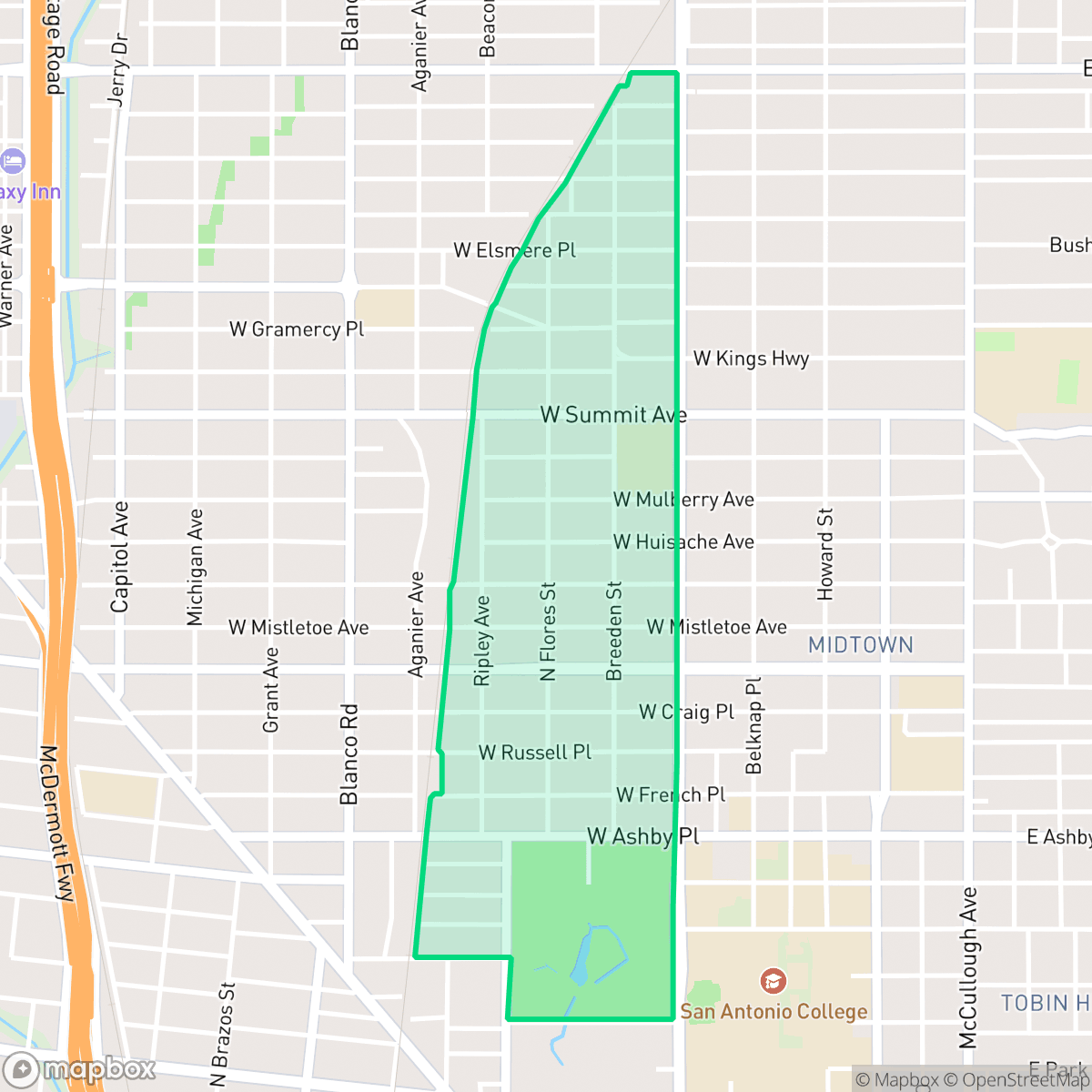
Alta Vista is a highly walkable San Antonio neighborhood characterized by its dense, historic grid and proximity to local favorites like Scratch Kitchen and Hausmann Millworks. Residents benefit from excellent pedestrian access and a vibrant community atmosphere, though they should be prepared for moderate noise levels from nearby road traffic and rail lines.
Key Highlights
About Alta Vista
Developed between the 1890s and 1920s, Alta Vista was one of San Antonio’s first "modern" subdivisions, transforming former ranch land during the city's early northward expansion. The neighborhood grew around electric streetcar lines that connected residents to San Pedro Springs Park, the oldest municipal park in Texas. This historic green space anchors the community and is home to the Greek Revival–style San Pedro Playhouse—the city's longest-running live theater—and the 1930 San Pedro Library, San Antonio's first branch library. Architecturally diverse, Alta Vista features a mix of Victorian, Craftsman, and early 20th-century bungalow homes. To preserve its unique character and historic streetscapes, the city established the Alta Vista Neighborhood Conservation District in 2003.
The area offers a distinct urban experience defined by its exceptional walkability and active street life. With a dense grid of sidewalks and proximity to creative hubs like Hausmann Millworks and local coffee spots, the neighborhood fosters a high level of engagement for its residents. The community maintains a strong sense of identity, supported by its lack of heavy industrial interference and a focus on residential and institutional land use.
While the neighborhood excels in pedestrian accessibility and community engagement, potential residents should consider the trade-offs regarding acoustic comfort and school district performance. Traffic and rail activity contribute to moderate noise levels throughout the area. Families may find the local school options polarized, as the broader San Antonio Independent School District faces challenges, while the highly-regarded Mark Twain Dual Language Academy provides a significant local academic asset. The area is well-suited for those who prioritize a walkable, urban lifestyle over suburban seclusion.
Neighborhood Scores Across 15 Qualities
Residential spacing provides a moderate level of separation between neighbors. According to iHuus data, the density is slightly higher than the San Antonio average, resulting in more closely packed structures and smaller yard buffers.
A consistent grid system with sidewalks and low-traffic streets makes much of the area easy to navigate on foot. According to iHuus data, this level of walkability is notably higher than the San Antonio average.
Standard tract housing with modest yards and simple rooflines characterizes this area. Visual variety is below the San Antonio average, though some sections feature mature tree canopies and larger estates.
Large public parks and wide green verges are available in certain sections, though some residential blocks lack nearby green space. Overall, pet-friendly amenities in Alta Vista are slightly below the San Antonio average, according to iHuus data.
Residential grids and low-density housing characterize this area, which is slightly less open than the San Antonio average. According to iHuus data, the landscape transitions between single-family homes and scattered institutional or industrial buildings.
Local dining and social hubs are notably more concentrated here than across the rest of San Antonio. Residents can find a diverse range of eateries and community spots, though most locations require a car to access.
Steady traffic sounds from a nearby busy street are present, though the acoustic environment remains slightly more peaceful than the San Antonio average according to iHuus data.
Frequent unhealthy air quality levels pose a significant risk to sensitive groups. This neighborhood experiences air quality that is slightly worse than the San Antonio average, according to iHuus data.
Residential life remains largely undisturbed by heavy industry, as the area consists primarily of homes and small commercial strips. According to iHuus data, this lack of significant industrial activity is consistent with the city average.
Health insurance access among residents is slightly lower than the San Antonio average, according to iHuus data.
Voting patterns and census indicators reflect a much more liberal political leaning than the San Antonio average. According to iHuus data, this area is characterized by predominantly liberal social and political preferences.
A balanced mix of young adults, families, and older residents defines the local demographic. This age distribution is more varied than the city average, according to iHuus data.
Flood risk in this area is difficult to precisely determine because FEMA has not yet completed a detailed study for this specific location. According to iHuus data, the level of risk is slightly higher than the San Antonio average.
Address-Level Insights for Alta Vista


iHuus Neighborhood Intelligence Insights
Get address-level neighborhood insights for Alta Vista
- Street-level scores — see how individual blocks compare, not just neighborhood averages
- Micro-zone boundaries — identify quiet pockets, flood boundaries, and walkable clusters before you visit
- 15 dimensions in full — walkability, noise, air quality, school quality, insurance coverage, population age profile, urban/rural index, and more
- Boundary risk alerts — know if your address sits near a block boundary where scores drop, the kind of detail no listing will ever mention
- School insights — individual school ratings and insights, not just district-level data
- Compare before you commit — side-by-side data across neighborhoods, down to block precision
No credit card required
Compare with Any Neighborhood
| Dimension | Alta Vista | 145 Association |
|---|---|---|
| 🚶 Walkabilityavg 6.44 | ||
| 🔊 Acoustic Comfortavg 4.07 | ||
| 🤫 Privacy Indexavg 5.75 | ||
| 🎨 Visual Appealavg 6.11 | ||
| 🐕 Dog Friendlinessavg 5.91 | ||
| 🗺️ Urban-Rural Indexavg 6.87 | ||
| ✨ Neighborhood Vibeavg 4.35 | ||
| 🏥 Health Insurance Coverageavg 5.94 | ||
| 🌿 Air Qualityavg 2.27 | ||
| 🏭 Industrial Proximityavg 8.31 | ||
| 🌊 Flood Safetyavg 4.2 | ||
| 🗳️ Ideological Leanavg 7.37 | ||
| 👥 Population Age Profileavg 4.68 | ||
| 🔥 Fire Safety | ||
| 🏫 School Quality |
Alta Vista Rankings
School Districts Serving Alta Vista
School Insights for Alta Vista
Below average outcomes; significant attendance and academic challenges.
School Insights
See what's really behind every school rating near Alta Vista
- Individual school ratings — each school's own score with outcome context, not just a district average
- Enrollment & class size data — student-to-teacher ratio and how it compares to the state average
- Full demographics breakdown — ethnicity and gender composition for every school in the enrollment zone
- Every school in the district — all schools within the enrollment boundary ranked by rating, not just the closest one
- Grade levels & benchmarks — elementary through high school, with below/above state-average flags
No credit card required