Alamo Farmsteads-Babcock Road, San Antonio
Updated · 15,668 residents
Alamo Farmsteads-Babcock Road offers a quiet, suburban environment defined by custom ranch-style homes on expansive, tree-lined lots. While the area provides a peaceful atmosphere with moderate walkability and high visual appeal, it maintains a low-density profile with limited local nightlife or retail activity.
Key Highlights
About Alamo Farmsteads-Babcock Road
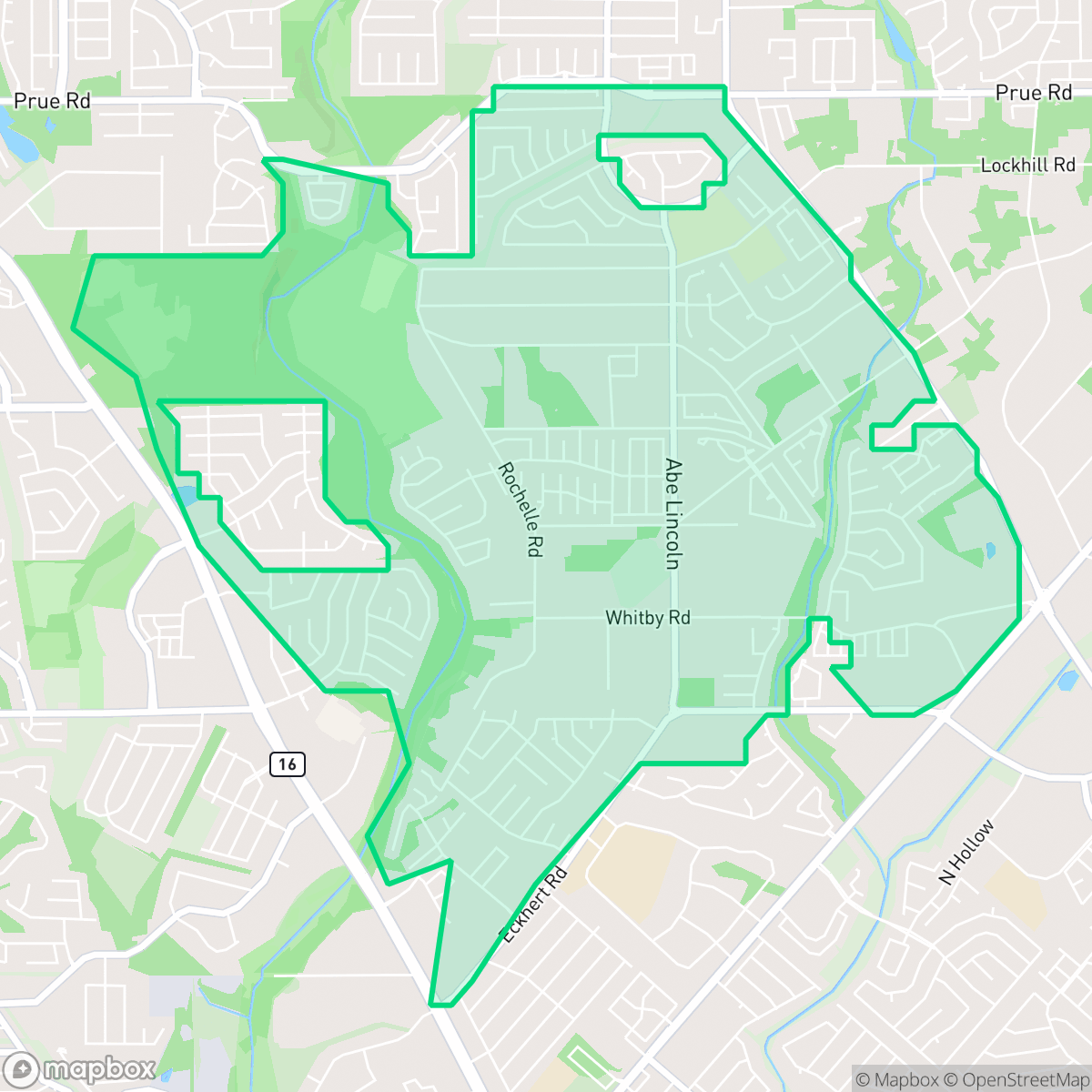
Located on San Antonio’s Northwest Side, the Alamo Farmsteads-Babcock Road neighborhood originated as a rural, agricultural area dominated by dairy farms and acreage estates. Historically defined by its equestrian culture, residents frequently rode horses along its quiet lanes as recently as the late 20th century. Although a suburban construction boom beginning in the 1980s transformed the area into a well-connected modern community, Alamo Farmsteads retains distinct echoes of its pastoral past. Today, the neighborhood is characterized by custom ranch-style homes situated on unusually large, wood-lined lots—often spanning one to five acres—which preserve a peaceful, country-like atmosphere within the city limits.
The area is characterized by its visual appeal, featuring homes with complex architectural details, private pools, and manicured landscaping. Residents benefit from a serene environment that balances suburban infrastructure with significant green space, including several local religious institutions and quiet residential streets. The neighborhood offers a sense of privacy through its moderate density, where homes are spaced to provide residents with personal space while maintaining a cohesive community feel.
Prospective residents should note that the area is primarily residential with limited commercial activity, resulting in a quiet, low-liveliness setting. While the neighborhood provides access to public education within the Northside Independent School District, it is important to consider environmental factors, including proximity to a nearby EPA Superfund site and moderate noise levels from local road traffic. This community is best suited for families or individuals seeking a spacious, established suburban lifestyle that prioritizes tranquility over urban convenience.
Neighborhood Scores Across 15 Qualities
Residential spacing is roughly average for San Antonio, offering a mix of suburban lots and denser multi-family units. While some areas provide a buffer between neighbors, certain sections feature closely spaced housing and shared walls that offer limited physical privacy.
Continuous sidewalk networks are available along main roads and within residential cul-de-sacs, offering slightly better connectivity than the San Antonio average. Residents can navigate the neighborhood with reliable pedestrian infrastructure and safe crossings.
Large homes with high-quality landscaping and private pools create a visual environment that is more polished than the San Antonio average. According to iHuus data, the area features prominent architectural details and spacious lot sizes.
Abundant tree-lined streets and a large central greenbelt offer significant walking space away from traffic. According to iHuus data, these connected green spaces and wide paths make the area more dog friendly than the San Antonio average.
Open land and scattered homes are common throughout this area, providing a slightly more rural atmosphere than the typical San Antonio landscape. According to iHuus data, the neighborhood features frequent fields and woodland pockets interspersed with suburban residential clusters.
Low-density residential blocks and scenic water features create a serene atmosphere, though most dining and essential services require a vehicle to access. This area offers a more tranquil pace than the San Antonio average, characterized by suburban greenery and limited walking-distance commerce.
Persistent noise from nearby major roadways and transit paths creates a less tranquil environment than the San Antonio average. Residents may experience frequent auditory disturbances according to iHuus data.
Frequent unhealthy air quality levels pose a significant risk to sensitive groups. This area performs slightly worse than the San Antonio average, according to iHuus data.
Industrial presence is minimal and slightly below the San Antonio average, as the area is mostly residential with only occasional light commercial activity. Some residents should note the proximity to an EPA Superfund site that may pose potential environmental risks to soil or groundwater.
Health insurance accessibility is greater in this area than the San Antonio average, according to iHuus data.
Political leanings in this area are slightly more conservative than the San Antonio average, though a liberal majority remains the primary characteristic according to iHuus data.
A balanced mix of young adults, families, and older residents characterizes the area. This demographic spread is slightly more varied than the typical San Antonio profile, according to iHuus data.
Flood risk levels remain undetermined due to a lack of detailed FEMA studies for this specific area, though the risk is notably higher than the San Antonio average according to iHuus data.
Address-Level Insights for Alamo Farmsteads-Babcock Road


iHuus Neighborhood Intelligence Insights
Get address-level neighborhood insights for Alamo Farmsteads-Babcock Road
- Street-level scores — see how individual blocks compare, not just neighborhood averages
- Micro-zone boundaries — identify quiet pockets, flood boundaries, and walkable clusters before you visit
- 15 dimensions in full — walkability, noise, air quality, school quality, insurance coverage, population age profile, urban/rural index, and more
- Boundary risk alerts — know if your address sits near a block boundary where scores drop, the kind of detail no listing will ever mention
- School insights — individual school ratings and insights, not just district-level data
- Compare before you commit — side-by-side data across neighborhoods, down to block precision
No credit card required
Compare with Any Neighborhood
| Dimension | Alamo Farmsteads-Babcock Road | 145 Association |
|---|---|---|
| 🚶 Walkabilityavg 6.44 | ||
| 🔊 Acoustic Comfortavg 4.07 | ||
| 🤫 Privacy Indexavg 5.75 | ||
| 🎨 Visual Appealavg 6.11 | ||
| 🐕 Dog Friendlinessavg 5.91 | ||
| 🗺️ Urban-Rural Indexavg 6.87 | ||
| ✨ Neighborhood Vibeavg 4.35 | ||
| 🏥 Health Insurance Coverageavg 5.94 | ||
| 🌿 Air Qualityavg 2.27 | ||
| 🏭 Industrial Proximityavg 8.31 | ||
| 🌊 Flood Safetyavg 4.2 | ||
| 🗳️ Ideological Leanavg 7.37 | ||
| 👥 Population Age Profileavg 4.68 | ||
| 🔥 Fire Safety | ||
| 🏫 School Quality |
Alamo Farmsteads-Babcock Road Rankings
School Districts Serving Alamo Farmsteads-Babcock Road
School Insights for Alamo Farmsteads-Babcock Road
Below average outcomes; significant attendance and academic challenges.
School Insights
See what's really behind every school rating near Alamo Farmsteads-Babcock Road
- Individual school ratings — each school's own score with outcome context, not just a district average
- Enrollment & class size data — student-to-teacher ratio and how it compares to the state average
- Full demographics breakdown — ethnicity and gender composition for every school in the enrollment zone
- Every school in the district — all schools within the enrollment boundary ranked by rating, not just the closest one
- Grade levels & benchmarks — elementary through high school, with below/above state-average flags
No credit card required