Southwest Richardson, Richardson
Updated · 8,218 residents
Southwest Richardson is a quiet, established suburban enclave defined by its mid-century architecture and an extensive, consistent sidewalk network. Residents benefit from high acoustic comfort and excellent dog-friendly amenities, including mature tree canopies and accessible park space.
Key Highlights
About Southwest Richardson
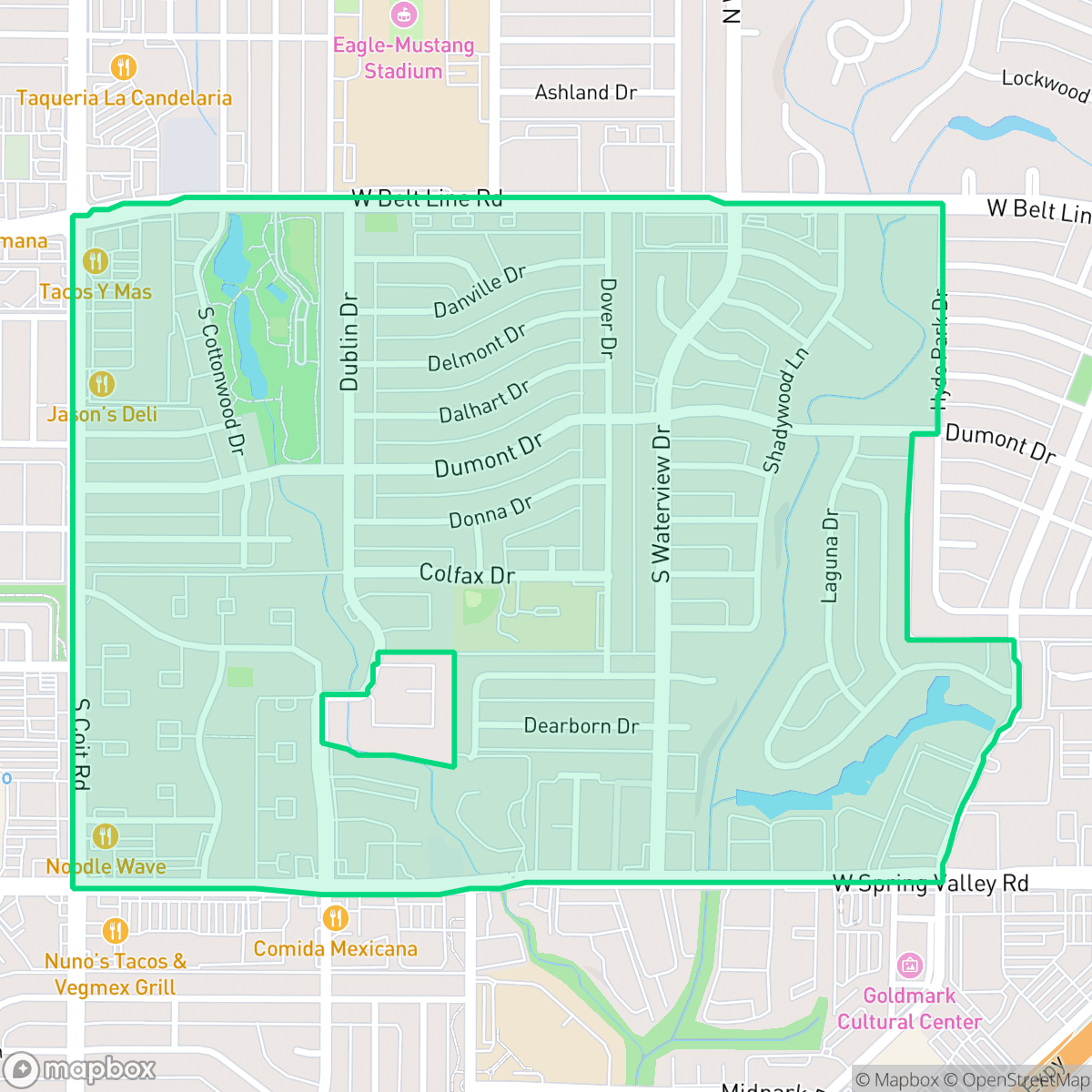
The Southwest Richardson area is anchored by the historic mid-century neighborhoods of Heights Park and Arapaho Heights, bounded by Coit Road, Arapaho Road, Central Expressway, and Belt Line Road. Developed primarily during the 1950s and 1960s, these neighborhoods are characterized by classic Ranch-style homes with pier-and-beam foundations and mature tree canopies. The cultural heart of the area is Heights Park, which historically featured a beloved space-age "Rocket" playground installed in the early 1960s. The playground was designed to honor the space race and local technology giant Texas Instruments. Although the original structure was retired due to safety concerns, its legacy is preserved by a replica gateway sculpture, "Rocket," designed by artist Jeff Laramore and dedicated in 2013.
The area offers a dense suburban environment characterized by a blend of single-family homes and multi-family apartment complexes. It maintains a distinct residential atmosphere, free from industrial activity, and features a consistent grid of sidewalks that makes the neighborhood highly walkable. According to iHuus data, the community enjoys a peaceful acoustic environment, with noise levels significantly lower than many other parts of the city. The presence of mature trees and wide green setbacks creates an inviting aesthetic that supports a high level of dog friendliness throughout the residential blocks. Prospective residents should consider the trade-offs regarding local amenities and educational infrastructure. While the neighborhood provides a serene living environment, it features limited commercial activity, requiring residents to travel for most retail and dining needs. Families with school-aged children will be served by the Richardson Independent School District, though individual campus performance varies. The area is well-suited for those seeking a stable, quiet suburban lifestyle with reliable access to outdoor recreation and a predictable, low-traffic residential experience.
Neighborhood Scores Across 15 Qualities
Privacy levels are slightly above the city average due to a mix of residential spacing and backyard fencing. While apartment blocks present denser living arrangements, single-family homes provide a moderate buffer between neighbors.
Pedestrian-friendly streets and connected greenbelts make navigating the area on foot easy. While sidewalk coverage is extensive, the neighborhood is slightly less walkable than the overall Richardson average.
Streetscapes feature a mix of traditional suburban housing and multi-family developments, which provides slightly less visual variety than the Richardson average. Many properties include manicured landscaping and private pools, though the area lacks the large estates found in more upscale parts of the city.
Extensive greenbelts, connected park trails, and wide grassy verges provide ample space for walking dogs. According to iHuus data, these interconnected natural corridors offer more accessible pet walking routes than the typical Richardson neighborhood.
Dense suburban layouts dominate the area, featuring a combination of single-family homes, multi-story apartment complexes, and commercial retail clusters. This landscape is consistent with the broader city average for the region.
Active pockets of dining and social hubs provide more variety than the typical Richardson neighborhood. While many blocks remain quiet and residential, the area features a notable concentration of eateries and community landmarks according to iHuus data.
Steady traffic sounds from nearby busy streets are common here. According to iHuus data, the acoustic environment is slightly noisier than the average for the rest of the city.
Air quality levels in Southwest Richardson fluctuate between acceptable and unhealthy conditions. According to iHuus data, the atmosphere is slightly more prone to pollution than the Richardson city average.
Land use is limited to residential, retail, and recreational areas with no detected warehouses or industrial facilities. This neighborhood offers a cleaner environment than the Richardson average, as iHuus data shows an absence of heavy industrial activity or hazardous sites.
Health insurance enrollment among residents is slightly above the Richardson city average, according to iHuus data. This indicates a relatively high level of access to medical coverage within the community.
Political leanings in this area trend more liberal than the Richardson average, according to iHuus data.
Residents live alongside a balanced mix of young adults, families, and older populations; this demographic distribution is very similar to the broader Richardson area according to iHuus data.
Flood safety levels in this area are slightly lower than the Richardson average. According to iHuus data, the specific risk remains undetermined because a detailed federal study has not yet been completed for this part of the neighborhood.
Address-Level Insights for Southwest Richardson


iHuus Neighborhood Intelligence Insights
Get address-level neighborhood insights for Southwest Richardson
- Street-level scores — see how individual blocks compare, not just neighborhood averages
- Micro-zone boundaries — identify quiet pockets, flood boundaries, and walkable clusters before you visit
- 15 dimensions in full — walkability, noise, air quality, school quality, insurance coverage, population age profile, urban/rural index, and more
- Boundary risk alerts — know if your address sits near a block boundary where scores drop, the kind of detail no listing will ever mention
- School insights — individual school ratings and insights, not just district-level data
- Compare before you commit — side-by-side data across neighborhoods, down to block precision
No credit card required
Compare with Any Neighborhood
| Dimension | Southwest Richardson | Arapaho |
|---|---|---|
| 🚶 Walkabilityavg 8.74 | ||
| 🔊 Acoustic Comfortavg 4.81 | ||
| 🤫 Privacy Indexavg 5.72 | ||
| 🎨 Visual Appealavg 7.35 | ||
| 🐕 Dog Friendlinessavg 7.11 | ||
| 🗺️ Urban-Rural Indexavg 6.61 | ||
| ✨ Neighborhood Vibeavg 4.69 | ||
| 🏥 Health Insurance Coverageavg 6.64 | ||
| 🌿 Air Qualityavg 3.77 | ||
| 🏭 Industrial Proximityavg 9.24 | ||
| 🌊 Flood Safetyavg 4.36 | ||
| 🗳️ Ideological Leanavg 6.22 | ||
| 👥 Population Age Profileavg 4.71 | ||
| 🔥 Fire Safety | ||
| 🏫 School Quality |
Southwest Richardson Rankings
School Districts Serving Southwest Richardson
School Insights for Southwest Richardson
Below average outcomes; significant attendance and academic challenges.
School Insights
See what's really behind every school rating near Southwest Richardson
- Individual school ratings — each school's own score with outcome context, not just a district average
- Enrollment & class size data — student-to-teacher ratio and how it compares to the state average
- Full demographics breakdown — ethnicity and gender composition for every school in the enrollment zone
- Every school in the district — all schools within the enrollment boundary ranked by rating, not just the closest one
- Grade levels & benchmarks — elementary through high school, with below/above state-average flags
No credit card required