Richardson Heights, Richardson
Updated · 1,567 residents
Richardson Heights is an established mid-century community defined by its classic ranch-style architecture and active civic engagement. While the area offers a vibrant local dining scene, residents should expect significant road noise and a car-dependent environment.
Key Highlights
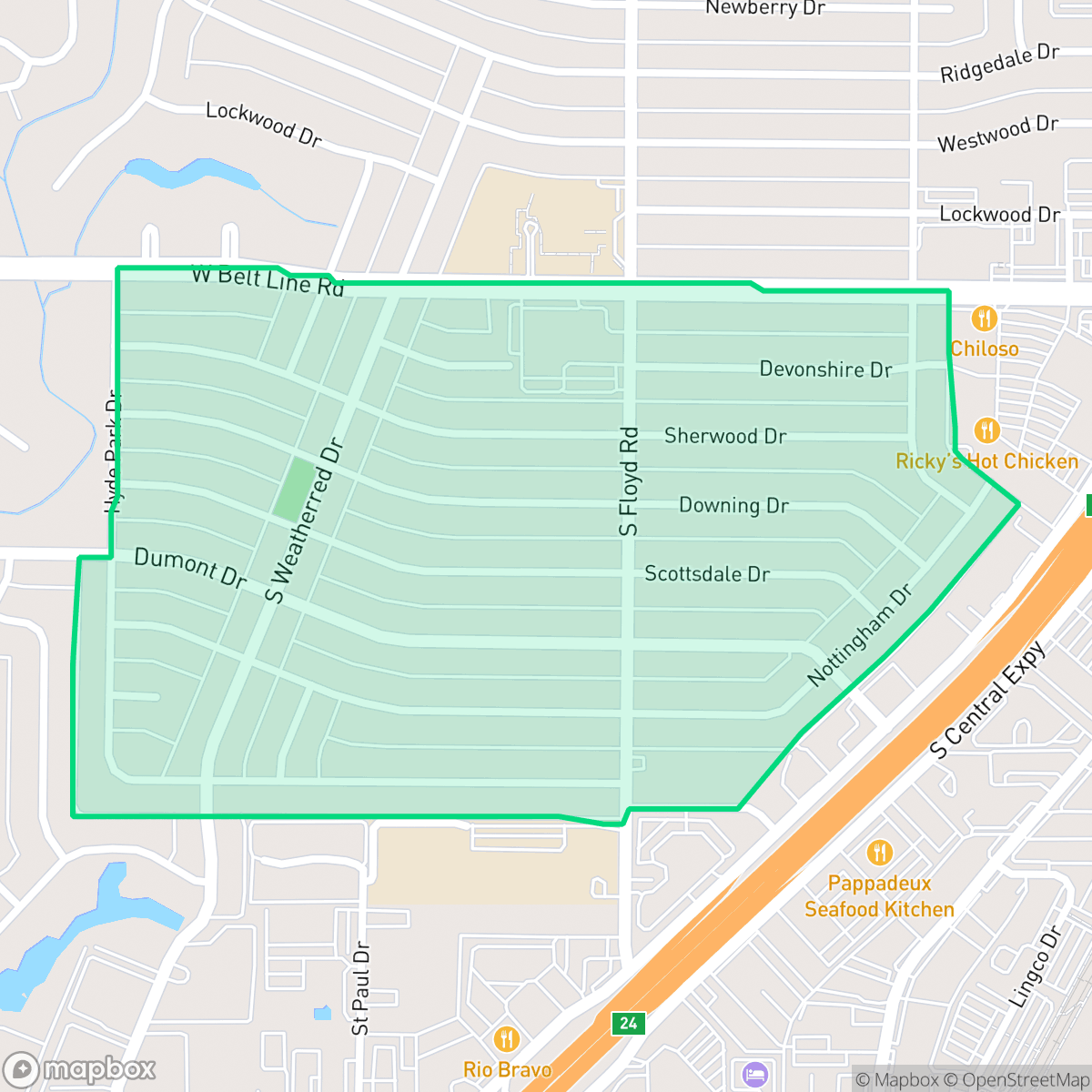
About Richardson Heights
Developed during the post-war housing boom of the 1950s and 1960s, Richardson Heights transitioned rapidly from cotton fields into a premier residential neighborhood. The area is characterized by its classic mid-century ranch-style homes with brick exteriors and low-pitched roofs. In the 1950s, the Richardson Heights Shopping Center was built as the city's first shopping center, later revitalized in 2012 by welcoming the region's first Alamo Drafthouse. The community is highly civically active; the Richardson Heights Neighborhood Association successfully fought local home demolitions and pioneered a citizen-led Crime Watch Patrol in the early 1990s that became a city-wide model after dropping local break-ins by 70%. Joint revitalization efforts under the 2009 Heights Plan for Excellence also led to the award-winning development of Durham Park.
Richardson Heights maintains a distinct identity through its post-war residential layout and strong community-led initiatives. The neighborhood balances quiet suburban streets with pockets of commercial activity, particularly near major thoroughfares where residents can access diverse dining options. According to iHuus data, the area presents a mixed-use environment that blends residential life with active daytime commercial traffic, though the overall layout requires reliance on personal vehicles for daily errands.
Prospective residents should consider the trade-offs associated with living in this mature section of the city. While the community benefits from the stability of the Richardson Independent School District, the area faces challenges regarding acoustic comfort due to proximity to high-traffic roads. Furthermore, the neighborhood has low flood safety ratings and limited walkability compared to the city average. It is best suited for individuals who value a tight-knit, civically engaged community and proximity to local commercial hubs, provided they are comfortable with the noise levels and infrastructure limitations inherent in this established part of the city.
Neighborhood Scores Across 15 Qualities
Residential spacing is mixed, featuring yards that provide some separation between homes while apartment clusters present closer proximity to neighbors. According to iHuus data, this level of density is slightly higher than the average for Richardson.
Sidewalk networks are consistently present on both sides of residential streets and major thoroughfares. This level of pedestrian infrastructure is slightly below the Richardson average.
Large single-family homes with complex rooflines and private pools create a well-maintained aesthetic that is roughly in line with the Richardson average. Manicured landscaping and spacious driveways characterize much of the area according to iHuus data.
Large parks and a mature tree canopy provide pleasant walking areas, though overall access to pet-friendly amenities is slightly below the Richardson average according to iHuus data.
Residential layouts feature a mix of single-family homes and multi-story apartment complexes, offering a built environment similar to the broader Richardson area. This density provides a standard suburban feel without the heavy concentration of urban infrastructure.
Residential life here maintains a steady, subdued pace that is roughly in line with the city average. While some blocks near the highway offer diverse dining options, much of the area consists of quiet, green spaces and low-density residential streets.
Steady hum from nearby busy streets defines the acoustic environment, which is slightly noisier than the Richardson average according to iHuus data.
Air quality in this area is slightly better than the Richardson average, though residents may still encounter days that present health concerns for sensitive groups. According to iHuus data, the atmosphere fluctuates between acceptable and unhealthy levels.
Industrial activity is nearly nonexistent here, with the area consisting primarily of residential streets and light commercial zones. While the lack of heavy industry is slightly lower than the city average, the neighborhood remains a tranquil environment free from significant industrial presence.
Health insurance accessibility is higher than the Richardson average, according to iHuus data. Most residents in this area maintain active coverage.
Political leanings in this area are largely liberal, representing a modest shift toward the left compared to the average across Richardson.
Residents live alongside a balanced spread of young adults, families, and older inhabitants. This demographic distribution is closely aligned with the average seen across Richardson.
Property locations within this area fall inside the 100 year floodplain, which indicates a significantly higher risk of flooding than the Richardson average. According to iHuus data, residents should anticipate that flood insurance will likely be a requirement for properties in this neighborhood.
Address-Level Insights for Richardson Heights


iHuus Neighborhood Intelligence Insights
Get address-level neighborhood insights for Richardson Heights
- Street-level scores — see how individual blocks compare, not just neighborhood averages
- Micro-zone boundaries — identify quiet pockets, flood boundaries, and walkable clusters before you visit
- 15 dimensions in full — walkability, noise, air quality, school quality, insurance coverage, population age profile, urban/rural index, and more
- Boundary risk alerts — know if your address sits near a block boundary where scores drop, the kind of detail no listing will ever mention
- School insights — individual school ratings and insights, not just district-level data
- Compare before you commit — side-by-side data across neighborhoods, down to block precision
No credit card required
Compare with Any Neighborhood
| Dimension | Richardson Heights | Arapaho |
|---|---|---|
| 🚶 Walkabilityavg 8.74 | ||
| 🔊 Acoustic Comfortavg 4.81 | ||
| 🤫 Privacy Indexavg 5.72 | ||
| 🎨 Visual Appealavg 7.35 | ||
| 🐕 Dog Friendlinessavg 7.11 | ||
| 🗺️ Urban-Rural Indexavg 6.61 | ||
| ✨ Neighborhood Vibeavg 4.69 | ||
| 🏥 Health Insurance Coverageavg 6.64 | ||
| 🌿 Air Qualityavg 3.77 | ||
| 🏭 Industrial Proximityavg 9.24 | ||
| 🌊 Flood Safetyavg 4.36 | ||
| 🗳️ Ideological Leanavg 6.22 | ||
| 👥 Population Age Profileavg 4.71 | ||
| 🔥 Fire Safety | ||
| 🏫 School Quality |
Richardson Heights Rankings
School Districts Serving Richardson Heights
School Insights for Richardson Heights
Below average outcomes; significant attendance and academic challenges.
School Insights
See what's really behind every school rating near Richardson Heights
- Individual school ratings — each school's own score with outcome context, not just a district average
- Enrollment & class size data — student-to-teacher ratio and how it compares to the state average
- Full demographics breakdown — ethnicity and gender composition for every school in the enrollment zone
- Every school in the district — all schools within the enrollment boundary ranked by rating, not just the closest one
- Grade levels & benchmarks — elementary through high school, with below/above state-average flags
No credit card required