J. J. Pearce, Richardson
Updated · 799 residents
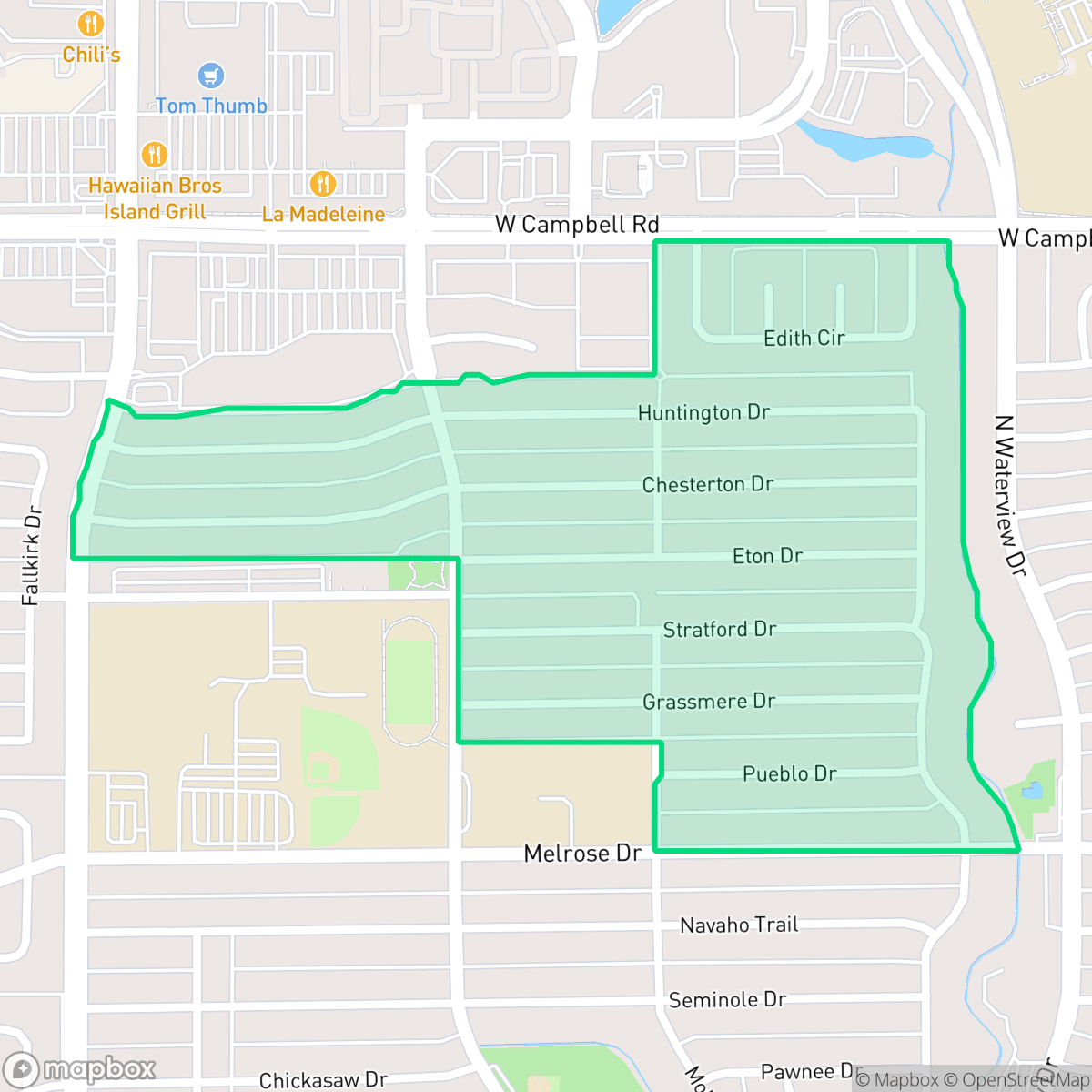
J. J. Pearce is a highly walkable residential community in western Richardson, defined by its quiet streets and proximity to local dining. According to iHuus data, the area offers exceptional walkability and high health insurance coverage, though residents should anticipate moderate noise levels from nearby road traffic.
Key Highlights
About J. J. Pearce
The J. J. Pearce neighborhood, originally developed as the J. J. Pearce Addition, was established in 1978 with home construction continuing into the early 1980s. Located on the west side of Richardson, the residential community was planned adjacent to J. J. Pearce High School. Both the school and the neighborhood were named in honor of Dr. Joseph Jones Pearce, the influential, long-time superintendent of the Richardson Independent School District from 1946 to 1977. Dr. Pearce himself lived in the neighborhood until his passing in 1995. Characterized by quiet, walkable streets and single-family homes, the neighborhood is supported by an active, voluntary homeowners association. In 2013, the association partnered with the school district to transform a vacant, muddy lot on Senior Way and Mimosa Drive into the J. J. Pearce HOA Park, a dedicated community pocket park.
The area maintains a distinct suburban character, characterized by mature landscaping and a well-connected street grid that supports high walkability. Residents benefit from a diverse selection of local eateries along the neighborhood periphery, including various Asian and grill-style restaurants that contribute to a lively local vibe. The community is largely residential, with open green spaces that provide a buffer between homes and the surrounding urban infrastructure. Prospective residents should consider the trade-offs associated with the area, such as moderate noise levels from road traffic and concerns regarding flood safety. While the neighborhood boasts excellent health insurance coverage and a strong sense of community, the air quality and privacy levels are consistent with typical suburban density. It is an ideal location for those who prioritize pedestrian access to daily amenities and a stable, established environment within the Richardson Independent School District.
Neighborhood Scores Across 15 Qualities
Residential spacing offers a balance of proximity and buffer between neighbors, aligning with the average density found throughout Richardson. According to iHuus data, the area features a mix of housing layouts that provide a moderate level of separation from adjacent properties.
Pedestrian infrastructure is excellent, featuring wide sidewalks on both sides of streets and ample crossings. According to iHuus data, the area offers superior walkability compared to the Richardson average.
Large residential lots and premium amenities contribute to an aesthetic that is more visually appealing than the Richardson average. According to iHuus data, the area is characterized by expansive driveways and well-maintained properties.
Connected green spaces and wide paths offer safe areas for walking pets, though overall accessibility is slightly below the Richardson average according to iHuus data.
Frequent open land and scattered homes create a semi-rural feel that is very similar to the Richardson average. This provides a balance of greenery and woodland interspersed with residential pockets, according to iHuus data.
Local dining options and community spaces provide a level of activity and social variety that is notably higher than the Richardson average. According to iHuus data, the area features a diverse mix of wellness businesses, parks, and international eateries situated alongside quiet green spaces.
Steady hum from nearby busy streets defines the acoustic environment, though levels remain slightly above the Richardson average according to iHuus data.
Air quality in this area fluctuates between acceptable and unhealthy levels, presenting occasional concerns for sensitive groups. According to iHuus data, conditions are slightly worse than the Richardson city average.
Residential tranquility is maintained by the complete absence of warehouses, industrial facilities, or hazard sites. This area offers a cleaner environment than the Richardson average, consisting primarily of quiet streets and open green spaces according to iHuus data.
Nearly all residents possess health insurance, which represents a significantly higher rate of coverage than the Richardson city average according to iHuus data.
Political leanings in this area are split relatively evenly between conservative and liberal perspectives. This distribution is notably more moderate than the broader Richardson city average, according to iHuus data.
Residents live alongside a balanced mix of young professionals, families, and seniors. According to iHuus data, the demographic distribution is slightly more varied than the typical profile found across Richardson.
Properties in this area are located within a designated floodplain, which implies a higher risk of flooding and a likely requirement for flood insurance. This level of risk is notably higher than the average found throughout Richardson.
Address-Level Insights for J. J. Pearce


iHuus Neighborhood Intelligence Insights
Get address-level neighborhood insights for J. J. Pearce
- Street-level scores — see how individual blocks compare, not just neighborhood averages
- Micro-zone boundaries — identify quiet pockets, flood boundaries, and walkable clusters before you visit
- 15 dimensions in full — walkability, noise, air quality, school quality, insurance coverage, population age profile, urban/rural index, and more
- Boundary risk alerts — know if your address sits near a block boundary where scores drop, the kind of detail no listing will ever mention
- School insights — individual school ratings and insights, not just district-level data
- Compare before you commit — side-by-side data across neighborhoods, down to block precision
No credit card required
Compare with Any Neighborhood
| Dimension | J. J. Pearce | Arapaho |
|---|---|---|
| 🚶 Walkabilityavg 8.74 | ||
| 🔊 Acoustic Comfortavg 4.81 | ||
| 🤫 Privacy Indexavg 5.72 | ||
| 🎨 Visual Appealavg 7.35 | ||
| 🐕 Dog Friendlinessavg 7.11 | ||
| 🗺️ Urban-Rural Indexavg 6.61 | ||
| ✨ Neighborhood Vibeavg 4.69 | ||
| 🏥 Health Insurance Coverageavg 6.64 | ||
| 🌿 Air Qualityavg 3.77 | ||
| 🏭 Industrial Proximityavg 9.24 | ||
| 🌊 Flood Safetyavg 4.36 | ||
| 🗳️ Ideological Leanavg 6.22 | ||
| 👥 Population Age Profileavg 4.71 | ||
| 🔥 Fire Safety | ||
| 🏫 School Quality |
J. J. Pearce Rankings
School Districts Serving J. J. Pearce
School Insights for J. J. Pearce
Below average outcomes; significant attendance and academic challenges.
School Insights
See what's really behind every school rating near J. J. Pearce
- Individual school ratings — each school's own score with outcome context, not just a district average
- Enrollment & class size data — student-to-teacher ratio and how it compares to the state average
- Full demographics breakdown — ethnicity and gender composition for every school in the enrollment zone
- Every school in the district — all schools within the enrollment boundary ranked by rating, not just the closest one
- Grade levels & benchmarks — elementary through high school, with below/above state-average flags
No credit card required