Highland Terrace, Richardson
Updated · 5,027 residents
Highland Terrace offers a blend of residential comfort and cultural vibrancy, anchored by its proximity to the DFW Chinatown corridor. The area features a mix of mid-century architecture and provides residents with moderate walkability, though noise levels from nearby road traffic are a common consideration for those living closer to major thoroughfares.
Key Highlights
About Highland Terrace
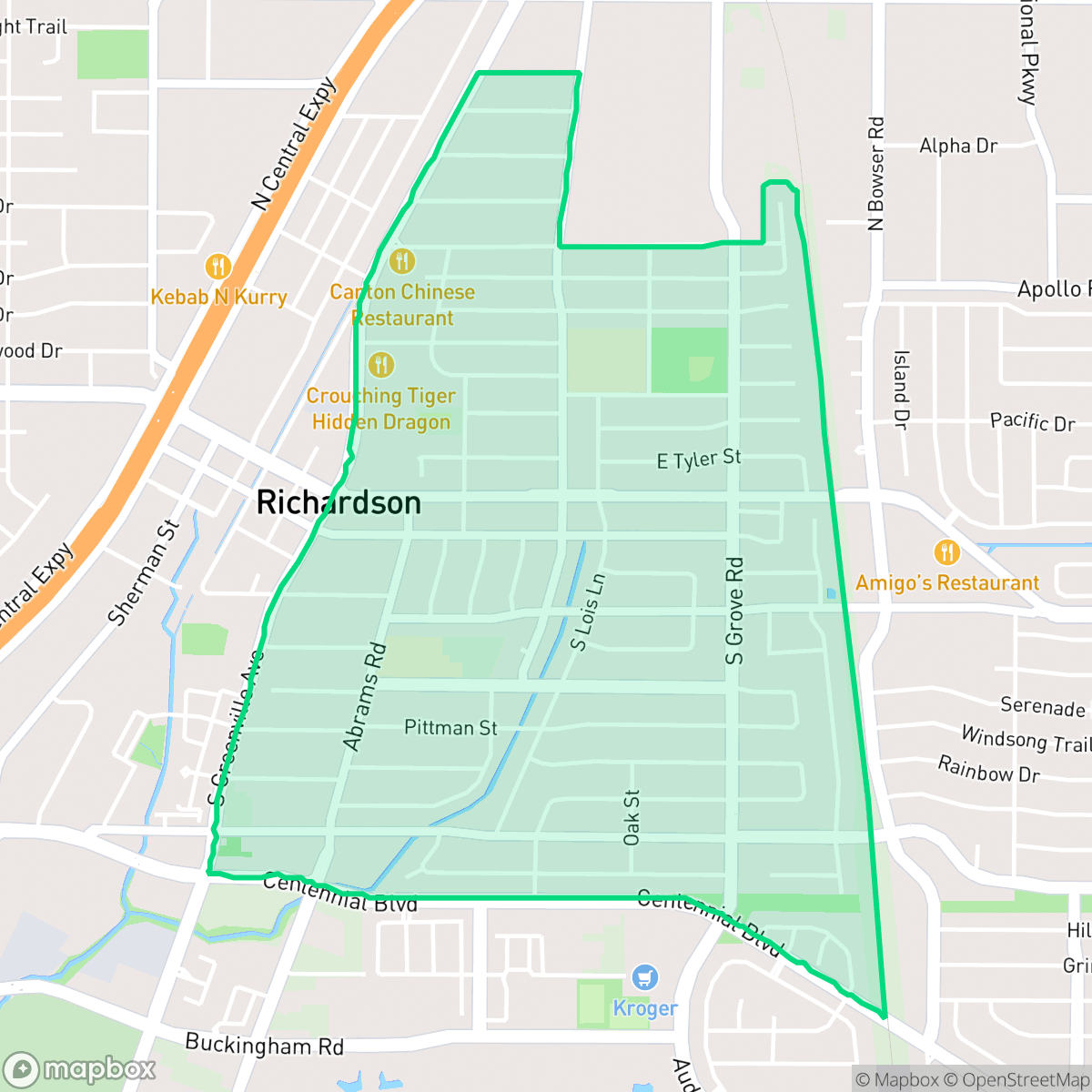
Developed primarily between the 1950s and 1970s, Highland Terrace is one of Richardson's largest residential neighborhoods, featuring classic mid-century ranches, contemporary brick builds, and traditional split-level homes. Bordered to the east by railway lines and commercial corridors, the neighborhood is culturally anchored by its close proximity to the Dallas-Fort Worth Chinatown, established in the 1980s by Chinese immigrants drawn to local technology companies. Today, the neighborhood is celebrated for its cultural diversity, walkability, and local community events like the annual Lunar New Year Festival. Highland Terrace is also home to Richardson Terrace Elementary and the Richardson ISD Math, Science, and Technology Magnet School.
The neighborhood maintains a distinct character through its diverse culinary landscape and established educational institutions, including the highly rated Math, Science, and Technology Magnet. Residents benefit from a central location that balances suburban residential streets with accessible commercial services. According to iHuus data, the area exhibits a higher ideological diversity compared to the city average, reflecting its evolving demographic profile and active community engagement. Prospective residents should consider that the area presents specific trade-offs, particularly regarding acoustic comfort and flood safety, which are lower than the city averages. While the neighborhood provides a high degree of access to local amenities and schools, the prevalence of road traffic noise and the need for careful consideration of flood-prone zones are notable factors. It is well-suited for families and individuals who prioritize school quality and proximity to cultural hubs over absolute quiet or rural-like seclusion.
Neighborhood Scores Across 15 Qualities
Residential layouts vary between closely grouped multi-unit complexes and single-family homes with modest yard buffers. This level of density is roughly in line with the average for Richardson.
Pedestrian movement is supported by sidewalks on most roads and safe crossings at major intersections, though the area is slightly less walkable than the Richardson average.
Large homes with manicured lawns and private pools characterize much of the area, though visual appeal is slightly below the Richardson average. According to iHuus data, the neighborhood features prominent roof footprints and well-maintained residential landscapes.
Grassy verges between sidewalks and roads are common across many residential blocks, but overall access to large parks is below the Richardson average. A small park is located in the southeast corner of the neighborhood according to iHuus data.
A varied landscape of residential pockets, commercial blocks, and light industrial zones creates a setting that is slightly less open than the Richardson average. According to iHuus data, the area features a transition between dense apartment complexes and more spacious, scattered housing.
A variety of local eateries and social hubs are interspersed with quiet, industrial, and residential pockets. This level of activity is slightly higher than the average for Richardson.
Steady noise from nearby busy streets is present throughout the area. According to iHuus data, this level of acoustic activity is slightly higher than the Richardson average.
Air quality levels fluctuate between acceptable and unhealthy, presenting occasional concerns for sensitive groups. This condition is slightly worse than the average seen throughout Richardson, according to iHuus data.
Residential tranquility is maintained by a lack of heavy industry, though occasional light commercial activity and small-scale services are present. This level of industrial proximity is slightly lower than the Richardson average due to the absence of large-scale warehouses or logistics hubs.
Health insurance enrollment is notably lower in this area than the Richardson average, according to iHuus data. This indicates a higher proportion of uninsured residents compared to the rest of the city.
Political leanings in this area trend more liberal than the Richardson average, according to iHuus data.
A balanced distribution of young adults, families, and older residents characterizes this area, mirroring the broader population spread seen across Richardson. This demographic variety provides a stable community composition according to iHuus data.
Flood risk in this area is difficult to determine because official FEMA studies for this specific location are currently incomplete. According to iHuus data, the level of risk is slightly higher than the average found throughout Richardson.
Address-Level Insights for Highland Terrace


iHuus Neighborhood Intelligence Insights
Get address-level neighborhood insights for Highland Terrace
- Street-level scores — see how individual blocks compare, not just neighborhood averages
- Micro-zone boundaries — identify quiet pockets, flood boundaries, and walkable clusters before you visit
- 15 dimensions in full — walkability, noise, air quality, school quality, insurance coverage, population age profile, urban/rural index, and more
- Boundary risk alerts — know if your address sits near a block boundary where scores drop, the kind of detail no listing will ever mention
- School insights — individual school ratings and insights, not just district-level data
- Compare before you commit — side-by-side data across neighborhoods, down to block precision
No credit card required
Compare with Any Neighborhood
| Dimension | Highland Terrace | Arapaho |
|---|---|---|
| 🚶 Walkabilityavg 8.74 | ||
| 🔊 Acoustic Comfortavg 4.81 | ||
| 🤫 Privacy Indexavg 5.72 | ||
| 🎨 Visual Appealavg 7.35 | ||
| 🐕 Dog Friendlinessavg 7.11 | ||
| 🗺️ Urban-Rural Indexavg 6.61 | ||
| ✨ Neighborhood Vibeavg 4.69 | ||
| 🏥 Health Insurance Coverageavg 6.64 | ||
| 🌿 Air Qualityavg 3.77 | ||
| 🏭 Industrial Proximityavg 9.24 | ||
| 🌊 Flood Safetyavg 4.36 | ||
| 🗳️ Ideological Leanavg 6.22 | ||
| 👥 Population Age Profileavg 4.71 | ||
| 🔥 Fire Safety | ||
| 🏫 School Quality |
Highland Terrace Rankings
School Districts Serving Highland Terrace
School Insights for Highland Terrace
Below average outcomes; significant attendance and academic challenges.
School Insights
See what's really behind every school rating near Highland Terrace
- Individual school ratings — each school's own score with outcome context, not just a district average
- Enrollment & class size data — student-to-teacher ratio and how it compares to the state average
- Full demographics breakdown — ethnicity and gender composition for every school in the enrollment zone
- Every school in the district — all schools within the enrollment boundary ranked by rating, not just the closest one
- Grade levels & benchmarks — elementary through high school, with below/above state-average flags
No credit card required