Heights Park, Richardson
Updated · 1,853 residents
Defined by its mid-century ranch architecture and the iconic Rocket sculpture, Heights Park offers a blend of established suburban charm and active local dining. While the area provides high health insurance coverage and a strong sense of community, residents should expect notable noise levels due to nearby highway traffic.
Key Highlights
About Heights Park
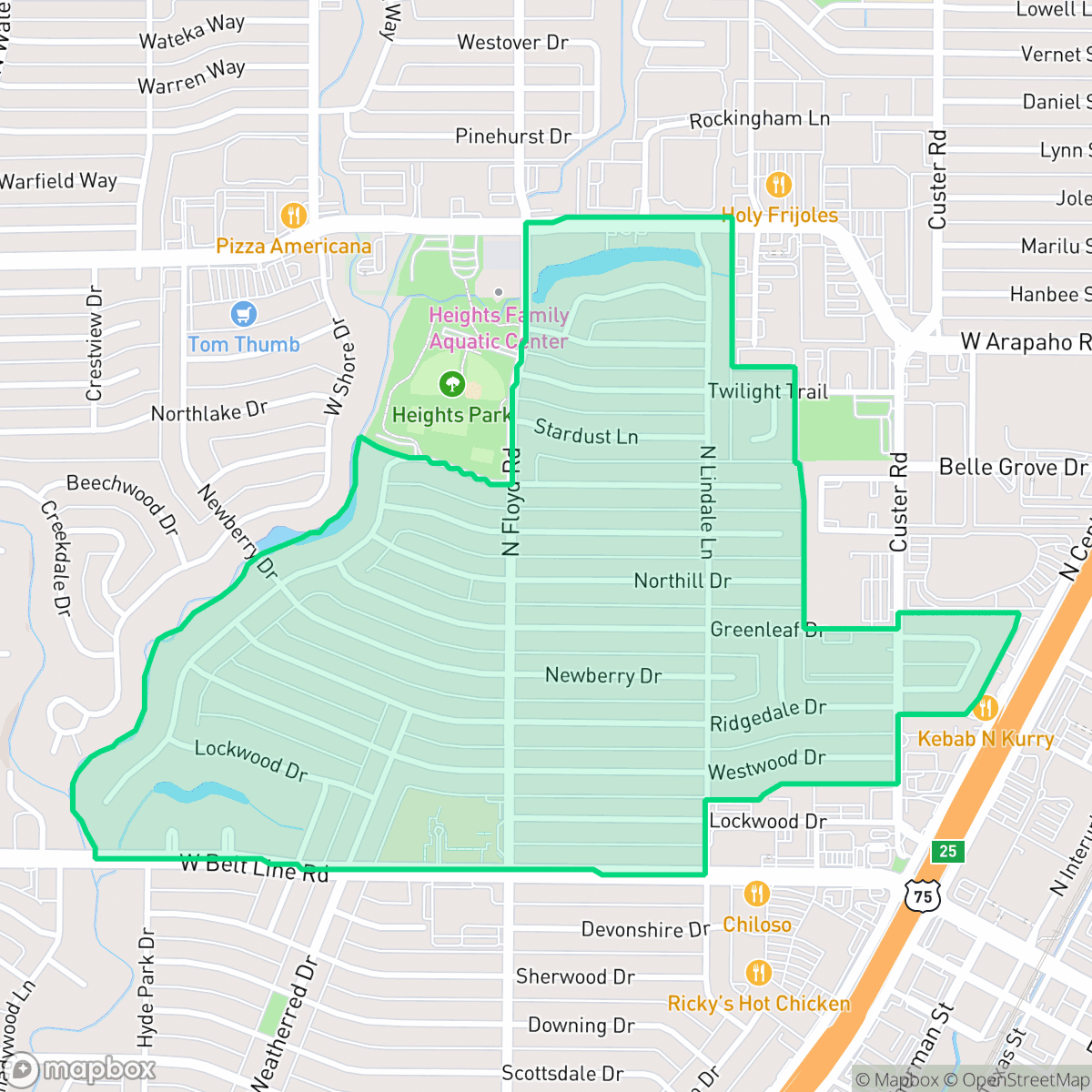
Developed primarily during the post-World War II housing boom of the 1950s and 1960s, Heights Park is an established neighborhood in Richardson, Texas, characterized by its classic mid-century Ranch-style homes. The community is bordered by Arapaho Road, Belt Line Road, Custer Road, and Thompson Drive. At its center lies its namesake public park, which historically became famous for its iconic 1960s "rocketship" playground slide. Although the original slide was decommissioned in 2008 due to safety regulations, the neighborhood's nostalgia for the landmark inspired the 2013 installation of "Rocket," a replica public art sculpture by artist Jeff Laramore at the Heights Recreation Center. In 2009, Heights Park partnered with neighboring communities to initiate the Heights Plan for Excellence, a successful civic revitalization effort that updated local infrastructure and parks.
The neighborhood functions as a vibrant suburban hub where residential streets meet light commercial activity. Residents benefit from a diverse local food scene, including Ethiopian and various international cuisines, set against a backdrop of quiet green spaces and small bodies of water. The area maintains a steady rhythm of life, supported by a strong civic infrastructure that prioritizes public art and community-led revitalization efforts. Education is served by the Richardson Independent School District, which provides a stable academic environment for families despite recent district-wide shifts.
Living in this part of Richardson involves balancing convenience with specific environmental trade-offs. The proximity to major thoroughfares contributes to a higher ambient noise level, and the area experiences more significant urban traffic compared to quieter, secluded pockets of the city. It is best suited for those who value an established community with easy access to regional transit routes and a variety of dining options, provided they are comfortable with the acoustic profile of a well-connected suburban location.
Neighborhood Scores Across 15 Qualities
Residential spacing provides a consistent buffer between neighbors, offering slightly more seclusion than the Richardson average.
Pedestrian infrastructure includes sidewalks on one side of the street and safe crossings, though ease of walking is slightly below the Richardson average.
Large homes and upscale amenities contribute to a pleasant streetscape, though the overall visual quality is slightly below the Richardson average according to iHuus data.
Limited access to public parks and green verges makes this area less ideal for dog owners compared to the Richardson average, according to iHuus data.
Open land and scattered homes amid woodland characterize this area, which maintains a level of openness similar to the Richardson average.
Diverse dining options and social hubs provide a more active atmosphere than the typical Richardson suburb. While some blocks offer a quiet residential rhythm near green spaces, others feature lively commercial pockets accessible via car.
Persistent noise from nearby railroad tracks and heavy freeway traffic characterizes this area. Acoustic comfort levels are notably lower than the Richardson city average, according to iHuus data.
Air quality levels fluctuate between acceptable and unhealthy on certain days, which may cause concern for sensitive groups. This condition is slightly more frequent in Heights Park than the average seen across Richardson, according to iHuus data.
Residential life remains largely undisturbed by heavy industry, as the area contains only occasional light commercial activity. This lack of industrial density is slightly lower than the Richardson average due to small pockets of mixed-use development.
Health insurance access among residents is notably higher than the Richardson average, according to iHuus data.
Political perspectives in this area are split relatively evenly between conservative and liberal leanings. This distribution is notably more balanced than the broader Richardson average, according to iHuus data.
Residents live among a diverse mix of young adults, families, and seniors. According to iHuus data, this age distribution is slightly more varied than the typical profile found across Richardson.
Located within a designated floodplain, this area carries a higher risk of flooding than much of Richardson. Residents should prepare for potential requirements for flood insurance according to iHuus data.
Address-Level Insights for Heights Park


iHuus Neighborhood Intelligence Insights
Get address-level neighborhood insights for Heights Park
- Street-level scores — see how individual blocks compare, not just neighborhood averages
- Micro-zone boundaries — identify quiet pockets, flood boundaries, and walkable clusters before you visit
- 15 dimensions in full — walkability, noise, air quality, school quality, insurance coverage, population age profile, urban/rural index, and more
- Boundary risk alerts — know if your address sits near a block boundary where scores drop, the kind of detail no listing will ever mention
- School insights — individual school ratings and insights, not just district-level data
- Compare before you commit — side-by-side data across neighborhoods, down to block precision
No credit card required
Compare with Any Neighborhood
| Dimension | Heights Park | Arapaho |
|---|---|---|
| 🚶 Walkabilityavg 8.74 | ||
| 🔊 Acoustic Comfortavg 4.81 | ||
| 🤫 Privacy Indexavg 5.72 | ||
| 🎨 Visual Appealavg 7.35 | ||
| 🐕 Dog Friendlinessavg 7.11 | ||
| 🗺️ Urban-Rural Indexavg 6.61 | ||
| ✨ Neighborhood Vibeavg 4.69 | ||
| 🏥 Health Insurance Coverageavg 6.64 | ||
| 🌿 Air Qualityavg 3.77 | ||
| 🏭 Industrial Proximityavg 9.24 | ||
| 🌊 Flood Safetyavg 4.36 | ||
| 🗳️ Ideological Leanavg 6.22 | ||
| 👥 Population Age Profileavg 4.71 | ||
| 🔥 Fire Safety | ||
| 🏫 School Quality |
Heights Park Rankings
School Districts Serving Heights Park
School Insights for Heights Park
Below average outcomes; significant attendance and academic challenges.
School Insights
See what's really behind every school rating near Heights Park
- Individual school ratings — each school's own score with outcome context, not just a district average
- Enrollment & class size data — student-to-teacher ratio and how it compares to the state average
- Full demographics breakdown — ethnicity and gender composition for every school in the enrollment zone
- Every school in the district — all schools within the enrollment boundary ranked by rating, not just the closest one
- Grade levels & benchmarks — elementary through high school, with below/above state-average flags
No credit card required