Haggard, Plano
Updated · 722 residents
Haggard is a historic district in downtown Plano known for its cultural landmarks and proximity to local dining. While the area offers a vibrant atmosphere, residents should be aware of significant noise levels from nearby road traffic and limited flood safety protections.
Key Highlights
About Haggard
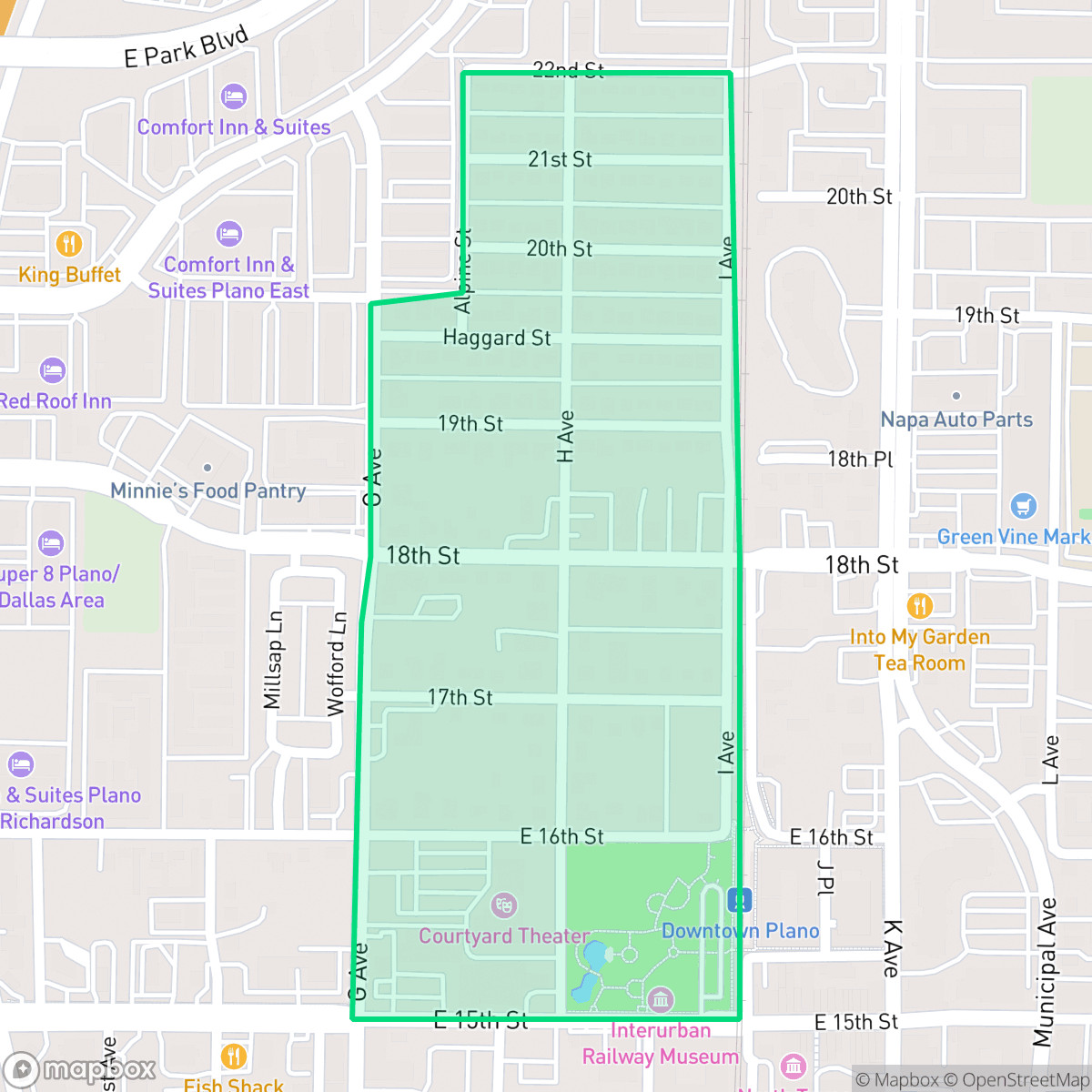
The Haggard Park Heritage District in Plano, Texas, designated in 1999, is a historic residential neighborhood centered around the 5.5-acre Haggard Park. Named after the pioneering Haggard family who settled the area in the mid-19th century, the district features historic homes dating from the late 1800s to the early 1960s. Positioned in Plano's historic downtown, the neighborhood is anchored by several prominent landmarks. These include the Interurban Railway Museum—housed in a restored 1908 Texas Electric Railway station—and the historic Saigling House, which serves as the ArtCentre of Plano. The neighborhood preserves the early architectural and transit history of Plano, transitioning from a late-19th-century agrarian hub to a vibrant, transit-oriented historic district.
The neighborhood functions as a blend of historic preservation and active commercial life. It is defined by its central location near downtown amenities, including popular dining options like Ebesu Robata & Sushi and Taco Rico. The area maintains a distinct, lively suburban character that benefits from its proximity to major transit routes and established green spaces, creating a unique environment that balances historic charm with daily convenience.
Living in this area requires navigating specific trade-offs, particularly regarding environmental factors. Data indicates high noise levels primarily driven by road traffic, alongside significant concerns regarding flood safety. Residents benefit from access to the high-performing Plano Independent School District, though the area faces challenges with health insurance coverage rates. This location is best suited for those who prioritize proximity to historic downtown culture and local amenities over absolute quiet or environmental isolation.
Neighborhood Scores Across 15 Qualities
Residential spacing provides a moderate level of separation between neighbors, which is slightly higher than the Plano average according to iHuus data.
Quiet streets provide a calm environment for walking, but the lack of sidewalks makes the area significantly less walkable than the Plano average according to iHuus data.
Standard tract housing dominates the landscape, featuring uniform rooflines and modest yards. This level of visual variety is lower than the Plano city average according to iHuus data.
Access to public parks and wide green verges is below the Plano average, according to iHuus data. Pet owners may find fewer opportunities for convenient off-leash areas or walking paths within the immediate vicinity.
Frequent open land and scattered homes among woodlands characterize this area. This landscape is slightly more developed than the surrounding Plano average, according to iHuus data.
Diverse dining options and local social hubs provide more activity than the typical Plano neighborhood. While street-level energy is higher than the city average, much of the area remains car-dependent.
Frequent noise from nearby freeways and rail lines makes this area significantly louder than the Plano average. Residents can expect consistent acoustic disturbances according to iHuus data.
Air quality in this area fluctuates between acceptable and unhealthy levels, mirroring the typical conditions found across Plano. Sensitive groups should remain aware of occasional days with higher pollution levels according to iHuus data.
Light industrial and commercial units are interspersed with residential zones, resulting in lower industrial density than the Plano average. Residents may experience more daytime commercial traffic near their homes than is typical for the city.
Health insurance accessibility is significantly lower than the Plano average. According to iHuus data, a very small portion of the local population maintains health coverage.
Political leanings in this area lean toward the liberal side, representing a notable departure from the broader Plano average according to iHuus data.
Residents live alongside a varied demographic of young adults, families, and seniors. This population distribution is slightly more concentrated toward certain age groups than the Plano average, according to iHuus data.
Address-Level Insights for Haggard


iHuus Neighborhood Intelligence Insights
Get address-level neighborhood insights for Haggard
- Street-level scores — see how individual blocks compare, not just neighborhood averages
- Micro-zone boundaries — identify quiet pockets, flood boundaries, and walkable clusters before you visit
- 15 dimensions in full — walkability, noise, air quality, school quality, insurance coverage, population age profile, urban/rural index, and more
- Boundary risk alerts — know if your address sits near a block boundary where scores drop, the kind of detail no listing will ever mention
- School insights — individual school ratings and insights, not just district-level data
- Compare before you commit — side-by-side data across neighborhoods, down to block precision
No credit card required
Compare with Any Neighborhood
| Dimension | Haggard | Armstrong Park |
|---|---|---|
| 🚶 Walkabilityavg 9.16 | ||
| 🔊 Acoustic Comfortavg 4.81 | ||
| 🤫 Privacy Indexavg 5.84 | ||
| 🎨 Visual Appealavg 7.71 | ||
| 🐕 Dog Friendlinessavg 7.64 | ||
| 🗺️ Urban-Rural Indexavg 6.7 | ||
| ✨ Neighborhood Vibeavg 4.43 | ||
| 🏥 Health Insurance Coverageavg 7.88 | ||
| 🌿 Air Qualityavg 4.17 | ||
| 🏭 Industrial Proximityavg 9.46 | ||
| 🌊 Flood Safetyavg 4.69 | ||
| 🗳️ Ideological Leanavg 5.08 | ||
| 👥 Population Age Profileavg 4.81 | ||
| 🔥 Fire Safety | ||
| 🏫 School Quality |
Haggard Rankings
School Districts Serving Haggard
School Insights for Haggard
Below average outcomes; significant attendance and academic challenges.
School Insights
See what's really behind every school rating near Haggard
- Individual school ratings — each school's own score with outcome context, not just a district average
- Enrollment & class size data — student-to-teacher ratio and how it compares to the state average
- Full demographics breakdown — ethnicity and gender composition for every school in the enrollment zone
- Every school in the district — all schools within the enrollment boundary ranked by rating, not just the closest one
- Grade levels & benchmarks — elementary through high school, with below/above state-average flags
No credit card required