Dallas North Estates, Plano
Updated · 1,853 residents
Dallas North Estates is a historic Plano neighborhood defined by its mid-century origins and the iconic Texas-shaped saltwater pool. Residents benefit from a quiet residential atmosphere with high flood safety and strong access to healthcare, though the area offers moderate walkability and standard air quality.
Key Highlights
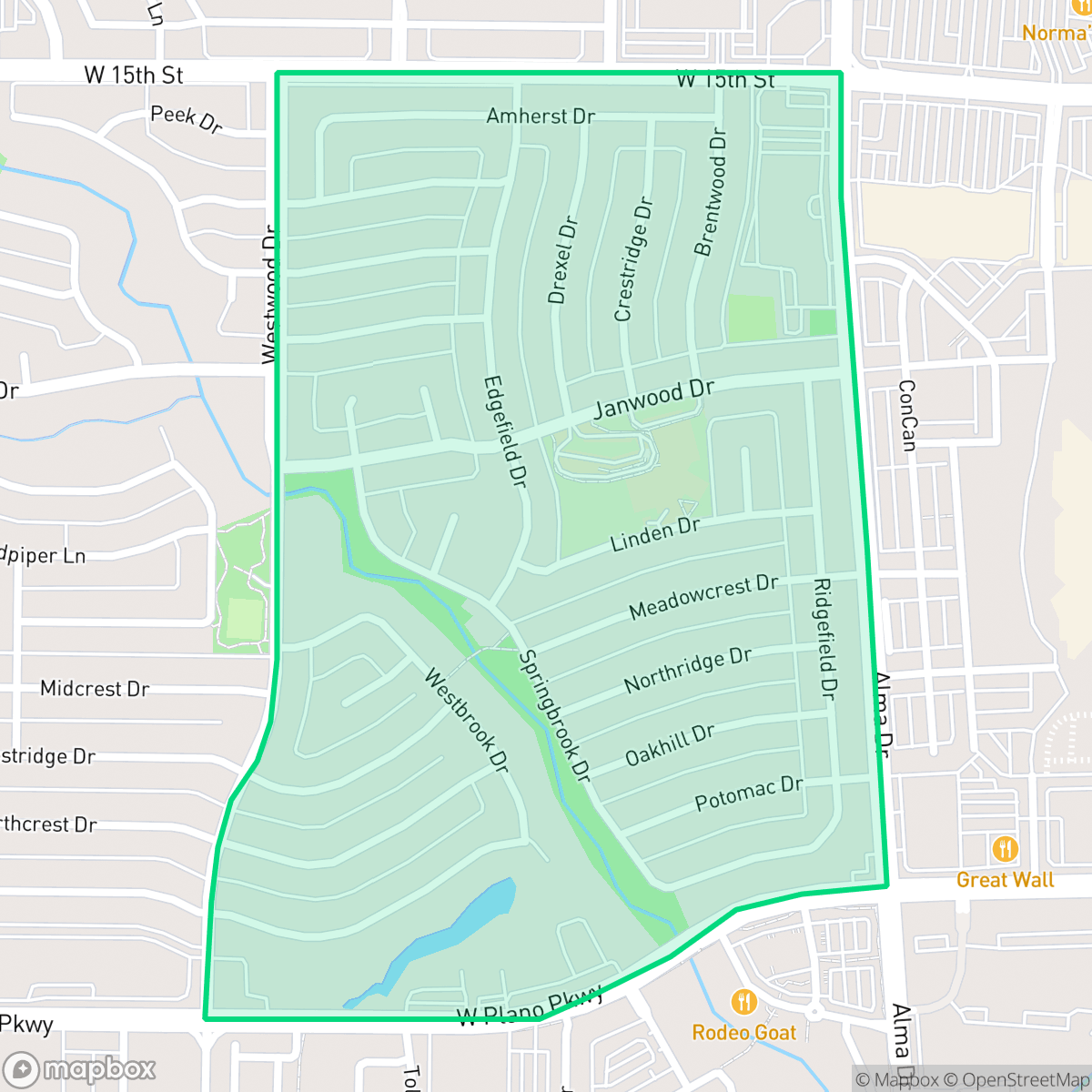
About Dallas North Estates
Developed from a wheat field starting in 1960, Dallas North Estates was financed by billionaire Texas oilman William Herbert Hunt. Hunt famously named the subdivision because he believed nobody at the time would know where Plano was. The neighborhood’s crown jewel is the historic Texas Pool, a 168,000-gallon, state-shaped saltwater pool conceived in 1959 and opened in 1961. Legend holds that its unique shape was first sketched into the dirt with a mesquite stick. Serving originally as the private Dallas North Swim Club—and hosting the 1961 Miss Plano Pageant—the pool was added to the National Register of Historic Places in 2019 and designated a City of Plano Heritage Landmark in 2023, remaining a beloved community hub.
The neighborhood maintains a distinct suburban character characterized by quiet streets and significant open green spaces. With a focus on residential stability, the area offers a peaceful environment with low industrial proximity and acoustic comfort levels that exceed the city average. The presence of the historic Texas Pool serves as a central community anchor, fostering a social atmosphere that balances the neighborhood's suburban layout with localized leisure opportunities. Residents also benefit from high levels of health insurance coverage, contributing to the overall stability of this established Plano community.
Living in this area involves a trade-off between its tranquil, low-density feel and its reliance on vehicles for daily errands. While it provides a safe and quiet setting, those seeking high-density urban walkability or extensive dog-friendly amenities may find the environment more suited to a traditional suburban lifestyle. The neighborhood is well-positioned within the Plano Independent School District, though prospective families should note the varying performance ratings of local schools. It is an ideal choice for those prioritizing long-term residential stability, flood safety, and a sense of community history over proximity to high-density commercial hubs.
Neighborhood Scores Across 15 Qualities
Residential spacing is typical for a suburban setting, with houses situated near neighbors but maintaining some buffer. This level of density is roughly in line with the average seen across Plano, according to iHuus data.
Sidewalks are available on parts of the streets and safe crossings are present, though the area is less walkable than the Plano average.
Large homes with complex rooflines and a high density of private swimming pools create an attractive streetscape. This visual quality is slightly below the Plano city average.
Wide grassy verges and a centralized public park provide decent space for walking pets, though overall amenities are below the Plano average according to iHuus data.
Open land and scattered greenery define the area, which maintains a slightly more rural feel than the Plano average. According to iHuus data, the landscape features a mix of woodland and fields interspersed with dense suburban residential tracts.
Suburban blocks offer a diverse mix of dining and leisure hubs that provide more activity than the Plano average. While various restaurants and parks are accessible, much of the area remains quiet and relies on vehicle travel for easy access to most amenities.
Frequent noise from nearby transit corridors and flight paths characterizes this area. According to iHuus data, acoustic comfort is notably lower than the Plano city average.
Air quality in this area fluctuates between acceptable and unhealthy levels, presenting occasional concerns for sensitive groups. According to iHuus data, these conditions are slightly lower than the average seen throughout Plano.
Industrial warehouses and hazardous facilities are absent from this area, matching the typical profile found throughout Plano. According to iHuus data, the landscape consists solely of residential properties and light commercial services.
Health insurance accessibility in this area is below the Plano average, according to iHuus data.
Political leanings within this area are relatively balanced, showing a more even split between conservative and liberal voters than the Plano average.
A balanced mix of young adults, families, and older residents characterizes this area. This age distribution is largely consistent with the broader Plano population, according to iHuus data.
Flood risk in this area is currently difficult to assess because FEMA has not yet completed a detailed flood study for the neighborhood. According to iHuus data, the level of risk is consistent with the average found across Plano.
Address-Level Insights for Dallas North Estates


iHuus Neighborhood Intelligence Insights
Get address-level neighborhood insights for Dallas North Estates
- Street-level scores — see how individual blocks compare, not just neighborhood averages
- Micro-zone boundaries — identify quiet pockets, flood boundaries, and walkable clusters before you visit
- 15 dimensions in full — walkability, noise, air quality, school quality, insurance coverage, population age profile, urban/rural index, and more
- Boundary risk alerts — know if your address sits near a block boundary where scores drop, the kind of detail no listing will ever mention
- School insights — individual school ratings and insights, not just district-level data
- Compare before you commit — side-by-side data across neighborhoods, down to block precision
No credit card required
Compare with Any Neighborhood
| Dimension | Dallas North Estates | Armstrong Park |
|---|---|---|
| 🚶 Walkabilityavg 9.16 | ||
| 🔊 Acoustic Comfortavg 4.81 | ||
| 🤫 Privacy Indexavg 5.84 | ||
| 🎨 Visual Appealavg 7.71 | ||
| 🐕 Dog Friendlinessavg 7.64 | ||
| 🗺️ Urban-Rural Indexavg 6.7 | ||
| ✨ Neighborhood Vibeavg 4.43 | ||
| 🏥 Health Insurance Coverageavg 7.88 | ||
| 🌿 Air Qualityavg 4.17 | ||
| 🏭 Industrial Proximityavg 9.46 | ||
| 🌊 Flood Safetyavg 4.69 | ||
| 🗳️ Ideological Leanavg 5.08 | ||
| 👥 Population Age Profileavg 4.81 | ||
| 🔥 Fire Safety | ||
| 🏫 School Quality |
Dallas North Estates Rankings
School Districts Serving Dallas North Estates
School Insights for Dallas North Estates
Below average outcomes; significant attendance and academic challenges.
School Insights
See what's really behind every school rating near Dallas North Estates
- Individual school ratings — each school's own score with outcome context, not just a district average
- Enrollment & class size data — student-to-teacher ratio and how it compares to the state average
- Full demographics breakdown — ethnicity and gender composition for every school in the enrollment zone
- Every school in the district — all schools within the enrollment boundary ranked by rating, not just the closest one
- Grade levels & benchmarks — elementary through high school, with below/above state-average flags
No credit card required