Long Meadow Farms, Pecan Grove
Updated · 2,296 residents
Long Meadow Farms is a master-planned community defined by its upscale traditional architecture and extensive pedestrian-friendly trail systems. The neighborhood offers a serene, semi-rural atmosphere with a quiet suburban feel, making it well-suited for families and residents seeking a balance between open green space and accessible outdoor amenities.
Key Highlights
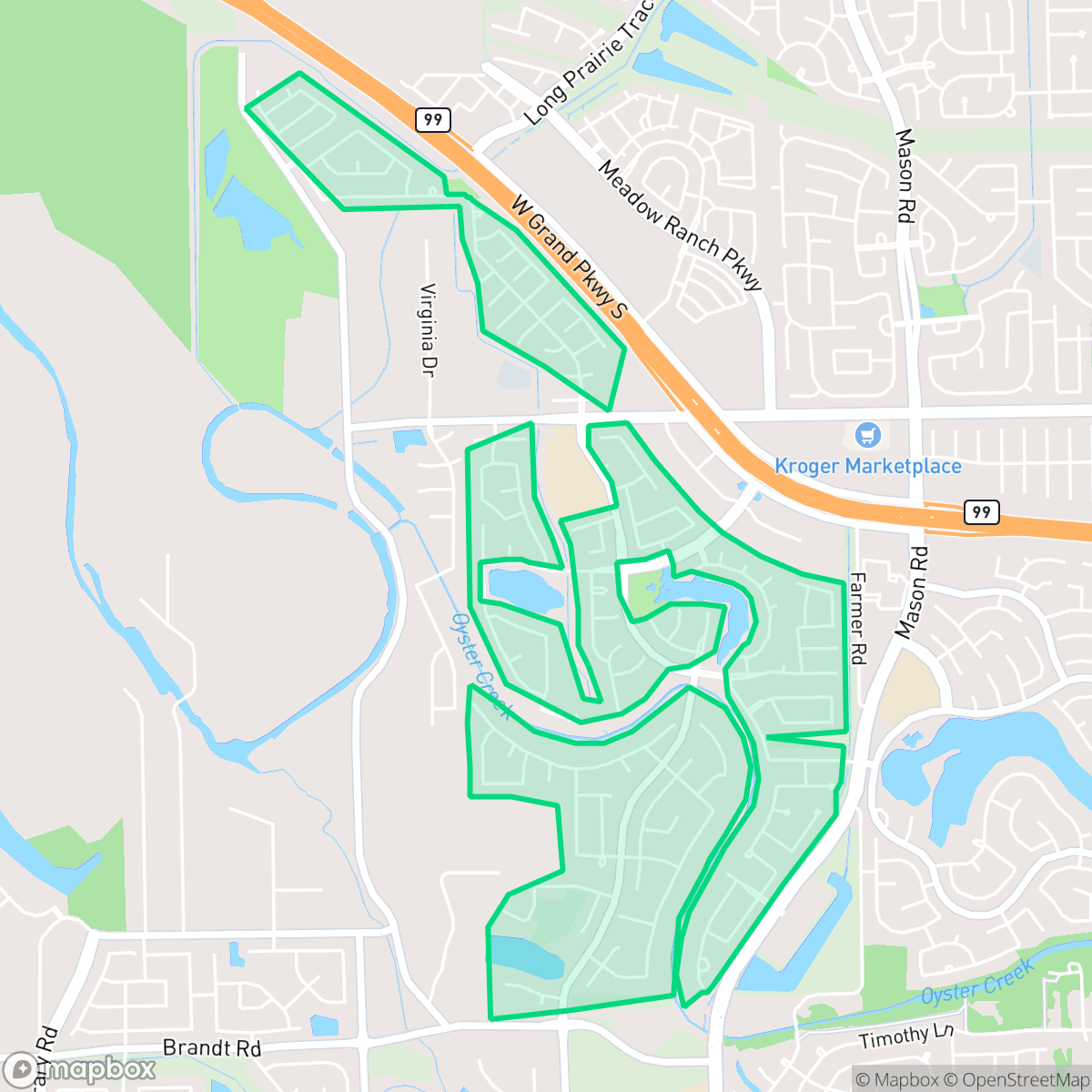
About Long Meadow Farms
Long Meadow Farms is a 1,400-acre master-planned community in Richmond, Texas, situated on land historically linked to Jane Long, the 'Mother of Texas.' In 1837, Long received a league of land in Fort Bend County from Stephen F. Austin, which she developed into a prairie for cattle and cotton. The property remained in the family for generations, and the modern neighborhood was designed to honor this heritage by preserving the site's original pecan trees, native wildflowers, and natural landscape. Development of the residential community began in 2004, focusing on traditional Texas-style architecture and extensive recreational amenities, including lakes, waterfalls, and miles of trails, while maintaining the scenic, rural character of the historic prairie land.
The area maintains a distinct visual appeal characterized by spacious, high-end residential properties set against a backdrop of native landscape. Residents benefit from a highly walkable environment where safe sidewalks and connected pathways encourage active outdoor living. While the community remains largely quiet and residential, it provides a stable environment for a diverse population ranging from young professionals to seniors. The neighborhood fosters a conservative social environment and offers a consistent, low-density living experience that prioritizes greenery over dense commercial development. Prospective residents should note the presence of nearby light commercial activity and essential infrastructure, which contributes to a steady background hum of traffic noise in certain sections. The community sits within a moderate flood risk zone due to its location in a 500-year floodplain. Educational opportunities are divided between the highly-regarded Lamar Consolidated Independent School District and the Fort Bend Independent School District, the latter of which is currently navigating a period of fiscal and operational transition.
Neighborhood Scores Across 15 Qualities
Residential spacing is mixed, offering some buffers between neighbors while maintaining a density that is roughly in line with the city average, according to iHuus data.
Sidewalks are available on one side of the street and safe crossings are provided. This level of pedestrian accessibility is above the city average, according to iHuus data.
Large residences and premium amenities define the local landscape, offering a visual quality that is slightly above the city average according to iHuus data.
Connected green spaces and wide, traffic-safe paths provide reliable environments for walking pets. According to iHuus data, this level of accessibility is slightly below the city average.
Large open spaces and scattered woodland characterize this area, offering a slightly less dense environment than the typical city average. Residents will find a mix of master-planned cul-de-sacs situated near the edge of agricultural lands.
Primarily a serene and low-density residential area, this neighborhood offers a calm atmosphere with limited local commercial activity. The level of social vibrancy is consistent with the city average, providing a quiet setting centered more on greenery and open space than on bustling retail.
Local traffic from a nearby busy street creates a consistent background noise that is slightly higher than the average for the city. Residents can expect a moderate level of acoustic activity throughout the day according to iHuus data.
Air quality levels are consistent with the city average, though residents may encounter occasional days that are less than ideal for sensitive groups. According to iHuus data, the area experiences a mix of acceptable and unhealthy air conditions.
Active wastewater treatment infrastructure and light commercial traffic are present near residential zones, making the industrial proximity notably higher than the city average according to iHuus data.
Health insurance enrollment remains high among residents, though it is slightly below the city average according to iHuus data.
Political leanings in this area trend more conservative than the city average. According to iHuus data, the community maintains a conservative majority with a small opposing presence.
Residents live alongside a balanced mix of young adults, families, and seniors. This age distribution is largely consistent with the broader Pecan Grove area according to iHuus data.
Flood risk in this area is slightly higher than the city average due to its location within a 500-year floodplain. According to iHuus data, some residual flood risk remains present for residents.
Address-Level Insights for Long Meadow Farms


iHuus Neighborhood Intelligence Insights
Get address-level neighborhood insights for Long Meadow Farms
- Street-level scores — see how individual blocks compare, not just neighborhood averages
- Micro-zone boundaries — identify quiet pockets, flood boundaries, and walkable clusters before you visit
- 15 dimensions in full — walkability, noise, air quality, school quality, insurance coverage, population age profile, urban/rural index, and more
- Boundary risk alerts — know if your address sits near a block boundary where scores drop, the kind of detail no listing will ever mention
- School insights — individual school ratings and insights, not just district-level data
- Compare before you commit — side-by-side data across neighborhoods, down to block precision
No credit card required
Compare with Any Neighborhood
| Dimension | Long Meadow Farms | Riverside |
|---|---|---|
| 🚶 Walkabilityavg 7.93 | ||
| 🔊 Acoustic Comfortavg 5.11 | ||
| 🤫 Privacy Indexavg 6.08 | ||
| 🎨 Visual Appealavg 7.92 | ||
| 🐕 Dog Friendlinessavg 7.78 | ||
| 🗺️ Urban-Rural Indexavg 7.56 | ||
| ✨ Neighborhood Vibeavg 3.62 | ||
| 🏥 Health Insurance Coverageavg 8.67 | ||
| 🌿 Air Qualityavg 4 | ||
| 🏭 Industrial Proximityavg 8.67 | ||
| 🌊 Flood Safetyavg 6.27 | ||
| 🗳️ Ideological Leanavg 1.47 | ||
| 👥 Population Age Profileavg 4.83 | ||
| 🔥 Fire Safety | ||
| 🏫 School Quality |
Long Meadow Farms Rankings
School Districts Serving Long Meadow Farms
School Insights for Long Meadow Farms
Below average outcomes; significant attendance and academic challenges.
School Insights
See what's really behind every school rating near Long Meadow Farms
- Individual school ratings — each school's own score with outcome context, not just a district average
- Enrollment & class size data — student-to-teacher ratio and how it compares to the state average
- Full demographics breakdown — ethnicity and gender composition for every school in the enrollment zone
- Every school in the district — all schools within the enrollment boundary ranked by rating, not just the closest one
- Grade levels & benchmarks — elementary through high school, with below/above state-average flags
No credit card required