Shadow Creek Ranch, Pearland
Updated · 18,148 residents
Shadow Creek Ranch is a master-planned community defined by its extensive network of lakes and scenic greenways. The area offers high walkability and well-manicured suburban aesthetics, though residents may experience moderate road noise and variable air quality.
Key Highlights
About Shadow Creek Ranch
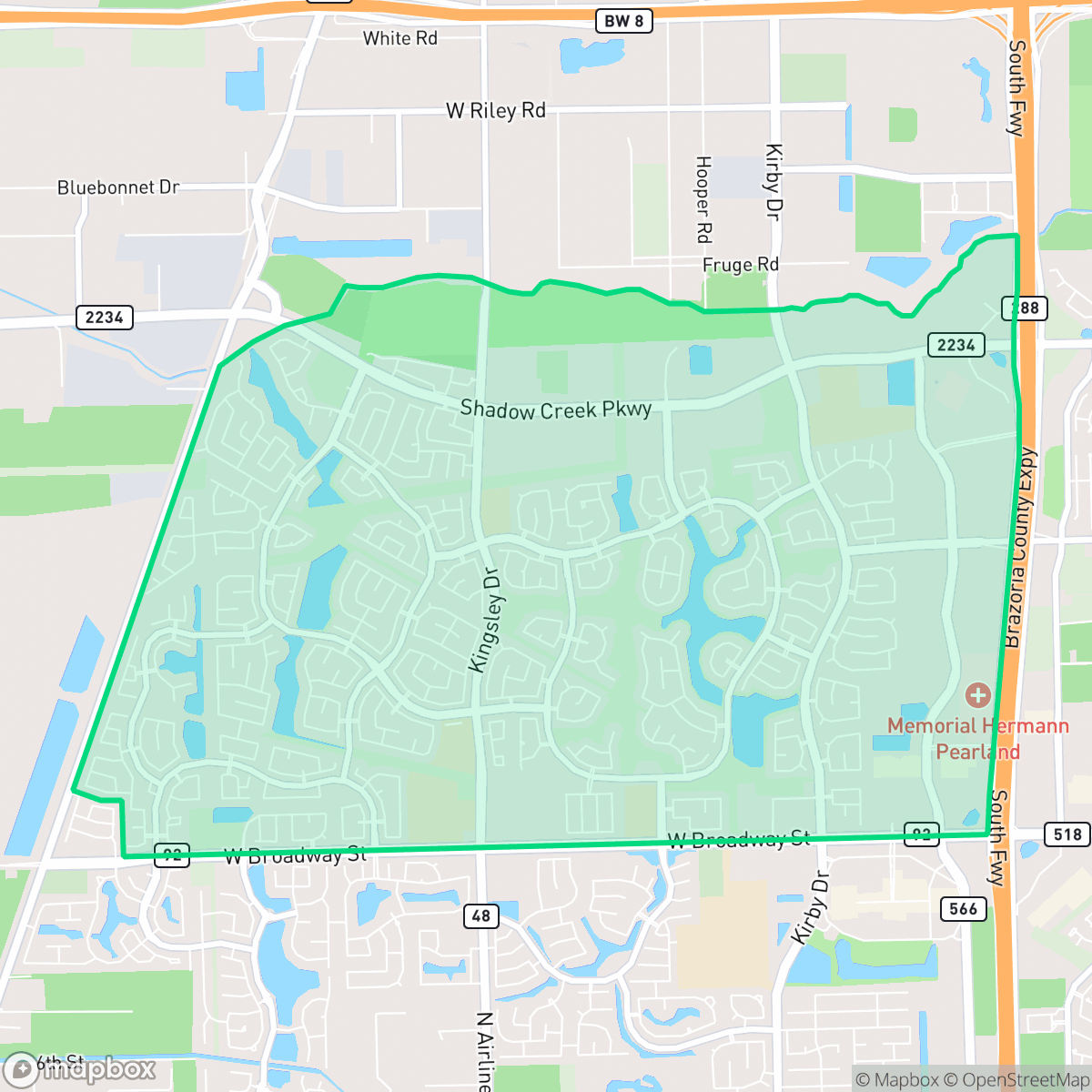
Shadow Creek Ranch is a 3,500-acre master-planned community in west Pearland, Texas, that transformed from raw agricultural farmland into a major suburban enclave. The land was annexed by the City of Pearland in the late 1990s and developed by Gary Cook and Carlo Ferreira of the Shadow Creek Development Company. Residential sales began in 2001, featuring homes built by prominent builders like Perry Homes and David Weekley Homes. Designed as a scenic, lake-themed neighborhood, the development features 300 acres of interconnected lakes, 700 acres of greenways and parks, and the 42-acre Shadow Creek Ranch Nature Trail, which preserves a portion of the region's historic coastal tallgrass prairie.
The neighborhood functions as a dense suburban enclave characterized by a consistent grid of modern tract housing and managed green spaces. It provides a stable environment for residents, supported by access to highly rated schools within the Alvin and Pearland Independent School Districts. Daily life is centered around local amenities and services, with a layout that encourages pedestrian activity through continuous sidewalks and dedicated trails surrounding the community's numerous ponds. The area maintains a quiet, residential rhythm, blending suburban comfort with convenient access to retail and dining options along major corridors.
Prospective residents should note that while the area is highly walkable by suburban standards, it remains a car-oriented environment for broader travel. The acoustic profile is influenced by road traffic, which serves as the primary source of ambient noise. Furthermore, the proximity to certain infrastructure, such as wastewater treatment facilities in peripheral zones, is a factor to consider. Overall, the community is well-suited for families and professionals who prioritize educational access, recreational space, and a structured, well-maintained living environment.
Neighborhood Scores Across 15 Qualities
Residential spacing is consistent with the Pearland average, featuring typical suburban density where homes are separated by small side yards and fences. According to iHuus data, this layout provides a moderate amount of buffer between neighboring properties.
Continuous sidewalks on both sides of residential streets and dedicated paths around neighborhood ponds make walking easy. This level of connectivity is notably higher than the Pearland average, according to iHuus data.
Manicured lawns, large homes with complex rooflines, and frequent private pools create an environment that is more visually polished than the Pearland average. According to iHuus data, the presence of upscale amenities and spacious properties contributes to a highly maintained streetscape.
Extensive retention pond trails and wide green verges provide safe, connected areas for walking pets. According to iHuus data, the availability of these traffic-free paths is higher than the Pearland city average.
Open land and wooded buffers characterize this area, which feels slightly more rural than the typical Pearland suburban landscape. According to iHuus data, the neighborhood features a mix of residential pockets alongside undeveloped fields and industrial-adjacent zones.
Local activity is characterized by a balanced mix of residential life and essential services, offering a more active atmosphere than the Pearland average. While many areas provide easy access to dining and wellness spots, some parts of the neighborhood remain primarily car-dependent or quiet in nature.
Frequent noise from nearby major thoroughfares and transit corridors is present. According to iHuus data, acoustic comfort levels in this area are lower than the Pearland average.
Air quality in this area fluctuates between acceptable and unhealthy levels on certain days. This trend is slightly worse than the Pearland city average, which may pose a risk to sensitive groups according to iHuus data.
Industrial presence is minimal here, as the area is primarily composed of residential streets and green spaces. This lack of heavy manufacturing or warehouses makes the neighborhood quieter than the Pearland average, according to iHuus data.
Health insurance enrollment is very high among residents in this area, significantly outpacing the Pearland average according to iHuus data.
A liberal majority characterizes the political landscape here, representing a notably more liberal leaning than the Pearland city average according to iHuus data.
Residents experience a diverse age distribution ranging from young professionals to older adults. This demographic spread is largely consistent with the broader Pearland area according to iHuus data.
Residual flood risk exists within this area due to its location in a 500-year floodplain. According to iHuus data, safety levels are slightly higher than the Pearland city average.
Address-Level Insights for Shadow Creek Ranch


iHuus Neighborhood Intelligence Insights
Get address-level neighborhood insights for Shadow Creek Ranch
- Street-level scores — see how individual blocks compare, not just neighborhood averages
- Micro-zone boundaries — identify quiet pockets, flood boundaries, and walkable clusters before you visit
- 15 dimensions in full — walkability, noise, air quality, school quality, insurance coverage, population age profile, urban/rural index, and more
- Boundary risk alerts — know if your address sits near a block boundary where scores drop, the kind of detail no listing will ever mention
- School insights — individual school ratings and insights, not just district-level data
- Compare before you commit — side-by-side data across neighborhoods, down to block precision
No credit card required
Compare with Any Neighborhood
| Dimension | Shadow Creek Ranch | Estates of Green Tee |
|---|---|---|
| 🚶 Walkabilityavg 7.82 | ||
| 🔊 Acoustic Comfortavg 4.17 | ||
| 🤫 Privacy Indexavg 6.03 | ||
| 🎨 Visual Appealavg 7.51 | ||
| 🐕 Dog Friendlinessavg 6.81 | ||
| 🗺️ Urban-Rural Indexavg 7.34 | ||
| ✨ Neighborhood Vibeavg 3.82 | ||
| 🏥 Health Insurance Coverageavg 7.9 | ||
| 🌿 Air Qualityavg 4.85 | ||
| 🏭 Industrial Proximityavg 7.91 | ||
| 🌊 Flood Safetyavg 6.26 | ||
| 🗳️ Ideological Leanavg 4.23 | ||
| 👥 Population Age Profileavg 4.69 | ||
| 🔥 Fire Safety | ||
| 🏫 School Quality |
Shadow Creek Ranch Rankings
School Districts Serving Shadow Creek Ranch
School Insights for Shadow Creek Ranch
Below average outcomes; significant attendance and academic challenges.
School Insights
See what's really behind every school rating near Shadow Creek Ranch
- Individual school ratings — each school's own score with outcome context, not just a district average
- Enrollment & class size data — student-to-teacher ratio and how it compares to the state average
- Full demographics breakdown — ethnicity and gender composition for every school in the enrollment zone
- Every school in the district — all schools within the enrollment boundary ranked by rating, not just the closest one
- Grade levels & benchmarks — elementary through high school, with below/above state-average flags
No credit card required