Lewisville Valley, Lewisville
Updated · 3,257 residents
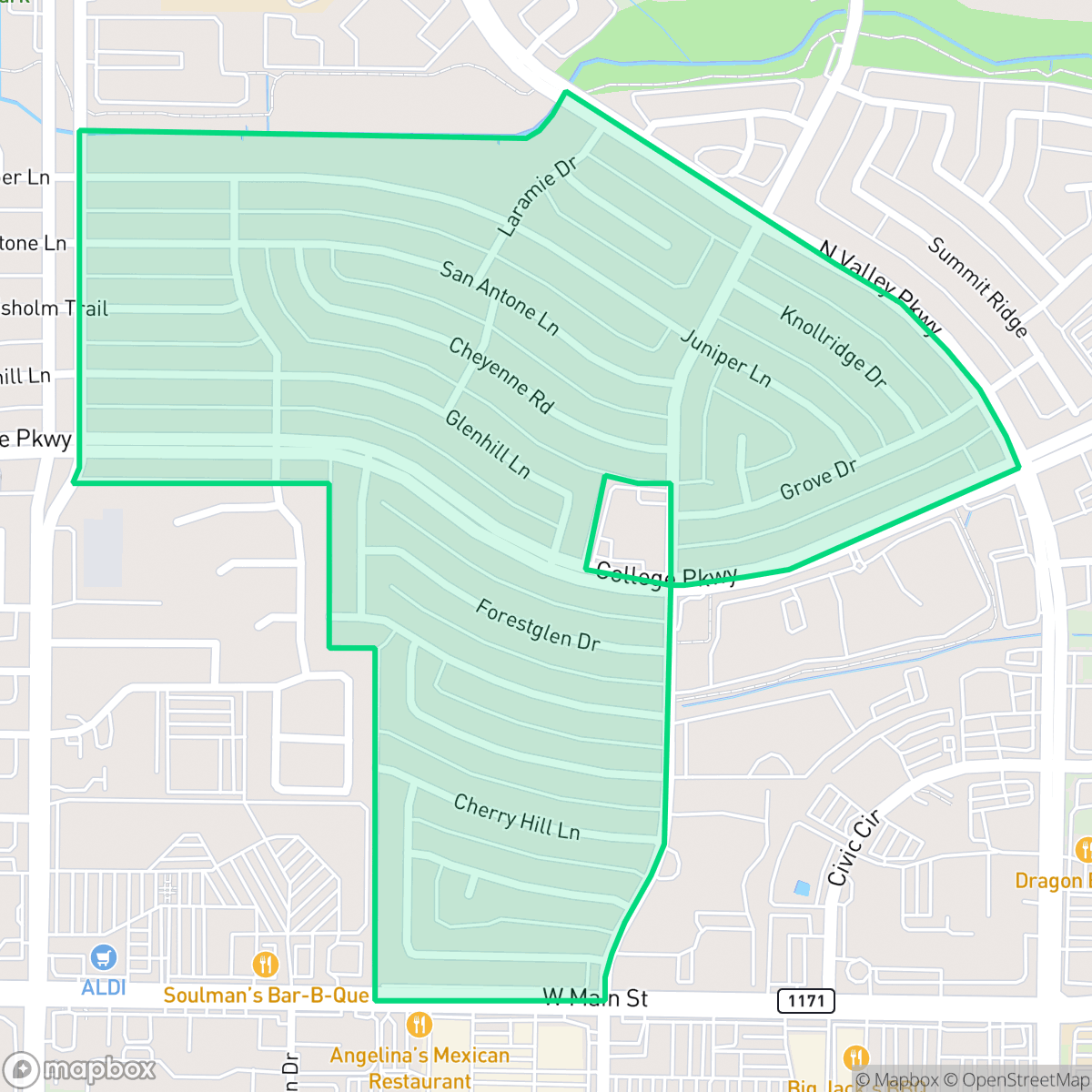
Lewisville Valley is a well-established suburban community known for its mature tree-lined streets and proximity to local dining and community landmarks like L.L. Woods Park. The area offers high walkability and strong health insurance coverage, though residents should expect a dense suburban layout with limited privacy between neighboring homes and noticeable road traffic noise.
Key Highlights
About Lewisville Valley
The Lewisville Valley neighborhood, originally developed as the Lewisville Valley Addition, represents a pivotal chapter in the city's westward expansion. In the late 1960s, Hunt Properties purchased and annexed more than 2,500 acres of land for the development, which officially joined the city in 1969. This major annexation, combined with the 1968 opening of Lewisville High School nearby on Valley Parkway, initiated a significant population shift from east to west. Developed primarily between 1972 and 1993, the neighborhood is characterized by established single-family homes and mature tree-lined streets. Today, it remains a stable residential hub anchored by local community spaces like L.L. Woods Park.
The neighborhood functions as a central residential hub within Lewisville, balancing a dense, classic suburban layout with access to essential services and local eateries. It benefits from a high degree of connectivity, featuring consistent sidewalk infrastructure that supports pedestrian movement throughout the area. Residents enjoy a stable environment supported by the Lewisville Independent School District, which provides robust educational opportunities for families, alongside a diverse local commercial landscape that includes popular restaurants and community-focused institutions.
Prospective residents should consider the trade-offs inherent in this established suburban setting. The high-density design results in closer proximity to neighbors and limited private outdoor space, while the acoustic environment is influenced by consistent road traffic. While the area is well-suited for those prioritizing school district access and neighborhood stability, it may be less ideal for those seeking high levels of privacy or a quiet, rural atmosphere.
Neighborhood Scores Across 15 Qualities
Housing density is consistent with the Lewisville average, featuring a suburban layout where homes are separated by small yards and shared fences. According to iHuus data, neighbors are positioned at moderate distances with varying levels of buffering between properties.
Pedestrian infrastructure is robust, featuring continuous sidewalks on both sides of streets and dedicated pathways through green spaces. This level of accessibility for walkers is slightly above the Lewisville average.
Residential scenery ranges from large, affluent estates with private pools to more uniform, tightly spaced tract housing. Overall visual appeal remains slightly below the Lewisville city average according to iHuus data.
Walking trails and greenbelts throughout the area provide good opportunities for pet owners, though some residential clusters have less access to public parks than the Lewisville average. According to iHuus data, wide grassy buffers and sidewalk verges offer relatively safe routes for exercise.
Open land and woodlands are interspersed with scattered homes, providing a setting that is slightly less dense than the average Lewisville area. According to iHuus data, the landscape maintains a balance between natural spaces and suburban development.
A mix of quiet green spaces and active dining pockets creates a more vibrant atmosphere than the typical Lewisville suburb. Residents can access a diverse selection of local restaurants and parks within a setting that balances suburban tranquility with accessible amenities.
Steady traffic sounds from a nearby busy street are present; however, acoustic levels are notably more tranquil than the Lewisville average according to iHuus data.
Air quality in this area fluctuates between acceptable and unhealthy levels, presenting occasional concerns for sensitive groups. This pattern of air quality is consistent with the broader Lewisville area, according to iHuus data.
Residential life here remains undisturbed by heavy industry or hazardous warehouses, as the area contains only light commercial and residential structures. This lack of industrial proximity is notably higher than the Lewisville average, according to iHuus data.
Health insurance enrollment is notably higher here than the Lewisville average, according to iHuus data. Most residents in this area have access to comprehensive medical coverage.
Political leanings in this area are roughly evenly split between conservative and liberal perspectives; this represents a slightly more conservative tilt than the Lewisville average, according to iHuus data.
A balanced variety of young adults, families, and older residents characterizes this area. According to iHuus data, the age distribution is slightly more varied than the average found throughout Lewisville.
Flood risk levels in this area are roughly comparable to the city average, though official assessments remain incomplete due to a lack of detailed federal studies. Residents should remain cautious as current data does not provide a definitive flood hazard rating for this specific location.
Address-Level Insights for Lewisville Valley


iHuus Neighborhood Intelligence Insights
Get address-level neighborhood insights for Lewisville Valley
- Street-level scores — see how individual blocks compare, not just neighborhood averages
- Micro-zone boundaries — identify quiet pockets, flood boundaries, and walkable clusters before you visit
- 15 dimensions in full — walkability, noise, air quality, school quality, insurance coverage, population age profile, urban/rural index, and more
- Boundary risk alerts — know if your address sits near a block boundary where scores drop, the kind of detail no listing will ever mention
- School insights — individual school ratings and insights, not just district-level data
- Compare before you commit — side-by-side data across neighborhoods, down to block precision
No credit card required
Compare with Any Neighborhood
| Dimension | Lewisville Valley | Continental Square |
|---|---|---|
| 🚶 Walkabilityavg 8.36 | ||
| 🔊 Acoustic Comfortavg 3.34 | ||
| 🤫 Privacy Indexavg 5.34 | ||
| 🎨 Visual Appealavg 6.97 | ||
| 🐕 Dog Friendlinessavg 7.22 | ||
| 🗺️ Urban-Rural Indexavg 6.72 | ||
| ✨ Neighborhood Vibeavg 4.81 | ||
| 🏥 Health Insurance Coverageavg 7.22 | ||
| 🌿 Air Qualityavg 4 | ||
| 🏭 Industrial Proximityavg 8.19 | ||
| 🌊 Flood Safetyavg 4.45 | ||
| 🗳️ Ideological Leanavg 4.94 | ||
| 👥 Population Age Profileavg 4.55 | ||
| 🔥 Fire Safety | ||
| 🏫 School Quality |
Lewisville Valley Rankings
School Districts Serving Lewisville Valley
School Insights for Lewisville Valley
Below average outcomes; significant attendance and academic challenges.
School Insights
See what's really behind every school rating near Lewisville Valley
- Individual school ratings — each school's own score with outcome context, not just a district average
- Enrollment & class size data — student-to-teacher ratio and how it compares to the state average
- Full demographics breakdown — ethnicity and gender composition for every school in the enrollment zone
- Every school in the district — all schools within the enrollment boundary ranked by rating, not just the closest one
- Grade levels & benchmarks — elementary through high school, with below/above state-average flags
No credit card required