Willowbrook, Houston
Updated · 8,985 residents
Willowbrook is a high-density commercial and residential hub in northwest Houston defined by its extensive retail centers and industrial logistics zones. While the area offers diverse dining options and access to the Cypress-Fairbanks school district, residents should anticipate a car-dependent environment with notable road traffic noise.
Key Highlights
About Willowbrook
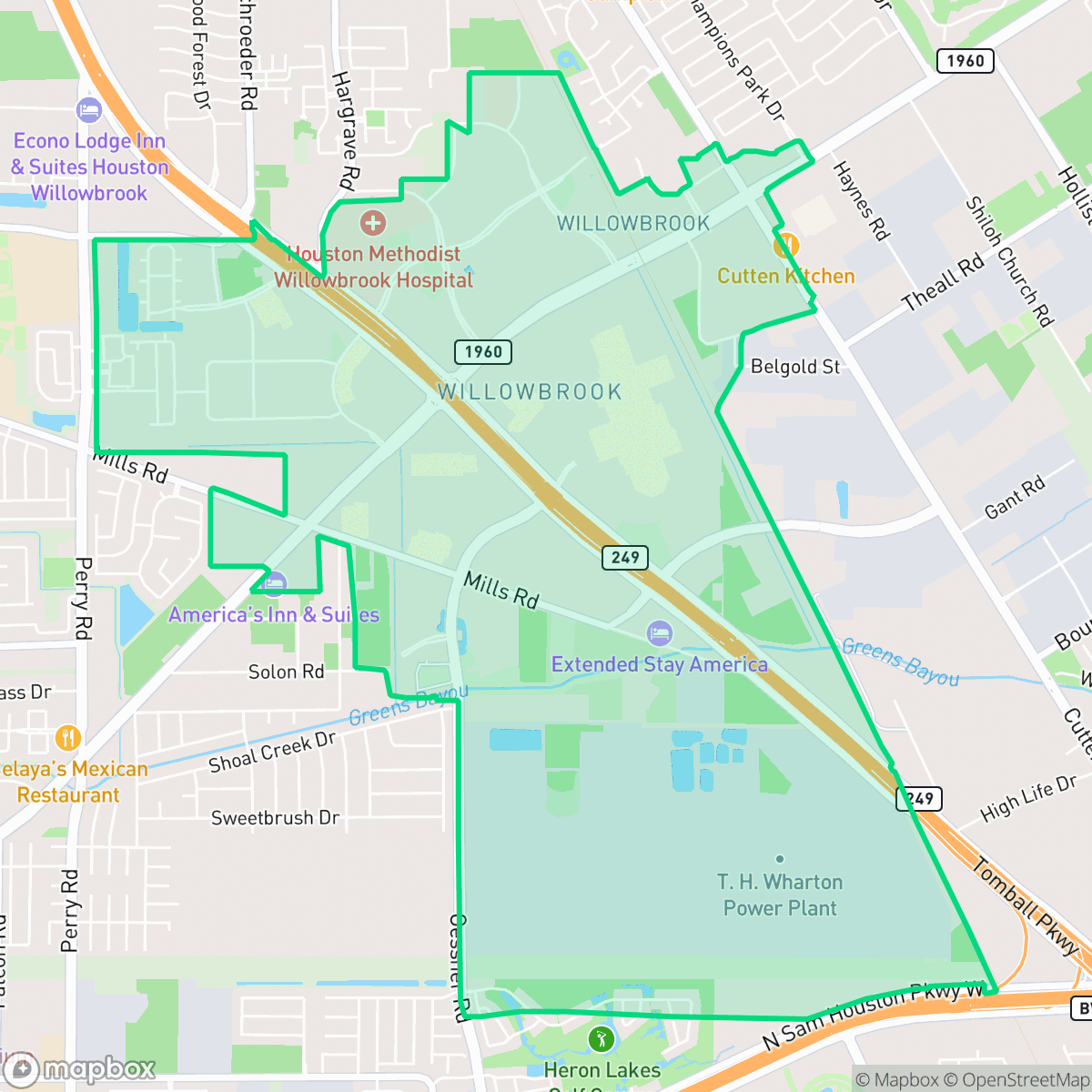
The Willowbrook neighborhood in northwest Houston developed rapidly during the late 1970s and 1980s, transforming from a wooded landscape into a major suburban commercial hub. The area's defining landmark is the Willowbrook Mall, which broke ground in 1979 and opened in 1981 at the intersection of State Highway 249 and FM 1960. Developed by the Homart Development Company, the 1.5-million-square-foot mall catalyzed surrounding residential and retail growth. Officially annexed by the City of Houston in 1993, Willowbrook is designated as Super Neighborhood #1. Today, its character remains defined by its high-density retail centers, the mall, and a major electric generating station, serving as a central economic anchor for northwest Houston.
The area serves as a primary economic anchor for northwest Houston, characterized by a dense mix of suburban housing, medical complexes, and large-scale industrial warehouses. The landscape is dominated by expansive grey infrastructure and major transit corridors, which contribute to a lively commercial atmosphere featuring a wide variety of dining options ranging from casual chains to established regional restaurants. According to iHuus data, the neighborhood maintains a balanced social profile, though the proximity to heavy logistics hubs and major highways creates a distinct industrial character that shapes the daily experience of those living here.
Living in this neighborhood requires a high reliance on personal vehicles, as the layout is significantly impacted by massive parking lots and arterial highway crossings that limit pedestrian mobility. Prospective residents should also consider the environmental trade-offs, including higher-than-average road noise levels and air quality concerns linked to the surrounding industrial activity. Despite these factors, the area remains a popular choice for families seeking access to the Cypress-Fairbanks Independent School District, which is widely recognized for its robust academic programs, as well as those who prioritize proximity to major employment centers and retail amenities.
Neighborhood Scores Across 15 Qualities
Housing layouts vary from closely spaced multi-family units to detached homes with wooded buffers. This level of residential density is roughly in line with the Houston average, according to iHuus data.
Residential streets are wide and shaded, offering a quiet environment for walking. However, significant pedestrian barriers like highway proximity and large parking lots make the area less walkable than the Houston average, according to iHuus data.
Spacious homes with private pools and manicured landscapes characterize many parts of the area, offering a visual quality slightly above the Houston average. According to iHuus data, the neighborhood features a mix of large residential estates and well-maintained professional campuses.
Abundant tree canopy, large backyards, and a centrally located park with walking paths offer reliable spaces for pet owners. According to iHuus data, the availability of green space and grassy verges is slightly below the Houston average.
Expansive industrial warehouses and logistics yards are interspersed with residential pockets and green spaces. This landscape presents a transitional character that is very similar to the broader Houston area.
Mixed-use pockets provide a consistent flow of dining and essential services, though much of the area remains car-dependent. This level of activity is slightly above the Houston average, offering a balance of quiet residential streets and accessible commercial hubs.
Local traffic from nearby busy streets creates a consistent level of sound. According to iHuus data, this noise level is slightly higher than the Houston average.
Unhealthy air quality levels occur frequently here, which is worse than the Houston average. According to iHuus data, residents in sensitive groups may face significant health risks due to frequent spikes in pollution.
Industrial presence is comparable to the Houston average, primarily consisting of light commercial zones and logistics hubs. While many areas are quiet and residential, certain pockets feature wastewater treatment facilities and large-scale distribution warehouses.
Health insurance enrollment among Willowbrook residents is higher than the Houston average, according to iHuus data.
Political leanings in Willowbrook are evenly split between conservative and liberal voters, representing a more moderate profile than the Houston average according to iHuus data.
Residents of all ages live here, reflecting a demographic spread that is slightly more balanced across age brackets than the Houston average, according to iHuus data.
Residual flood risk exists within this area as it sits partly within a 500-year floodplain. According to iHuus data, the flood safety levels are slightly above the Houston city average.
Address-Level Insights for Willowbrook


iHuus Neighborhood Intelligence Insights
Get address-level neighborhood insights for Willowbrook
- Street-level scores — see how individual blocks compare, not just neighborhood averages
- Micro-zone boundaries — identify quiet pockets, flood boundaries, and walkable clusters before you visit
- 15 dimensions in full — walkability, noise, air quality, school quality, insurance coverage, population age profile, urban/rural index, and more
- Boundary risk alerts — know if your address sits near a block boundary where scores drop, the kind of detail no listing will ever mention
- School insights — individual school ratings and insights, not just district-level data
- Compare before you commit — side-by-side data across neighborhoods, down to block precision
No credit card required
Compare with Any Neighborhood
| Dimension | Willowbrook | Acres Home |
|---|---|---|
| 🚶 Walkabilityavg 7.08 | ||
| 🔊 Acoustic Comfortavg 4.14 | ||
| 🤫 Privacy Indexavg 5.34 | ||
| 🎨 Visual Appealavg 6.42 | ||
| 🐕 Dog Friendlinessavg 6.33 | ||
| 🗺️ Urban-Rural Indexavg 6.64 | ||
| ✨ Neighborhood Vibeavg 4.4 | ||
| 🏥 Health Insurance Coverageavg 5.46 | ||
| 🌿 Air Qualityavg 3.58 | ||
| 🏭 Industrial Proximityavg 6.9 | ||
| 🌊 Flood Safetyavg 6.27 | ||
| 🗳️ Ideological Leanavg 6.39 | ||
| 👥 Population Age Profileavg 4.6 | ||
| 🔥 Fire Safety | ||
| 🏫 School Quality |
Willowbrook Rankings
School Districts Serving Willowbrook
School Insights for Willowbrook
Below average outcomes; significant attendance and academic challenges.
School Insights
See what's really behind every school rating near Willowbrook
- Individual school ratings — each school's own score with outcome context, not just a district average
- Enrollment & class size data — student-to-teacher ratio and how it compares to the state average
- Full demographics breakdown — ethnicity and gender composition for every school in the enrollment zone
- Every school in the district — all schools within the enrollment boundary ranked by rating, not just the closest one
- Grade levels & benchmarks — elementary through high school, with below/above state-average flags
No credit card required