Willow Meadows - Willowbend Area, Houston
Updated · 14,542 residents
The Willow Meadows and Willowbend Area is a quiet, car-dependent residential community known for its mid-century ranch homes and proximity to the Texas Medical Center. While residents enjoy access to significant green space and dog-friendly parks, the area experiences notable noise from nearby highway traffic.
Key Highlights
About Willow Meadows - Willowbend Area
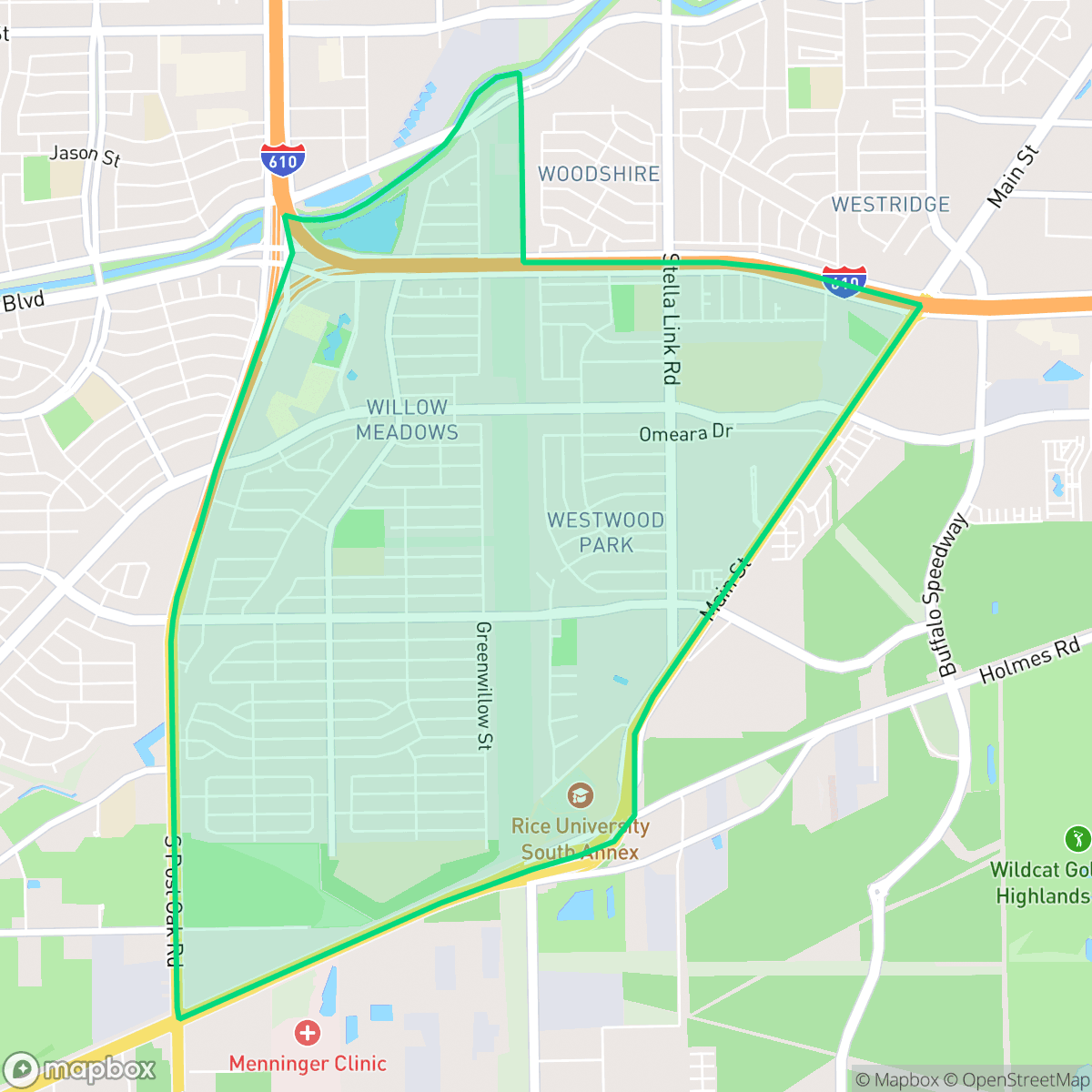
Developed in the 1950s during Houston’s post-war suburban boom, the Willow Meadows - Willowbend Area is a classic southwest Houston community defined by its mid-century architectural heritage. The neighborhood is characterized by tree-lined streets and spacious lots featuring single-story, red-brick ranch-style homes with low-pitched roofs and open floor plans. Geographically tied to local waterways, the area is bordered by Brays Bayou and intersected by Willow Creek, which flows into the nearby Willow Waterhole Bayou. A central educational landmark is Red Elementary School, which opened in 1957 and was named after pioneering Texas physician Dr. Samuel Clark Red. Today, the neighborhood maintains its distinct mid-century charm while offering close proximity to the Texas Medical Center.
The neighborhood offers a dense suburban environment that balances residential streets with light industrial and commercial infrastructure. Residents benefit from a consistent sidewalk network that facilitates local movement, though the presence of a major highway creates a significant pedestrian barrier and contributes to elevated noise levels. The area maintains a stable, albeit car-oriented, living experience with access to local dining and community churches, providing a calm atmosphere that contrasts with the bustle of central Houston.
Prospective residents should note that while the area provides excellent access to green spaces and is highly rated for dog friendliness, the environmental landscape includes proximity to industrial facilities and heavy traffic zones. According to iHuus data, the neighborhood is well-suited for those who prioritize established housing stock and proximity to the medical district over a high-energy nightlife. Families may consider the diverse educational landscape, which ranges from local elementary options to highly-rated charter schools, though they should be aware of the broader operational volatility currently affecting the Houston Independent School District.
Neighborhood Scores Across 15 Qualities
Residential spacing varies from shared-wall apartment complexes to detached homes with moderate yard buffers. This level of privacy is slightly higher than the Houston average, according to iHuus data.
Established sidewalks are available throughout residential zones and local parks, though large highways act as significant pedestrian barriers. According to iHuus data, the walkability of this area is roughly comparable to the Houston average.
Standard suburban housing and uniform rooflines define the landscape, offering slightly more visual variety than the Houston average. According to iHuus data, the area features a mix of tract-style homes and high-density apartments with shared amenities.
Extensive green spaces, including large sports fields and grassy utility corridors, offer ample room for pet exercise. According to iHuus data, these interconnected park areas and wide paths provide a level of dog friendliness that is higher than the Houston average.
Open land and forested patches are interspersed with suburban housing and industrial plots, offering a landscape that is slightly more open than the typical Houston urban core according to iHuus data.
Low-density suburban blocks and industrial zones create a subdued atmosphere with limited local activity. Most dining and essential services require a vehicle, as the area offers fewer walkable commercial hubs than the Houston average.
Frequent sounds from nearby freeways and railroad tracks characterize this area. According to iHuus data, acoustic comfort is lower than the Houston average due to this persistent proximity to major transit corridors.
Occasional periods of unhealthy air may occur, though conditions are slightly better than the Houston average according to iHuus data. Sensitive groups should remain aware of days when air quality levels pose a potential concern.
Varying levels of industrial activity exist near major highway interchanges, including logistics hubs and large warehouses that generate significant truck traffic. While many areas remain predominantly residential, some sections of the neighborhood are subject to the noise and activity associated with heavy equipment storage and commercial distribution centers.
Health insurance access is notably higher than the Houston average, according to iHuus data. This indicates a well-covered population with better access to medical services.
Political leanings in this area are more liberal than the Houston average, according to iHuus data. A liberal majority is present alongside a modest opposing presence.
Residents will find a balanced demographic spread of young adults, families, and older populations. This age distribution is slightly more varied than the average found across Houston, according to iHuus data.
Flood risk in this area is currently undetermined due to a lack of detailed federal studies, placing it slightly below the Houston average. Residents should exercise caution as official FEMA assessments for this specific zone are not yet complete.
Address-Level Insights for Willow Meadows - Willowbend Area


iHuus Neighborhood Intelligence Insights
Get address-level neighborhood insights for Willow Meadows - Willowbend Area
- Street-level scores — see how individual blocks compare, not just neighborhood averages
- Micro-zone boundaries — identify quiet pockets, flood boundaries, and walkable clusters before you visit
- 15 dimensions in full — walkability, noise, air quality, school quality, insurance coverage, population age profile, urban/rural index, and more
- Boundary risk alerts — know if your address sits near a block boundary where scores drop, the kind of detail no listing will ever mention
- School insights — individual school ratings and insights, not just district-level data
- Compare before you commit — side-by-side data across neighborhoods, down to block precision
No credit card required
Compare with Any Neighborhood
| Dimension | Willow Meadows - Willowbend Area | Acres Home |
|---|---|---|
| 🚶 Walkabilityavg 7.08 | ||
| 🔊 Acoustic Comfortavg 4.14 | ||
| 🤫 Privacy Indexavg 5.34 | ||
| 🎨 Visual Appealavg 6.42 | ||
| 🐕 Dog Friendlinessavg 6.33 | ||
| 🗺️ Urban-Rural Indexavg 6.64 | ||
| ✨ Neighborhood Vibeavg 4.4 | ||
| 🏥 Health Insurance Coverageavg 5.46 | ||
| 🌿 Air Qualityavg 3.58 | ||
| 🏭 Industrial Proximityavg 6.9 | ||
| 🌊 Flood Safetyavg 6.27 | ||
| 🗳️ Ideological Leanavg 6.39 | ||
| 👥 Population Age Profileavg 4.6 | ||
| 🔥 Fire Safety | ||
| 🏫 School Quality |
Willow Meadows - Willowbend Area Rankings
School Districts Serving Willow Meadows - Willowbend Area
School Insights for Willow Meadows - Willowbend Area
Below average outcomes; significant attendance and academic challenges.
School Insights
See what's really behind every school rating near Willow Meadows - Willowbend Area
- Individual school ratings — each school's own score with outcome context, not just a district average
- Enrollment & class size data — student-to-teacher ratio and how it compares to the state average
- Full demographics breakdown — ethnicity and gender composition for every school in the enrollment zone
- Every school in the district — all schools within the enrollment boundary ranked by rating, not just the closest one
- Grade levels & benchmarks — elementary through high school, with below/above state-average flags
No credit card required