Williamsburg Parish, Houston
Updated · 1,546 residents
Williamsburg Parish is a highly walkable residential community in the Greater Katy area known for its well-manicured streets and upscale aesthetic. According to iHuus data, the neighborhood provides excellent access to local pedestrian trails, though residents should expect persistent noise from nearby transit corridors.
Key Highlights
About Williamsburg Parish
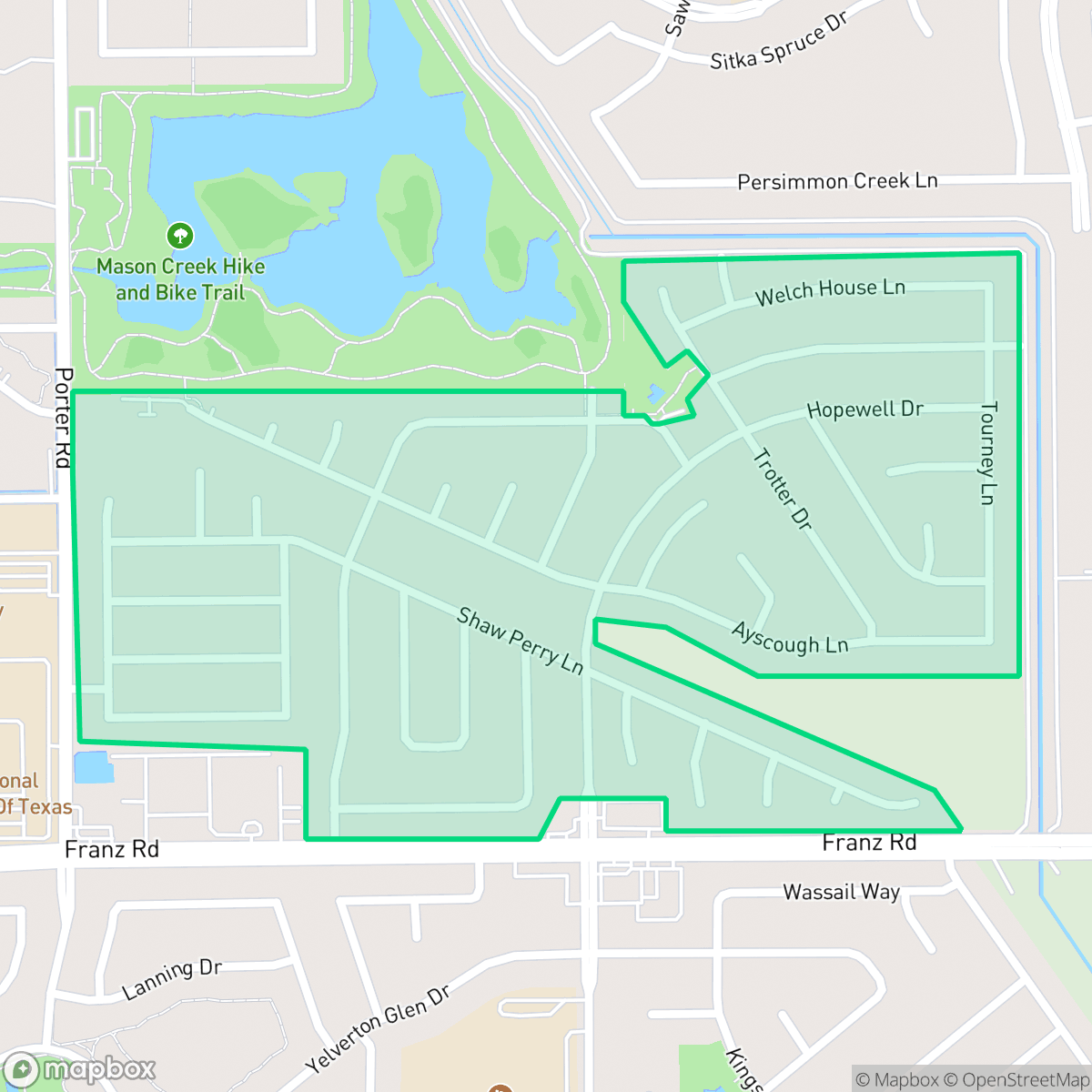
Williamsburg Parish is a residential subdivision in the Greater Katy area of unincorporated Harris County. Developed in the 1970s, it is part of a larger cluster of neighborhoods—including Williamsburg Settlement, Williamsburg Colony, and Williamsburg Hamlet—conceived by Houston developer Marvin Leggett. Leggett envisioned these communities as modern, master-planned residential areas designed to support the anticipated growth of the nearby Park Ten and the emerging Grand Parkway corridor. While the surrounding region reflects the older agricultural and railroad history of the Katy area, Williamsburg Parish serves as a representative example of the rapid suburban expansion that transformed the Houston periphery during the late 20th century. Today, the neighborhood is primarily defined by its mid-to-late 20th-century residential architecture and its integration into the local Katy Independent School District and the Mason Creek Hike and Bike Trail system.
The neighborhood is characterized by a polished visual appeal, featuring large homes with spacious driveways and private yards that contribute to a quiet, suburban atmosphere. It maintains a balanced demographic, attracting a mix of families, professionals, and retirees who benefit from the high-quality educational opportunities provided by the Katy Independent School District. The area features extensive sidewalk networks that make it one of the more pedestrian-friendly pockets in the region, complemented by access to the Mason Creek Hike and Bike Trail system.
Prospective residents should note that the area experiences significant auditory disturbances due to its proximity to major freeways and railroad tracks. While it is situated within a 500-year floodplain, the community generally offers better flood safety than the broader Houston average. The neighborhood is well-suited for those who prioritize aesthetic consistency, school district quality, and walkability, provided they are comfortable with the ambient noise levels inherent to this transit-adjacent location.
Neighborhood Scores Across 15 Qualities
Detached homes feature private yards with some buffering between properties, though spacing is slightly more compact than the Houston average according to iHuus data.
Extensive sidewalk networks and clear pedestrian crossings make navigating the area on foot easy. This level of accessibility is significantly higher than the Houston average according to iHuus data.
Large multi-gabled roofs, private pools, and well-maintained lawns create a highly aesthetic streetscape that is notably more visually polished than the Houston average. According to iHuus data, the area is characterized by spacious driveways and frequent upscale amenities.
Wide grass verges and accessible school fields provide ample space for exercise. According to iHuus data, the area offers significantly more pet-friendly terrain than the Houston average.
Residential layouts consist primarily of single-family homes and neighborhood amenities. This level of openness is roughly in line with the Houston average.
Locals experience a balanced urban environment that matches the city average for activity levels. The area features a mix of quiet suburban landscapes and light industrial units alongside a moderate selection of dining and services.
Persistent noise from nearby freeways and railroad tracks makes this area noisier than the Houston average. Residents can expect frequent auditory disturbances from heavy transit corridors, according to iHuus data.
Air quality levels in this area fluctuate between acceptable and unhealthy, though they remain slightly better than the Houston average according to iHuus data. Sensitive individuals should remain aware of occasional days with higher pollution concentrations.
Residential and institutional uses dominate the area, which features a lower presence of industrial structures than the Houston average. According to iHuus data, the landscape is characterized by residential life and occasional light commercial activity rather than heavy warehouses or machinery.
Health insurance access is significantly higher than the Houston average. According to iHuus data, a large majority of residents in this area maintain active coverage.
Political leanings in this area are split relatively evenly between conservative and liberal perspectives. This landscape is notably more balanced than the more liberal-leaning average seen across Houston, according to iHuus data.
Residents live alongside a balanced mix of young professionals, families, and seniors. This demographic distribution is largely in line with the average seen across Houston.
Flood risk is present due to being located within a 500-year floodplain, though this level of safety is higher than the Houston city average according to iHuus data.
Address-Level Insights for Williamsburg Parish


iHuus Neighborhood Intelligence Insights
Get address-level neighborhood insights for Williamsburg Parish
- Street-level scores — see how individual blocks compare, not just neighborhood averages
- Micro-zone boundaries — identify quiet pockets, flood boundaries, and walkable clusters before you visit
- 15 dimensions in full — walkability, noise, air quality, school quality, insurance coverage, population age profile, urban/rural index, and more
- Boundary risk alerts — know if your address sits near a block boundary where scores drop, the kind of detail no listing will ever mention
- School insights — individual school ratings and insights, not just district-level data
- Compare before you commit — side-by-side data across neighborhoods, down to block precision
No credit card required
Compare with Any Neighborhood
| Dimension | Williamsburg Parish | Acres Home |
|---|---|---|
| 🚶 Walkabilityavg 7.08 | ||
| 🔊 Acoustic Comfortavg 4.14 | ||
| 🤫 Privacy Indexavg 5.34 | ||
| 🎨 Visual Appealavg 6.42 | ||
| 🐕 Dog Friendlinessavg 6.33 | ||
| 🗺️ Urban-Rural Indexavg 6.64 | ||
| ✨ Neighborhood Vibeavg 4.4 | ||
| 🏥 Health Insurance Coverageavg 5.46 | ||
| 🌿 Air Qualityavg 3.58 | ||
| 🏭 Industrial Proximityavg 6.9 | ||
| 🌊 Flood Safetyavg 6.27 | ||
| 🗳️ Ideological Leanavg 6.39 | ||
| 👥 Population Age Profileavg 4.6 | ||
| 🔥 Fire Safety | ||
| 🏫 School Quality |
Williamsburg Parish Rankings
School Districts Serving Williamsburg Parish
School Insights for Williamsburg Parish
Below average outcomes; significant attendance and academic challenges.
School Insights
See what's really behind every school rating near Williamsburg Parish
- Individual school ratings — each school's own score with outcome context, not just a district average
- Enrollment & class size data — student-to-teacher ratio and how it compares to the state average
- Full demographics breakdown — ethnicity and gender composition for every school in the enrollment zone
- Every school in the district — all schools within the enrollment boundary ranked by rating, not just the closest one
- Grade levels & benchmarks — elementary through high school, with below/above state-average flags
No credit card required