Washington Avenue Coalition - Memorial Park, Houston
Updated · 30,871 residents
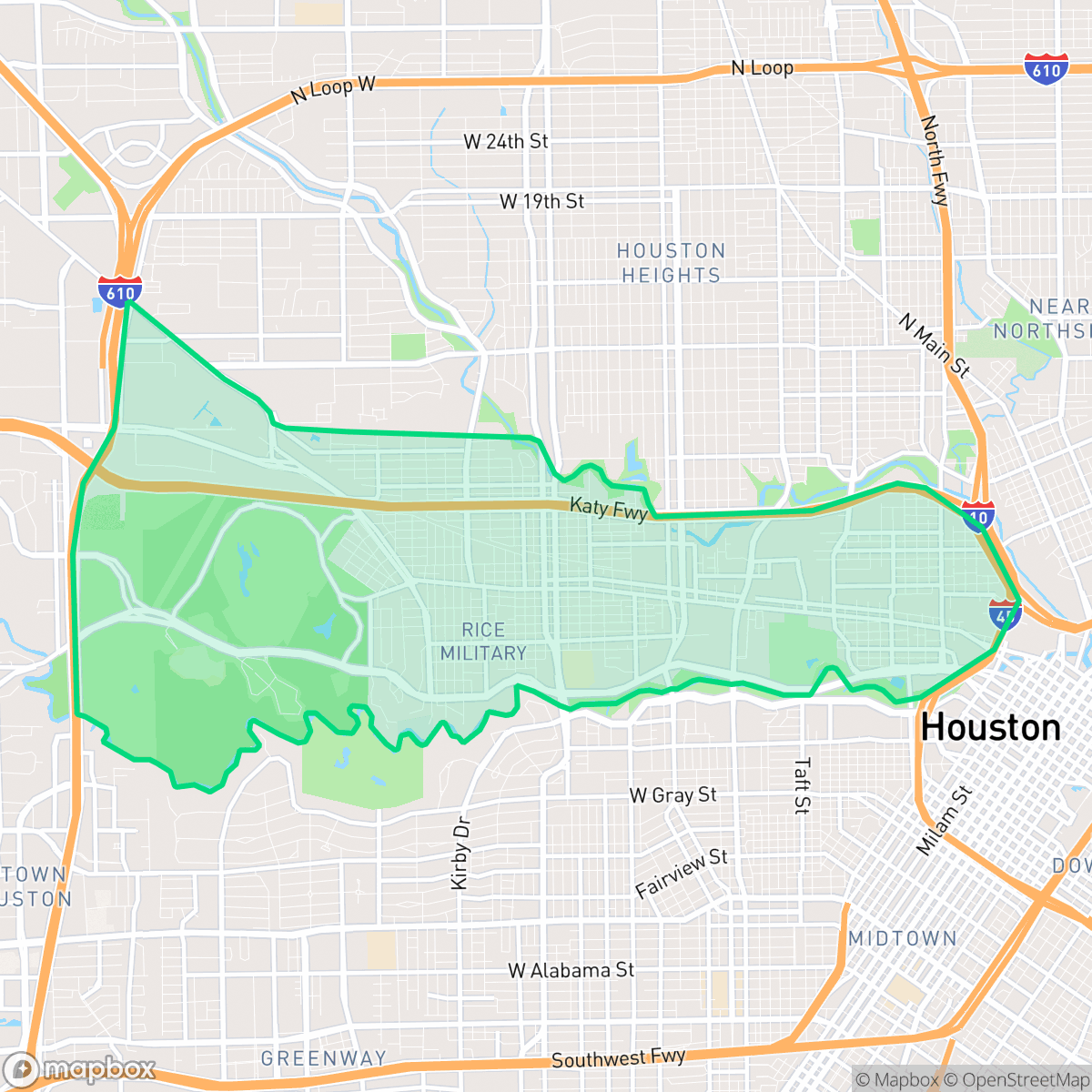
Washington Avenue Coalition - Memorial Park is a dense, high-energy urban district defined by its proximity to the expansive Memorial Park and a blend of modern townhomes and historic architecture. While the area offers high walkability and excellent access to local dining, residents face significant noise from road traffic and limited privacy due to the high-density housing layout.
Key Highlights
About Washington Avenue Coalition - Memorial Park
The Washington Avenue Coalition - Memorial Park super neighborhood in Houston bridges 19th-century history with rapid modern redevelopment. Its western edge is anchored by the 1,500-acre Memorial Park, established in 1924 on the former grounds of Camp Logan, a World War I U.S. Army training camp. The area is also home to two historic 19th-century resting places: Glenwood Cemetery, founded in 1871, and Olivewood Cemetery, established in 1875 as Houston’s first cemetery for the African American community. On the neighborhood's eastern end, the historic First and Sixth Wards feature some of the city's finest Victorian-era architecture. Over the late 20th and early 21st centuries, the corridor transitioned from a primarily industrial and working-class district into a vibrant arts enclave and a bustling, high-density residential and commercial hub.
The area functions as a central hub for Houston residents seeking proximity to both nature and the city's nightlife. It is characterized by a mix of luxury townhomes, multi-family complexes, and restored Victorian-era homes, creating a diverse visual landscape that transitions from industrial roots to modern urban living. The presence of the expansive Memorial Park provides residents with significant green space for recreation, while the neighborhood's grid layout and consistent sidewalk network contribute to its high walkability. According to iHuus data, the area maintains a distinct urban-suburban balance, drawing those who prioritize connectivity to central commercial corridors.
Prospective residents should be aware of the trade-offs associated with this high-density environment. The neighborhood experiences elevated noise levels, primarily due to road traffic from nearby major highways and arterial roads, and the prevalence of shared-wall construction results in limited private outdoor space. While the area is well-served by high-performing elementary schools like Crockett and Memorial, the broader Houston Independent School District faces ongoing institutional challenges. This neighborhood is best suited for professionals and active individuals who prioritize accessibility to city amenities and outdoor recreation over traditional suburban privacy.
Neighborhood Scores Across 15 Qualities
Dense townhome and apartment construction creates minimal separation between units, resulting in lower privacy levels than the Houston average. According to iHuus data, many residences feature shared walls or very narrow gaps between structures.
Pedestrian movement is supported by a consistent sidewalk network and interconnected park paths, making the area slightly more walkable than the Houston average. While the urban grid offers high connectivity, large highways and rail lines can occasionally disrupt continuous walking routes.
Upscale amenities and luxury townhomes characterize the area, offering a more polished aesthetic than the Houston average. According to iHuus data, the landscape features a mix of high-density modern developments and larger estates with private pools.
Access to the Buffalo Bayou trails and nearby riverside green spaces provides superior walking conditions for pets compared to the city average. While some dense urban pockets have limited public grass, the neighborhood features significant parkland and connected green corridors.
Residential clusters and multi-story apartments exist alongside significant commercial and industrial warehouses. This balance of built environments is slightly less dense than the Houston average, according to iHuus data.
Diverse dining and social hubs create a more active atmosphere than the city average, though pockets of quiet, industrial, and suburban blocks are interspersed with high-energy urban areas. Depending on the specific block, residents may experience anything from vibrant, walkable streets to more car-dependent, serene settings.
Frequent noise from nearby freeway and railroad activity is common in this area. According to iHuus data, acoustic comfort levels are lower than the Houston average.
Air quality levels fluctuate between acceptable and unhealthy conditions, though they remain slightly better than the Houston city average according to iHuus data. Sensitive groups may experience occasional concern during certain periods.
Residential and light commercial uses dominate the area, though proximity to a freight rail line and nearby warehouses may cause intermittent noise. According to iHuus data, the neighborhood is notably better positioned than the Houston average regarding heavy industrial exposure.
Health insurance access is significantly higher in this area than the Houston average, according to iHuus data. Residents benefit from much broader coverage rates compared to most of the city.
Political leanings in this area lean toward liberal values, representing a more progressive tilt than the Houston average according to iHuus data.
Residents experience a balanced mix of young professionals, families, and older adults. According to iHuus data, this demographic distribution is very similar to the broader Houston area.
Residual flood risk exists due to the area being located within a 500-year floodplain, though safety levels are slightly higher than the Houston average according to iHuus data.
Address-Level Insights for Washington Avenue Coalition - Memorial Park


iHuus Neighborhood Intelligence Insights
Get address-level neighborhood insights for Washington Avenue Coalition - Memorial Park
- Street-level scores — see how individual blocks compare, not just neighborhood averages
- Micro-zone boundaries — identify quiet pockets, flood boundaries, and walkable clusters before you visit
- 15 dimensions in full — walkability, noise, air quality, school quality, insurance coverage, population age profile, urban/rural index, and more
- Boundary risk alerts — know if your address sits near a block boundary where scores drop, the kind of detail no listing will ever mention
- School insights — individual school ratings and insights, not just district-level data
- Compare before you commit — side-by-side data across neighborhoods, down to block precision
No credit card required
Compare with Any Neighborhood
| Dimension | Washington Avenue Coalition - Memorial Park | Acres Home |
|---|---|---|
| 🚶 Walkabilityavg 7.08 | ||
| 🔊 Acoustic Comfortavg 4.14 | ||
| 🤫 Privacy Indexavg 5.34 | ||
| 🎨 Visual Appealavg 6.42 | ||
| 🐕 Dog Friendlinessavg 6.33 | ||
| 🗺️ Urban-Rural Indexavg 6.64 | ||
| ✨ Neighborhood Vibeavg 4.4 | ||
| 🏥 Health Insurance Coverageavg 5.46 | ||
| 🌿 Air Qualityavg 3.58 | ||
| 🏭 Industrial Proximityavg 6.9 | ||
| 🌊 Flood Safetyavg 6.27 | ||
| 🗳️ Ideological Leanavg 6.39 | ||
| 👥 Population Age Profileavg 4.6 | ||
| 🔥 Fire Safety | ||
| 🏫 School Quality |
Washington Avenue Coalition - Memorial Park Rankings
School Districts Serving Washington Avenue Coalition - Memorial Park
School Insights for Washington Avenue Coalition - Memorial Park
Below average outcomes; significant attendance and academic challenges.
School Insights
See what's really behind every school rating near Washington Avenue Coalition - Memorial Park
- Individual school ratings — each school's own score with outcome context, not just a district average
- Enrollment & class size data — student-to-teacher ratio and how it compares to the state average
- Full demographics breakdown — ethnicity and gender composition for every school in the enrollment zone
- Every school in the district — all schools within the enrollment boundary ranked by rating, not just the closest one
- Grade levels & benchmarks — elementary through high school, with below/above state-average flags
No credit card required