University Place, Houston
Updated · 19,389 residents
University Place is a highly walkable neighborhood defined by its upscale, manicured aesthetic and proximity to Rice University. Residents enjoy a lively atmosphere with diverse dining options and easy access to greenways, though they should expect consistent traffic noise from nearby thoroughfares.
Key Highlights
About University Place
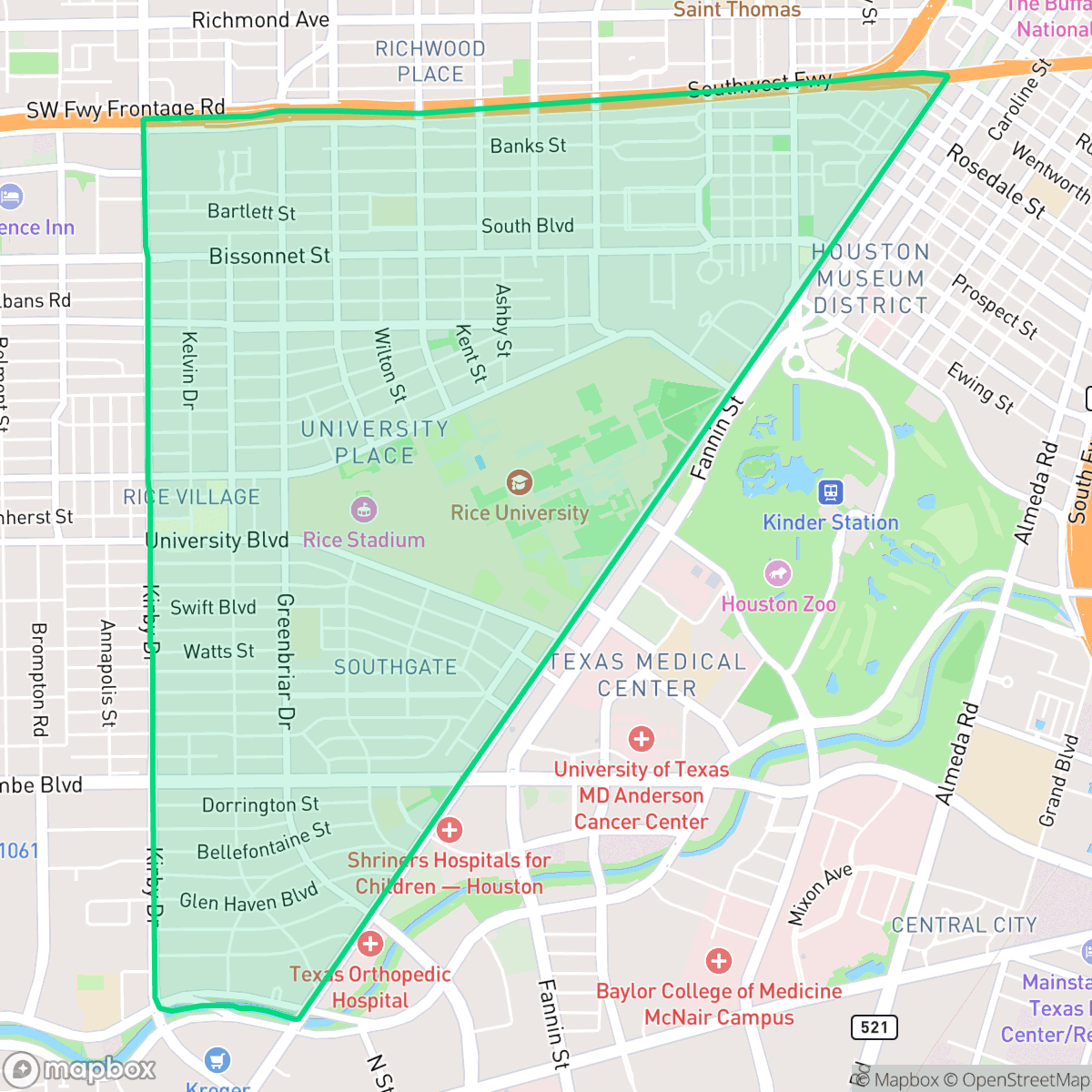
University Place is a Houston Super Neighborhood encompassing several historic residential areas, including Boulevard Oaks, Southampton, and Old Braeswood, all surrounding the campus of Rice University. Established as Houston’s first Super Neighborhood in 2000, the area is defined by its 1920s and 1930s residential architecture and iconic tree-lined esplanades, such as North and South Boulevards. The neighborhood’s character is deeply influenced by its proximity to Rice University, which opened in 1912, and the nearby Museum District. Known for its deed-restricted, affluent enclaves and the popular Rice Village shopping district, the area reflects the early 20th-century development of Houston’s Inner Loop, balancing historic preservation with its role as an intellectual and cultural gateway to the city.
The area functions as an intellectual and social hub, characterized by a balanced mix of residential streets and active commercial corridors. With extensive sidewalk networks and a strong focus on pedestrian access, it offers a level of convenience that exceeds the typical Houston experience. The visual landscape is defined by lush, mature landscaping and a blend of custom estates and mid-rise housing, creating a polished environment that appeals to a wide demographic of young professionals and families. According to iHuus data, the neighborhood maintains a notably vibrant social scene with concentrated dining and cultural options.
While the neighborhood offers significant benefits, prospective residents should consider specific trade-offs. The area experiences steady background noise from surrounding traffic, and some portions remain within a 500-year floodplain. Although the local environment is largely free of heavy industry, there is a nearby Superfund site that warrants awareness for those researching environmental factors. Additionally, while the neighborhood is served by the Houston Independent School District, the district remains a volatile entity with significant operational challenges, despite the presence of high-performing magnet programs.
Neighborhood Scores Across 15 Qualities
Residential spacing varies from tightly packed townhomes to detached houses with mature tree buffers. This level of privacy is roughly in line with the Houston average.
Extensive sidewalk networks and pedestrian-oriented layouts make navigating this area on foot much easier than the Houston average. While some major highways create physical barriers, the residential grid and park connections provide many safe, continuous walking paths.
Large custom estates, private pools, and lush, mature landscaping characterize this area. According to iHuus data, the visual quality of the neighborhood sits well above the Houston average.
Access to the Buffalo Bayou greenbelt and various residential greenways provides more recreational space for pets than the Houston average. Shaded paths and wide grassy verges offer safe, continuous routes for exercise throughout the area.
Residential streets and green spaces are found in roughly equal measure here. This layout offers a slightly less urban feel than the Houston average, characterized by a blend of tree-covered estates and mid-rise apartment complexes.
Social activity and local dining options are much more concentrated here than in the average Houston neighborhood. While some areas remain car-dependent, many blocks feature a diverse mix of steady social hubs, galleries, and dining establishments.
Ongoing traffic sounds from nearby busy thoroughfares create a consistent hum throughout the area. According to iHuus data, acoustic comfort in this neighborhood is slightly below the Houston average.
Air quality levels here fluctuate between acceptable and unhealthy, presenting occasional concerns for sensitive groups. According to iHuus data, the air quality in University Place is better than the Houston city average.
Primarily residential and commercial, this area is notably free of heavy industry, warehouses, or industrial hazards compared to the Houston average. While most of the neighborhood is devoid of large-scale industrial facilities, iHuus data indicates a nearby Superfund site that may present environmental considerations.
Health insurance enrollment among residents is significantly higher than the Houston average, according to iHuus data. This indicates a well-covered population with greater access to medical services.
Political leanings in this area are notably more liberal than the Houston average, according to iHuus data.
Residents live alongside a balanced mix of young adults, families, and older populations. According to iHuus data, this demographic spread is slightly more varied than the Houston average.
Flood risk is slightly higher than the Houston average because parts of the area sit within a 500-year floodplain. Residents should be aware of some residual flood risk according to iHuus data.
Address-Level Insights for University Place


iHuus Neighborhood Intelligence Insights
Get address-level neighborhood insights for University Place
- Street-level scores — see how individual blocks compare, not just neighborhood averages
- Micro-zone boundaries — identify quiet pockets, flood boundaries, and walkable clusters before you visit
- 15 dimensions in full — walkability, noise, air quality, school quality, insurance coverage, population age profile, urban/rural index, and more
- Boundary risk alerts — know if your address sits near a block boundary where scores drop, the kind of detail no listing will ever mention
- School insights — individual school ratings and insights, not just district-level data
- Compare before you commit — side-by-side data across neighborhoods, down to block precision
No credit card required
Compare with Any Neighborhood
| Dimension | University Place | Acres Home |
|---|---|---|
| 🚶 Walkabilityavg 7.08 | ||
| 🔊 Acoustic Comfortavg 4.14 | ||
| 🤫 Privacy Indexavg 5.34 | ||
| 🎨 Visual Appealavg 6.42 | ||
| 🐕 Dog Friendlinessavg 6.33 | ||
| 🗺️ Urban-Rural Indexavg 6.64 | ||
| ✨ Neighborhood Vibeavg 4.4 | ||
| 🏥 Health Insurance Coverageavg 5.46 | ||
| 🌿 Air Qualityavg 3.58 | ||
| 🏭 Industrial Proximityavg 6.9 | ||
| 🌊 Flood Safetyavg 6.27 | ||
| 🗳️ Ideological Leanavg 6.39 | ||
| 👥 Population Age Profileavg 4.6 | ||
| 🔥 Fire Safety | ||
| 🏫 School Quality |
University Place Rankings
School Districts Serving University Place
School Insights for University Place
Below average outcomes; significant attendance and academic challenges.
School Insights
See what's really behind every school rating near University Place
- Individual school ratings — each school's own score with outcome context, not just a district average
- Enrollment & class size data — student-to-teacher ratio and how it compares to the state average
- Full demographics breakdown — ethnicity and gender composition for every school in the enrollment zone
- Every school in the district — all schools within the enrollment boundary ranked by rating, not just the closest one
- Grade levels & benchmarks — elementary through high school, with below/above state-average flags
No credit card required