Timbergrove Manor, Houston
Updated · 4,077 residents
Timbergrove Manor is a quiet, mid-century residential enclave located inside the 610 Loop, defined by its mature pine trees and grid-based street layout. While the area offers moderate walkability and access to local green spaces like White Oak Bayou, residents experience a mix of suburban tranquility and occasional road noise. The neighborhood is characterized by its dense residential footprint and proximity to light industrial zones.
Key Highlights
About Timbergrove Manor
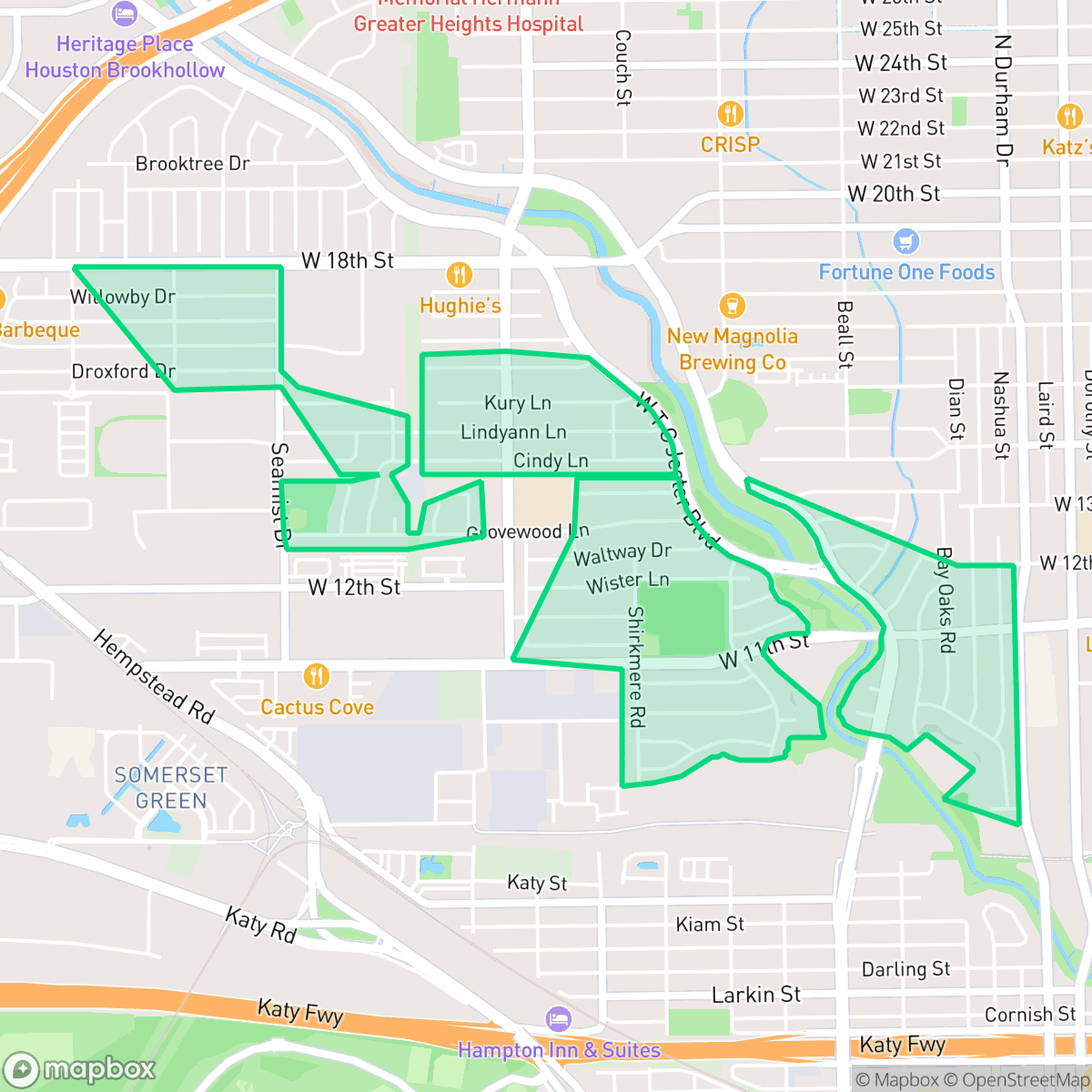
Originally settled by German-American farmers in the 1800s and later the site of the 1930s "Eureka" oil discovery, Timbergrove Manor in northwest Houston was developed starting in 1950. Envisioned by developers C.R. Brace, E.R. Carruth, and Alex Susholtz to accommodate the postwar housing boom, the neighborhood was named for its abundance of native pine trees. It is highly regarded for its uniform, mid-century ranch-style homes situated on spacious lots inside the 610 Loop. Key local landmarks include the scenic White Oak Bayou and the 20.2-acre West 11th Street Park, a preserved wilderness area once owned by the Hogg Foundation. Today, Timbergrove Manor retains its distinct suburban character, defined by its preserved mid-century architecture and lush, tree-lined streets.
The area maintains a distinct suburban atmosphere, characterized by its collection of mid-century ranch-style homes and established greenery. Residents benefit from a grid-based street network that supports moderate walkability, though connectivity can be inconsistent due to surrounding commercial and industrial blocks. Local amenities include a selection of casual dining options and proximity to the scenic White Oak Bayou, which serves as a primary recreational asset for the community. Prospective residents should note that the neighborhood functions as a dense residential environment where homes are situated in close proximity, resulting in limited privacy in some sections. While the area is generally quiet, road traffic contributes to a moderate noise level, and the presence of nearby warehouses occasionally introduces industrial activity. Families should also consider the current operational volatility within the Houston Independent School District, which oversees local public education, when evaluating long-term housing stability.
Neighborhood Scores Across 15 Qualities
Residential spacing is somewhat compressed, with some houses positioned closely together or sharing walls. According to iHuus data, this level of density is slightly higher than the Houston average.
Residential streets feature sidewalks on one side and safe crossings, though connectivity is occasionally interrupted by large commercial blocks. According to iHuus data, walking ease in this area is slightly below the Houston average.
Standard tract housing and apartment complexes define the landscape, featuring many small private backyard pools. This visual profile is consistent with the average for Houston.
Private fenced backyards are common throughout the area, though sidewalks offer limited green verges for walking pets. According to iHuus data, the availability of public park access and street-side greenery is slightly below the Houston average.
Residential areas feature a dense suburban landscape of single-family homes and apartments interspersed with large commercial structures. This level of development is consistent with the broader Houston area.
A tranquil, suburban atmosphere prevails here, though the area is below the city average for activity and relies heavily on vehicles for access to dining and services. Most amenities and dining options require driving, as the neighborhood features a mix of green space, light industrial units, and limited walkable commerce.
Steady traffic sounds from nearby thoroughfares are present, though the area remains slightly quieter than the Houston average according to iHuus data.
Air quality fluctuates between acceptable and unhealthy levels, though conditions are generally better than the Houston average according to iHuus data. Sensitive groups should remain aware of occasional days with higher pollutant concentrations.
Residential streets sit alongside active commercial zones and light industrial units. According to iHuus data, this level of industrial proximity is slightly lower than the Houston average.
Health insurance access is exceptionally high among residents, significantly outpacing the Houston average according to iHuus data.
Political leanings in this area are relatively evenly split between conservative and liberal perspectives, mirroring the broader political landscape of Houston.
Residents live alongside a balanced mix of young adults, families, and older individuals. This demographic variety is slightly more varied than the typical Houston age profile, according to iHuus data.
Flood risk levels in this area are difficult to precisely determine because official federal studies for the neighborhood are currently incomplete. According to iHuus data, the level of risk appears slightly higher than the average found across Houston.
Address-Level Insights for Timbergrove Manor


iHuus Neighborhood Intelligence Insights
Get address-level neighborhood insights for Timbergrove Manor
- Street-level scores — see how individual blocks compare, not just neighborhood averages
- Micro-zone boundaries — identify quiet pockets, flood boundaries, and walkable clusters before you visit
- 15 dimensions in full — walkability, noise, air quality, school quality, insurance coverage, population age profile, urban/rural index, and more
- Boundary risk alerts — know if your address sits near a block boundary where scores drop, the kind of detail no listing will ever mention
- School insights — individual school ratings and insights, not just district-level data
- Compare before you commit — side-by-side data across neighborhoods, down to block precision
No credit card required
Compare with Any Neighborhood
| Dimension | Timbergrove Manor | Acres Home |
|---|---|---|
| 🚶 Walkabilityavg 7.08 | ||
| 🔊 Acoustic Comfortavg 4.14 | ||
| 🤫 Privacy Indexavg 5.34 | ||
| 🎨 Visual Appealavg 6.42 | ||
| 🐕 Dog Friendlinessavg 6.33 | ||
| 🗺️ Urban-Rural Indexavg 6.64 | ||
| ✨ Neighborhood Vibeavg 4.4 | ||
| 🏥 Health Insurance Coverageavg 5.46 | ||
| 🌿 Air Qualityavg 3.58 | ||
| 🏭 Industrial Proximityavg 6.9 | ||
| 🌊 Flood Safetyavg 6.27 | ||
| 🗳️ Ideological Leanavg 6.39 | ||
| 👥 Population Age Profileavg 4.6 | ||
| 🔥 Fire Safety | ||
| 🏫 School Quality |
Timbergrove Manor Rankings
School Districts Serving Timbergrove Manor
School Insights for Timbergrove Manor
Below average outcomes; significant attendance and academic challenges.
School Insights
See what's really behind every school rating near Timbergrove Manor
- Individual school ratings — each school's own score with outcome context, not just a district average
- Enrollment & class size data — student-to-teacher ratio and how it compares to the state average
- Full demographics breakdown — ethnicity and gender composition for every school in the enrollment zone
- Every school in the district — all schools within the enrollment boundary ranked by rating, not just the closest one
- Grade levels & benchmarks — elementary through high school, with below/above state-average flags
No credit card required