Sunnyside, Houston
Updated · 23,769 residents
Sunnyside is a historically significant residential area in southern Houston characterized by a dense grid of modest tract housing and a mix of institutional and industrial spaces. While the neighborhood offers a calm, suburban environment with access to local social hubs and school fields, residents should expect a car-dependent lifestyle and proximity to logistics centers.
Key Highlights
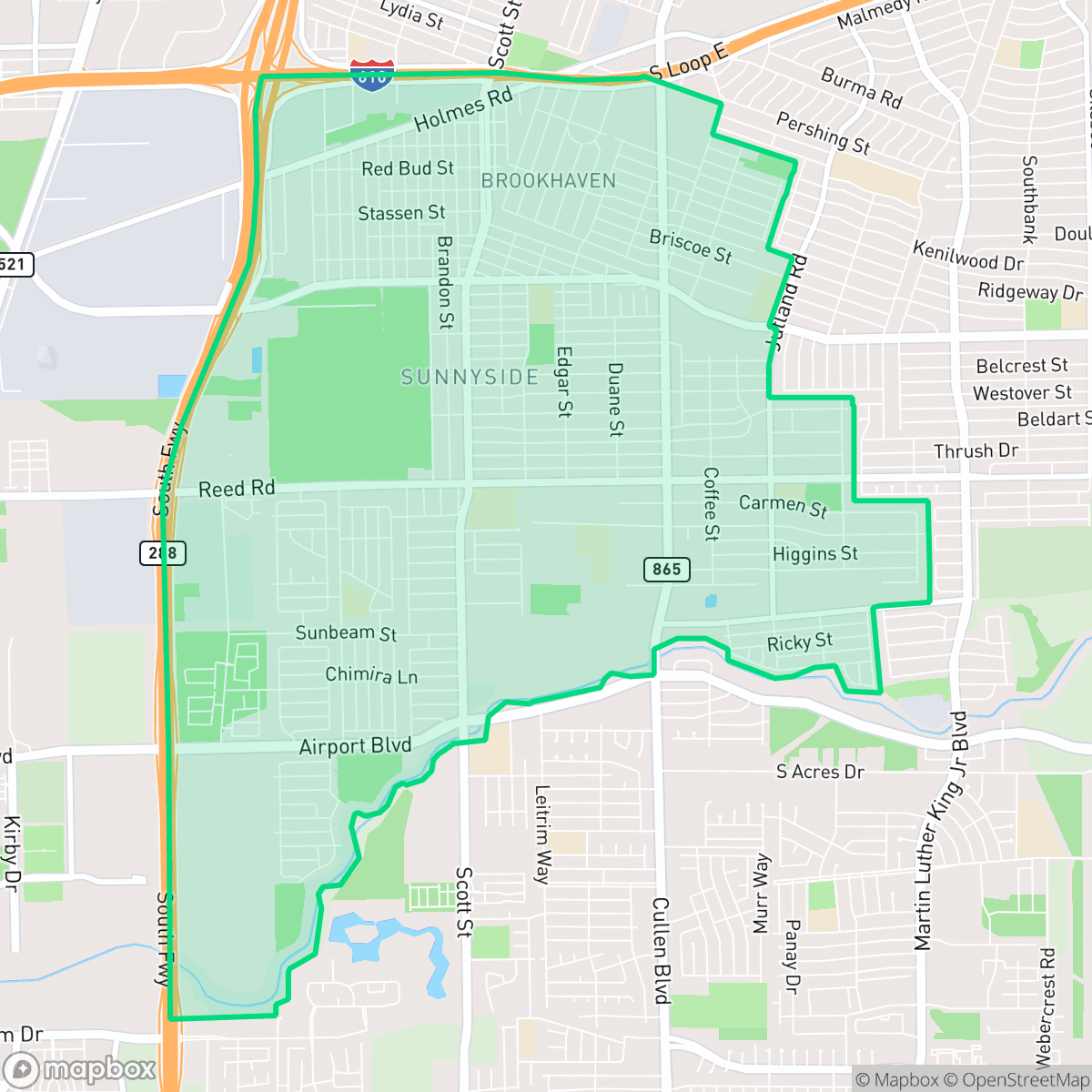
About Sunnyside
Platted in 1912 by developer H.H. Holmes, Sunnyside is the oldest African-American community in southern Houston. Originally established outside the city limits to offer spacious lots and a refuge from urban overcrowding, the neighborhood was annexed by Houston in 1956. During the 1970s and 1980s, Sunnyside’s thriving business corridor earned it nicknames like "Black Wall Street" and "Baby River Oaks". A prominent local landmark is the Cullen Clinic (now Poindexter Dental), a Historically Protected Landmark built by Dr. Zeb Poindexter Jr.—the first African American to graduate from the UT School of Dentistry. The building was designed by John S. Chase, the first licensed African-American architect in Texas. Additionally, the neighborhood hosted the historic Sky Ranch Flying Service, an airport established in 1946 by Tuskegee Airmen.
The area functions as a dense suburban landscape, defined by a grid of single-family homes and multi-family units interspersed with warehouse and industrial corridors. Its layout is primarily car-oriented, as the street network prioritizes transit routes over pedestrian infrastructure, though residents benefit from the presence of neighborhood churches and community-focused dining spots. The environment is relatively quiet in residential pockets, yet it remains influenced by nearby logistics operations and major transport arteries.
Prospective residents should be aware of the trade-offs regarding noise and air quality, as the proximity to industrial zones and highway traffic contributes to a higher-than-average acoustic footprint. While the neighborhood provides access to several local schools that maintain strong ratings, the broader school district faces ongoing organizational instability. The community is well-suited for those seeking an established residential area with a strong sense of local identity and proximity to major Houston thoroughfares, provided they are comfortable with a car-dependent daily routine.
Neighborhood Scores Across 15 Qualities
Residential spacing offers a moderate level of separation between neighbors, which is slightly higher than the Houston average. According to iHuus data, density varies from closely packed single-family homes to apartment buildings with less individual buffering.
Quiet, low-traffic streets make for pleasant walks, but many residential areas lack sidewalks or continuous pedestrian paths. This level of walkability is lower than the Houston average according to iHuus data.
Uniform tract housing and high-density apartment complexes define the skyline, offering less visual variety than the Houston average. Most properties feature modest yards and simple rooflines without significant private greenery or luxury amenities.
Green verges and nearby school fields offer decent space for walking pets, though overall access to public parkland is slightly below the Houston average. According to iHuus data, much of the neighborhood's greenery is concentrated in private backyards or wooded corner areas.
A diverse landscape of single-family homes and apartment complexes exists alongside large-scale industrial warehouses and transit infrastructure. This mix of low-density suburban pockets and heavy industrial corridors aligns with the average level of openness seen across Houston.
A steady rhythm of local social hubs and dining spots exists alongside industrial corridors, though the landscape is primarily car-dependent. This level of activity is slightly above the Houston average, providing a balanced mix of residential serenity and essential services.
A consistent level of noise from nearby busy streets is present, which is consistent with the average levels found across Houston.
Air quality in Sunnyside fluctuates between acceptable and unhealthy levels on certain days. According to iHuus data, conditions are slightly better than the Houston city average, though sensitive groups should remain cautious during periods of poor visibility.
Predominantly residential and light commercial, this area lacks heavy industrial hazards or large-scale warehouses. According to iHuus data, the neighborhood is slightly better positioned than the Houston average regarding proximity to industrial zones.
Access to health insurance is notably lower in this area compared to the Houston average, according to iHuus data.
Voting patterns and census indicators reflect a distinctly liberal political leaning that is significantly more pronounced than the Houston average, according to iHuus data.
Residents live alongside a balanced mix of young professionals, families, and seniors. According to iHuus data, the age distribution in Sunnyside is very similar to the broader Houston area.
Residual flood risk exists within this area as it sits partially within a 500-year floodplain. According to iHuus data, the level of safety is slightly higher than the Houston average.
Address-Level Insights for Sunnyside


iHuus Neighborhood Intelligence Insights
Get address-level neighborhood insights for Sunnyside
- Street-level scores — see how individual blocks compare, not just neighborhood averages
- Micro-zone boundaries — identify quiet pockets, flood boundaries, and walkable clusters before you visit
- 15 dimensions in full — walkability, noise, air quality, school quality, insurance coverage, population age profile, urban/rural index, and more
- Boundary risk alerts — know if your address sits near a block boundary where scores drop, the kind of detail no listing will ever mention
- School insights — individual school ratings and insights, not just district-level data
- Compare before you commit — side-by-side data across neighborhoods, down to block precision
No credit card required
Compare with Any Neighborhood
| Dimension | Sunnyside | Acres Home |
|---|---|---|
| 🚶 Walkabilityavg 7.08 | ||
| 🔊 Acoustic Comfortavg 4.14 | ||
| 🤫 Privacy Indexavg 5.34 | ||
| 🎨 Visual Appealavg 6.42 | ||
| 🐕 Dog Friendlinessavg 6.33 | ||
| 🗺️ Urban-Rural Indexavg 6.64 | ||
| ✨ Neighborhood Vibeavg 4.4 | ||
| 🏥 Health Insurance Coverageavg 5.46 | ||
| 🌿 Air Qualityavg 3.58 | ||
| 🏭 Industrial Proximityavg 6.9 | ||
| 🌊 Flood Safetyavg 6.27 | ||
| 🗳️ Ideological Leanavg 6.39 | ||
| 👥 Population Age Profileavg 4.6 | ||
| 🔥 Fire Safety | ||
| 🏫 School Quality |
Sunnyside Rankings
School Districts Serving Sunnyside
School Insights for Sunnyside
Below average outcomes; significant attendance and academic challenges.
School Insights
See what's really behind every school rating near Sunnyside
- Individual school ratings — each school's own score with outcome context, not just a district average
- Enrollment & class size data — student-to-teacher ratio and how it compares to the state average
- Full demographics breakdown — ethnicity and gender composition for every school in the enrollment zone
- Every school in the district — all schools within the enrollment boundary ranked by rating, not just the closest one
- Grade levels & benchmarks — elementary through high school, with below/above state-average flags
No credit card required