Spring Branch, Houston
Updated · 120,357 residents
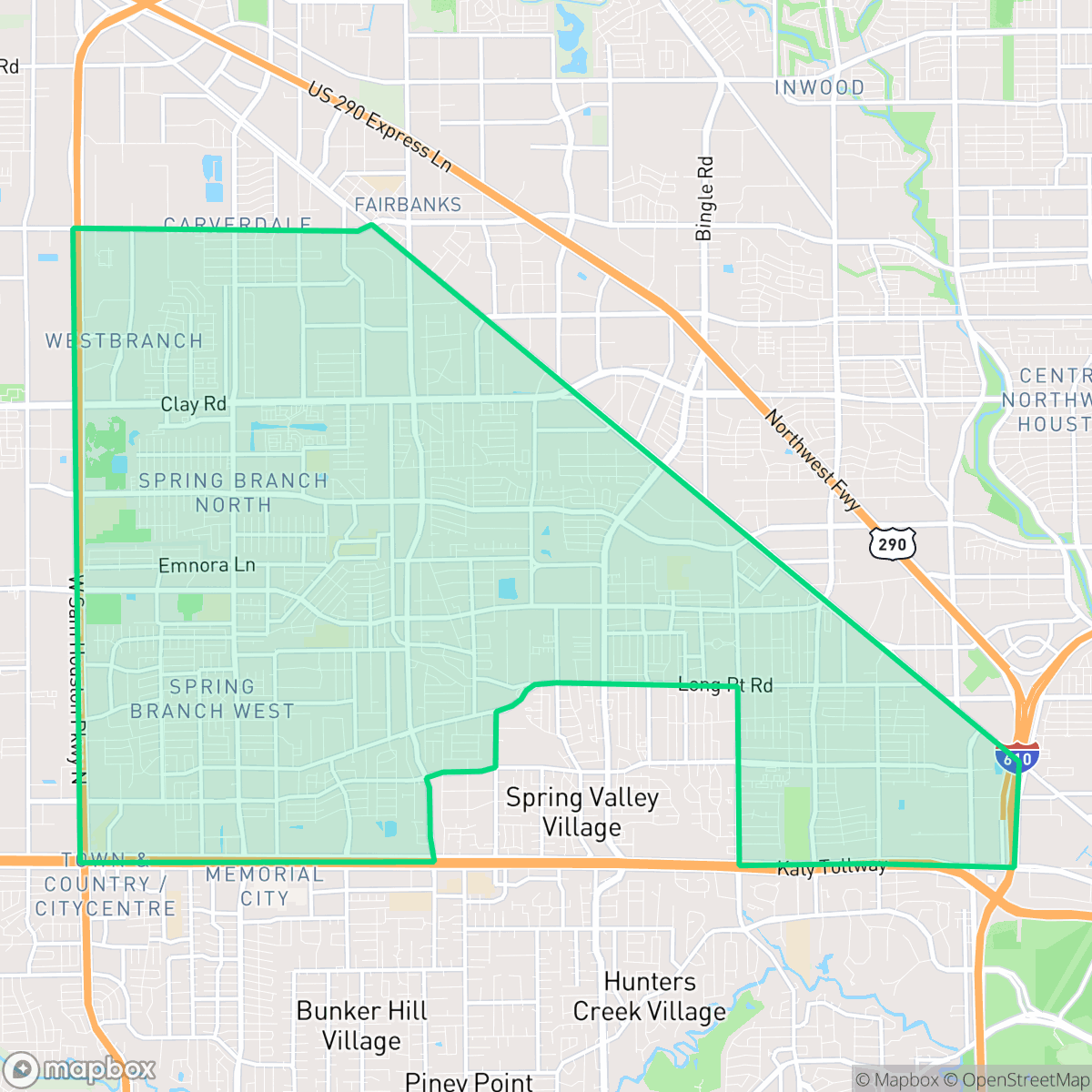
Spring Branch is a diverse, sprawling community in west-northwest Houston known for its multicultural culinary scene and a blend of mid-century suburban character and modern redevelopment. The area offers moderate walkability along its main corridors, though residential density varies significantly from tightly packed townhomes to spacious lots with mature tree cover.
Key Highlights
About Spring Branch
Established in the 1840s, Spring Branch in west-northwest Houston began as a rural settlement of German dairy farmers and sawmill operators, led by early pioneer Karl Kolbe. The community’s deep heritage is preserved in landmarks like the 1848 St. Peter’s United Church and the historic Hillendahl Cemetery, famously preserved within a modern shopping center parking lot. Many of the area's major thoroughfares—such as Gessner, Wirt, and Blalock roads—bear the names of these founding families. Following its annexation by Houston in the mid-20th century, Spring Branch transitioned from a rural suburb to a vibrant, multicultural hub. Today, the neighborhood is defined by its rich cultural diversity, notably featuring a bustling "Koreatown" and a thriving Hispanic community centered along Long Point Road.
The area functions as a dense suburban landscape where light industrial warehouses and commercial strips frequently intersect with residential pockets. Residents benefit from consistent sidewalk networks along major thoroughfares, though the neighborhood remains largely car-dependent for daily errands. The built environment is characterized by a mix of standard tract housing and newer multi-family developments, providing a range of living options that cater to a broad demographic. According to iHuus data, the visual appeal of the neighborhood is anchored by mature landscaping and a mix of roof geometries that reflect its mid-century origins and subsequent growth.
Prospective residents should consider the trade-offs between the established, quiet residential streets and the proximity to logistics hubs that generate localized truck traffic. While the neighborhood provides access to local parks and green verges, it is best suited for those who value a central location within Houston and a community that balances traditional suburban space with ongoing urban transition. The area maintains a consistent rhythm of life, though those sensitive to noise may prefer the quieter, lower-density sections located away from the primary freight corridors and major highways.
Neighborhood Scores Across 15 Qualities
Residential privacy varies throughout the area, ranging from tightly packed townhomes and apartments to detached houses with moderate buffers. This level of density is consistent with the average found across Houston.
Pedestrian movement is supported by established sidewalk networks and low-traffic residential streets, though connectivity is occasionally interrupted by large commercial blocks and industrial routes. While sidewalk availability is consistent in many areas, the overall ease of walking is slightly below the Houston average due to fragmented paths near major thoroughfares.
Manicured landscapes, large custom homes, and frequent private pools create an upscale aesthetic that is slightly above the Houston average. This visual character varies between affluent estates with mature greenery and more standard, high-density residential pockets.
Accessible walking space for pets varies by area, ranging from wide utility corridors and large sports parks to more restricted residential streets with narrow verges. Overall, opportunities for public dog walking are slightly below the Houston average.
A transition of residential pockets and apartment complexes sits alongside large-scale warehouses and industrial hubs. This landscape of suburban sprawl and logistics infrastructure is largely consistent with the Houston average.
A mix of light industrial units, green spaces, and diverse dining provides a consistent but quiet atmosphere. While many local eateries and social hubs are available, the area is largely car-dependent and aligns with the city average for activity levels.
A steady hum from nearby busy streets defines the acoustic environment. According to iHuus data, this level of ambient noise is slightly higher than the Houston city average.
Air quality fluctuates between acceptable and unhealthy levels, though conditions are slightly better than the Houston average according to iHuus data. Sensitive groups may experience occasional concern during periods of poor air quality.
Residential and light commercial uses predominate throughout most of the area, though some western and eastern sectors contain significant logistics hubs and warehouse activity. This level of industrial presence is slightly lower than the Houston average.
Health insurance access among residents is slightly lower than the Houston average, according to iHuus data.
Political leanings in this area are relatively balanced between conservative and liberal perspectives; this represents a more moderate ideological landscape than the broader Houston average, according to iHuus data.
Residents live alongside a balanced mix of young adults, families, and older individuals. This demographic spread is consistent with the average found across Houston.
Residual flood risk exists due to being located within a 500-year floodplain, though safety levels are slightly above the Houston average according to iHuus data.
Address-Level Insights for Spring Branch


iHuus Neighborhood Intelligence Insights
Get address-level neighborhood insights for Spring Branch
- Street-level scores — see how individual blocks compare, not just neighborhood averages
- Micro-zone boundaries — identify quiet pockets, flood boundaries, and walkable clusters before you visit
- 15 dimensions in full — walkability, noise, air quality, school quality, insurance coverage, population age profile, urban/rural index, and more
- Boundary risk alerts — know if your address sits near a block boundary where scores drop, the kind of detail no listing will ever mention
- School insights — individual school ratings and insights, not just district-level data
- Compare before you commit — side-by-side data across neighborhoods, down to block precision
No credit card required
Compare with Any Neighborhood
| Dimension | Spring Branch | Acres Home |
|---|---|---|
| 🚶 Walkabilityavg 7.08 | ||
| 🔊 Acoustic Comfortavg 4.14 | ||
| 🤫 Privacy Indexavg 5.34 | ||
| 🎨 Visual Appealavg 6.42 | ||
| 🐕 Dog Friendlinessavg 6.33 | ||
| 🗺️ Urban-Rural Indexavg 6.64 | ||
| ✨ Neighborhood Vibeavg 4.4 | ||
| 🏥 Health Insurance Coverageavg 5.46 | ||
| 🌿 Air Qualityavg 3.58 | ||
| 🏭 Industrial Proximityavg 6.9 | ||
| 🌊 Flood Safetyavg 6.27 | ||
| 🗳️ Ideological Leanavg 6.39 | ||
| 👥 Population Age Profileavg 4.6 | ||
| 🔥 Fire Safety | ||
| 🏫 School Quality |
Spring Branch Rankings
School Districts Serving Spring Branch
School Insights for Spring Branch
Below average outcomes; significant attendance and academic challenges.
School Insights
See what's really behind every school rating near Spring Branch
- Individual school ratings — each school's own score with outcome context, not just a district average
- Enrollment & class size data — student-to-teacher ratio and how it compares to the state average
- Full demographics breakdown — ethnicity and gender composition for every school in the enrollment zone
- Every school in the district — all schools within the enrollment boundary ranked by rating, not just the closest one
- Grade levels & benchmarks — elementary through high school, with below/above state-average flags
No credit card required