Spring Branch West, Houston
Updated · 35,577 residents
Spring Branch West is a culturally diverse community defined by its collection of mid-century ranch homes and proximity to the Addicks Reservoir. While the area offers a consistent street grid that supports moderate walkability, it maintains a suburban character that typically requires a vehicle for daily errands.
Key Highlights
About Spring Branch West
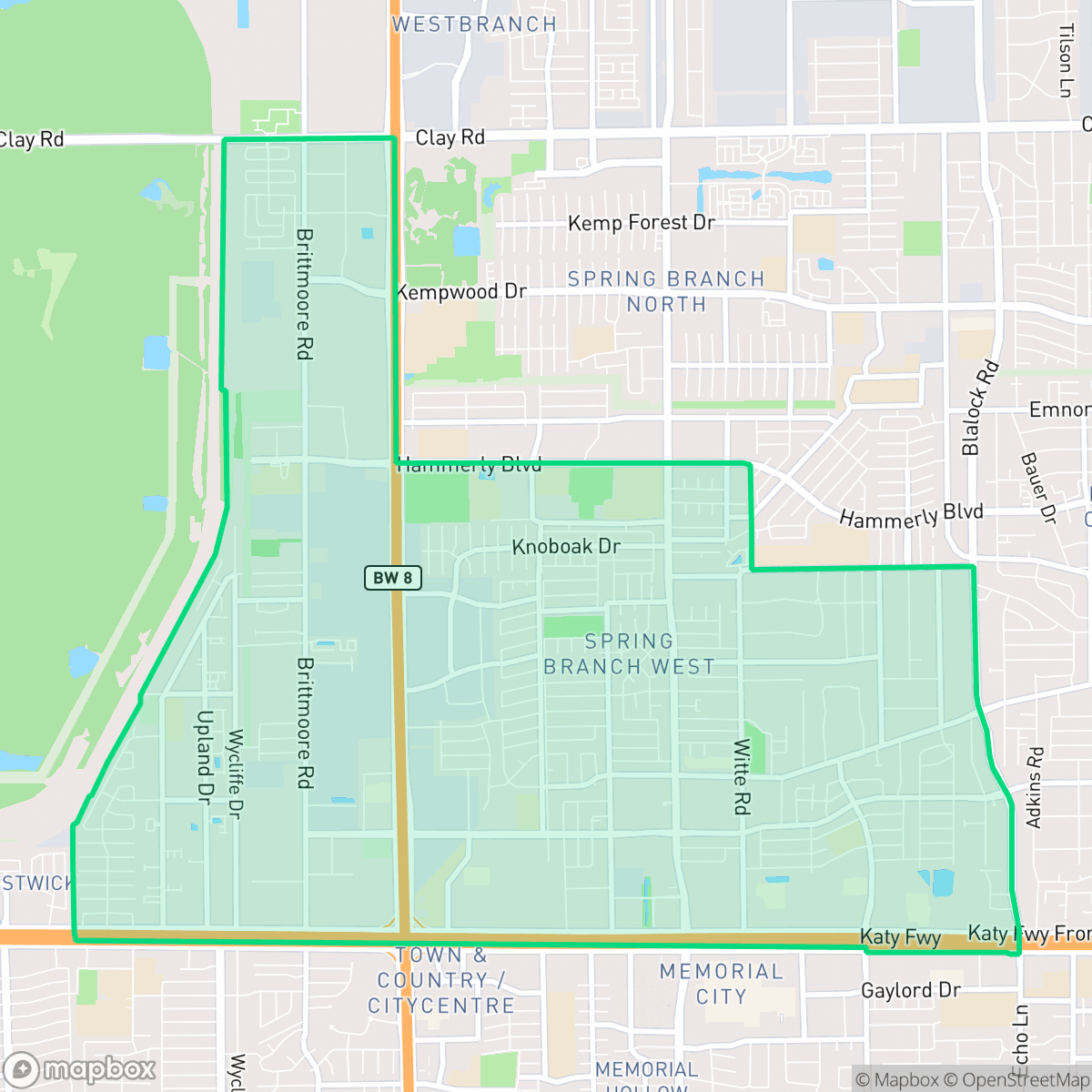
Spring Branch West, designated as Houston Super Neighborhood #10, originated in the mid-19th century as a rural German-American farming community settled by pioneers like Karl Kolbe and the Hillendahl family. The western portion of Spring Branch was annexed by the City of Houston in the 1950s, sparking rapid suburbanization. The neighborhood's architectural character is defined by deed-restricted subdivisions developed during the late 1950s and 1960s, featuring classic mid-century ranch-style homes. Bordered to the west by the Addicks Reservoir and bisected by historic Long Point Road, the area maintained a rural, horse-pasture feel well into the late 20th century. Today, Spring Branch West has evolved into a culturally diverse community, notably home to thriving Korean-American and Hispanic-American populations.
Spring Branch West features a dense suburban fabric that balances residential pockets with significant industrial and logistics infrastructure. The area is characterized by a mix of mid-century ranch homes, many of which include private pools and manicured landscaping, alongside high-density multi-family complexes. Residents benefit from a consistent street grid that supports moderate walkability, though the presence of large warehouse districts and freight corridors means that daily errands and professional commutes generally require a vehicle. According to iHuus data, the neighborhood maintains a strong flood safety rating, providing a measure of security for homeowners in this part of Houston.
The educational landscape is split between the Cypress-Fairbanks and Spring Branch independent school districts, both of which are currently navigating fiscal challenges and operational transitions. While the neighborhood offers diverse dining options, particularly within the Korean and Hispanic culinary scenes, the overall atmosphere remains quiet and car-dependent. Prospective residents should consider the proximity to major logistics centers, which contribute to the local industrial character, and the varying levels of privacy found between the established single-family subdivisions and the more densely populated apartment zones.
Neighborhood Scores Across 15 Qualities
Housing layouts vary from tightly packed apartment complexes to detached homes with moderate buffers. According to iHuus data, the levels of privacy and spacing are slightly higher than the Houston average.
Established sidewalk networks and tree-lined residential streets provide good pedestrian access, though large commercial blocks and major highways can interrupt connectivity. This level of walkability is slightly below the Houston average according to iHuus data.
Large custom homes with manicured landscaping and private pools characterize much of the area, offering a more aesthetically pleasing environment than the Houston average. According to iHuus data, the presence of mature trees and expansive lots contributes to a premium visual landscape.
Residential streets offer decent walking space via green verges and tree-lined corridors, though access to public parks is slightly below the Houston average. Many areas feature large school sports fields and utility corridors that serve as accessible routes for pet owners.
A varied landscape of single-family homes, apartment complexes, and large-scale warehouse districts defines the area. This suburban character is largely consistent with the average density found across Houston.
Suburban blocks and light industrial corridors create a steady but low-key atmosphere that is largely consistent with the Houston average. While various dining options and essential services are present, the landscape is primarily car-dependent with most amenities requiring a drive.
Steady traffic sounds from nearby busy streets are common in this area. According to iHuus data, acoustic levels are slightly higher than the Houston average.
Air quality levels fluctuate between acceptable and unhealthy for sensitive groups, though conditions remain slightly better than the Houston average according to iHuus data.
Residential areas and light commercial zones are interspersed with significant logistics hubs and large warehouses, particularly near the eastern and western edges. While much of the neighborhood is quiet, certain sectors experience heavy truck traffic and increased activity from distribution centers, matching the city average for industrial proximity.
Health insurance availability in this area is slightly above the Houston average. According to iHuus data, a portion of the population remains uninsured.
Conservative voters hold a clear majority in this area, representing a significantly different political landscape than the Houston city average according to iHuus data.
Residents live alongside a diverse range of age groups, including young professionals, families, and seniors. According to iHuus data, this demographic distribution is consistent with the typical age profile found across Houston.
Residual flood risk exists as portions of the area fall within the 500-year floodplain; however, safety levels remain higher than the Houston average according to iHuus data.
Address-Level Insights for Spring Branch West


iHuus Neighborhood Intelligence Insights
Get address-level neighborhood insights for Spring Branch West
- Street-level scores — see how individual blocks compare, not just neighborhood averages
- Micro-zone boundaries — identify quiet pockets, flood boundaries, and walkable clusters before you visit
- 15 dimensions in full — walkability, noise, air quality, school quality, insurance coverage, population age profile, urban/rural index, and more
- Boundary risk alerts — know if your address sits near a block boundary where scores drop, the kind of detail no listing will ever mention
- School insights — individual school ratings and insights, not just district-level data
- Compare before you commit — side-by-side data across neighborhoods, down to block precision
No credit card required
Compare with Any Neighborhood
| Dimension | Spring Branch West | Acres Home |
|---|---|---|
| 🚶 Walkabilityavg 7.08 | ||
| 🔊 Acoustic Comfortavg 4.14 | ||
| 🤫 Privacy Indexavg 5.34 | ||
| 🎨 Visual Appealavg 6.42 | ||
| 🐕 Dog Friendlinessavg 6.33 | ||
| 🗺️ Urban-Rural Indexavg 6.64 | ||
| ✨ Neighborhood Vibeavg 4.4 | ||
| 🏥 Health Insurance Coverageavg 5.46 | ||
| 🌿 Air Qualityavg 3.58 | ||
| 🏭 Industrial Proximityavg 6.9 | ||
| 🌊 Flood Safetyavg 6.27 | ||
| 🗳️ Ideological Leanavg 6.39 | ||
| 👥 Population Age Profileavg 4.6 | ||
| 🔥 Fire Safety | ||
| 🏫 School Quality |
Spring Branch West Rankings
School Districts Serving Spring Branch West
School Insights for Spring Branch West
Below average outcomes; significant attendance and academic challenges.
School Insights
See what's really behind every school rating near Spring Branch West
- Individual school ratings — each school's own score with outcome context, not just a district average
- Enrollment & class size data — student-to-teacher ratio and how it compares to the state average
- Full demographics breakdown — ethnicity and gender composition for every school in the enrollment zone
- Every school in the district — all schools within the enrollment boundary ranked by rating, not just the closest one
- Grade levels & benchmarks — elementary through high school, with below/above state-average flags
No credit card required