Spring Branch East, Houston
Updated · 32,636 residents
Spring Branch East is a historically significant Houston community defined by its transition from industrial roots to a diverse residential and commercial landscape. Residents benefit from a consistent sidewalk grid and a variety of global dining options along Long Point Road, though the area remains largely car-dependent. The neighborhood offers a mix of modest bungalows and modern townhomes, balancing its industrial heritage with evolving suburban appeal.
Key Highlights
About Spring Branch East
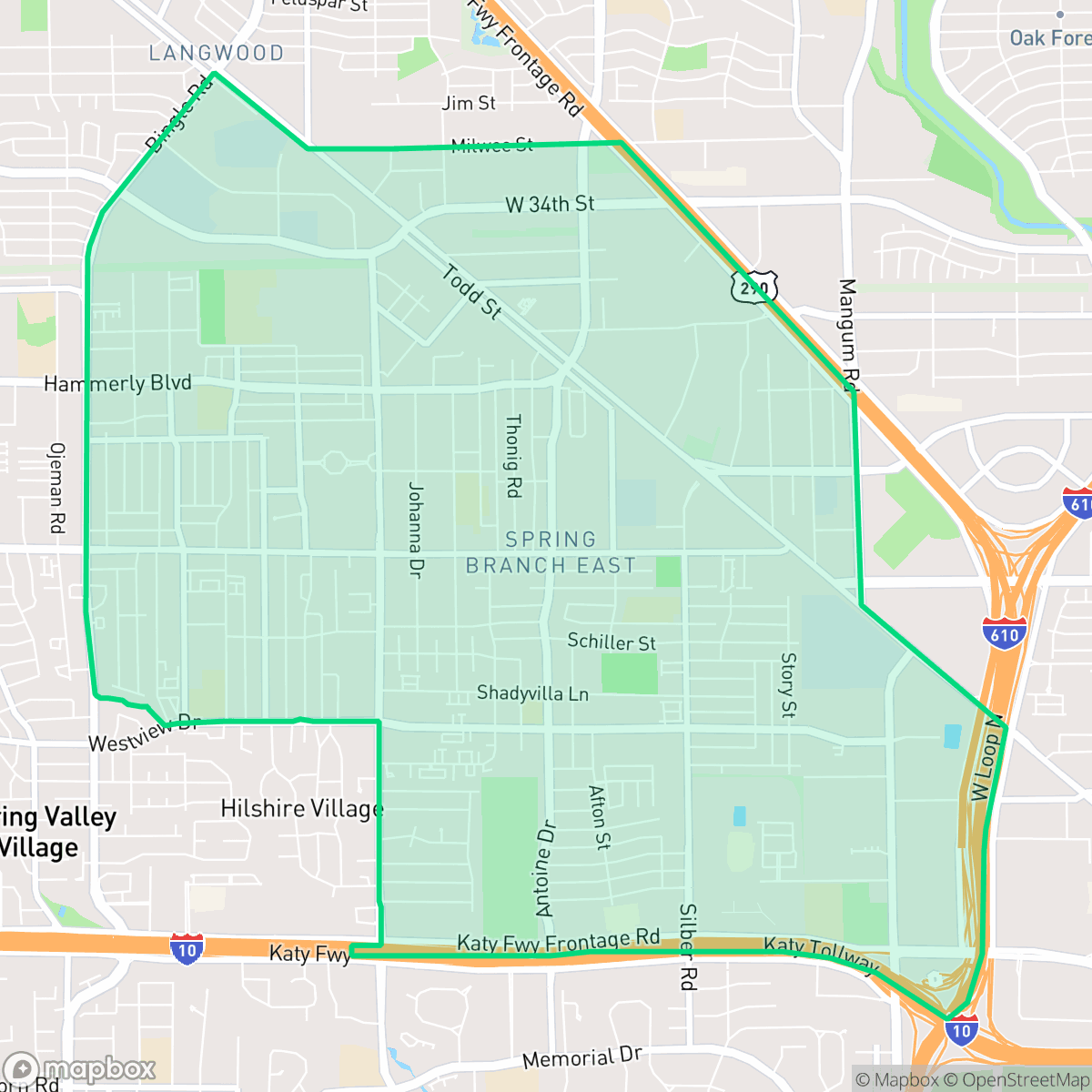
Spring Branch East (Super Neighborhood 86) is the oldest section of Houston's Spring Branch community, tracing its origins to 1830 when German immigrant Karl Kolbe settled along a local spring-fed creek. Annexed by Houston in the 1940s, the neighborhood historically featured a mix of modest wood-sided bungalows and heavy industrial developments. Most notably, its southern border along Silber Road was dominated by the massive Cameron Iron Works manufacturing facility. In the late 1990s, this site was redeveloped into the Marq’E Entertainment Center, signaling a shift toward modern revitalization and gated subdivisions. Today, the neighborhood's diverse cultural identity is anchored by eclectic global eateries along Long Point Road and long-standing local institutions like Becker’s Books on Westview Drive, which has served the community since 1994.
The neighborhood current character is defined by a blend of industrial warehouses and established residential pockets. Housing styles range from traditional wood-sided bungalows to newer townhome developments, reflecting the area evolution from a mid-century industrial hub to a more dense suburban environment. The presence of significant logistics facilities and proximity to major transit corridors shapes the local landscape, creating a functional, industrial-adjacent atmosphere. A standout quality is the diverse culinary scene, with eclectic global eateries concentrated along Long Point Road serving as a primary social anchor for the community.
Regarding livability, residents experience moderate noise levels primarily attributed to road traffic. While the neighborhood features an extensive sidewalk network that supports pedestrian connectivity, the car-dependent layout remains a key consideration for daily commuting and errands. The area maintains relatively high flood safety compared to other parts of the city. It is well-suited for individuals and families seeking a central location with access to diverse local services and a variety of educational options, including highly-rated elementary campuses such as Valley Oaks.
Neighborhood Scores Across 15 Qualities
Residential spacing fluctuates between closely packed townhomes and detached houses with modest buffers. According to iHuus data, privacy levels are roughly in line with the Houston average.
Residential streets offer a quiet environment for walking, though the lack of consistent sidewalks in certain areas makes pedestrian navigation less seamless than the Houston average. High traffic barriers and fragmented paths near major thoroughfares can impact connectivity in some parts of the neighborhood, according to iHuus data.
Larger homes and private pools are common in certain pockets, making the visual landscape slightly more upscale than the Houston average. According to iHuus data, the area features a mix of manicured estates and dense, functional apartment complexes.
Limited public green space and narrow sidewalks make for inconsistent walking routes for pets. According to iHuus data, the availability of accessible dog walking areas is below the Houston average.
Residential pockets sit alongside large-scale warehouses and commercial strips, creating a transitional landscape similar to the broader Houston area. This mix of apartment complexes and industrial zoning provides a dense, utilitarian environment rather than wide-open rural land.
Diverse dining options and local social hubs provide a more active atmosphere than the city average. While some blocks feature lively pockets of commerce and greenery, much of the area maintains a quiet, suburban rhythm shaped by light industrial units and highway proximity.
A steady hum of local traffic from nearby busy streets defines the acoustic environment. This level of ambient sound is typical for the city average.
Air quality in this area fluctuates between acceptable and unhealthy levels, though conditions remain slightly better than the Houston average according to iHuus data. Sensitive groups should remain aware of occasional periods of concern.
While much of the area is residential, significant logistics hubs and large warehouses introduce notable truck traffic and intermittent noise near certain streets. This level of industrial activity is roughly in line with the Houston average.
Health insurance access is lower than the Houston average, which may impact local access to certain healthcare services. According to iHuus data, a smaller portion of the population maintains coverage compared to the broader city.
Political leanings in this area are relatively balanced, representing a more even split between conservative and liberal voters than the Houston average according to iHuus data.
Residents live alongside a balanced mix of young adults, families, and older populations. This demographic spread is largely in line with the broader Houston area, according to iHuus data.
Residual flood risk exists within this area due to its location in a 500-year floodplain; however, safety levels remain above the Houston city average according to iHuus data.
Address-Level Insights for Spring Branch East


iHuus Neighborhood Intelligence Insights
Get address-level neighborhood insights for Spring Branch East
- Street-level scores — see how individual blocks compare, not just neighborhood averages
- Micro-zone boundaries — identify quiet pockets, flood boundaries, and walkable clusters before you visit
- 15 dimensions in full — walkability, noise, air quality, school quality, insurance coverage, population age profile, urban/rural index, and more
- Boundary risk alerts — know if your address sits near a block boundary where scores drop, the kind of detail no listing will ever mention
- School insights — individual school ratings and insights, not just district-level data
- Compare before you commit — side-by-side data across neighborhoods, down to block precision
No credit card required
Compare with Any Neighborhood
| Dimension | Spring Branch East | Acres Home |
|---|---|---|
| 🚶 Walkabilityavg 7.08 | ||
| 🔊 Acoustic Comfortavg 4.14 | ||
| 🤫 Privacy Indexavg 5.34 | ||
| 🎨 Visual Appealavg 6.42 | ||
| 🐕 Dog Friendlinessavg 6.33 | ||
| 🗺️ Urban-Rural Indexavg 6.64 | ||
| ✨ Neighborhood Vibeavg 4.4 | ||
| 🏥 Health Insurance Coverageavg 5.46 | ||
| 🌿 Air Qualityavg 3.58 | ||
| 🏭 Industrial Proximityavg 6.9 | ||
| 🌊 Flood Safetyavg 6.27 | ||
| 🗳️ Ideological Leanavg 6.39 | ||
| 👥 Population Age Profileavg 4.6 | ||
| 🔥 Fire Safety | ||
| 🏫 School Quality |
Spring Branch East Rankings
School Districts Serving Spring Branch East
School Insights for Spring Branch East
Below average outcomes; significant attendance and academic challenges.
School Insights
See what's really behind every school rating near Spring Branch East
- Individual school ratings — each school's own score with outcome context, not just a district average
- Enrollment & class size data — student-to-teacher ratio and how it compares to the state average
- Full demographics breakdown — ethnicity and gender composition for every school in the enrollment zone
- Every school in the district — all schools within the enrollment boundary ranked by rating, not just the closest one
- Grade levels & benchmarks — elementary through high school, with below/above state-average flags
No credit card required