Spring Branch Central, Houston
Updated · 32,313 residents
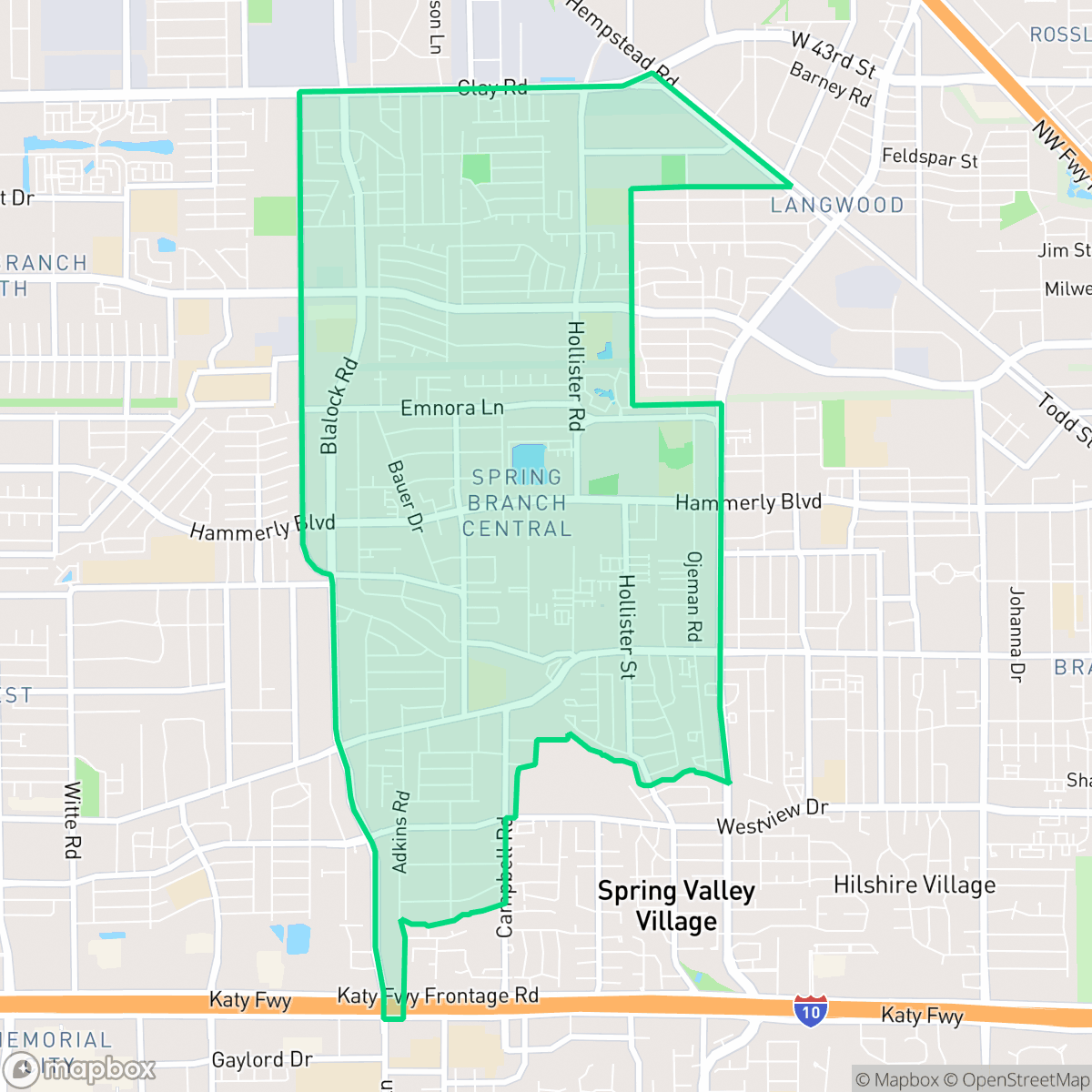
Spring Branch Central is a diverse, industrial-suburban neighborhood in west Houston defined by a mix of single-family homes, townhomes, and active logistics centers. While the area offers a quiet residential atmosphere with access to varied local dining, it remains a car-dependent environment with limited pedestrian infrastructure in its industrial pockets.
Key Highlights
About Spring Branch Central
Spring Branch Central (Super Neighborhood 85) in west Houston traces its origins to 1830, when German immigrant Karl Kolbe settled along a spring-fed stream that inspired the area's name. By the mid-1840s, other German families established a farming community of dairies and sawmills. A historic landmark of this era, a small frame church built in 1864 to replace an earlier 1854 log cabin chapel, still stands at 9022 Long Point Road within the neighborhood. Following its annexation by Houston in the mid-20th century, Spring Branch Central transitioned from a rural, post-war middle-class suburb into a highly diverse urban community, notably shaped by growing Hispanic and Korean American populations since the late 20th century.
The area serves as an urban-industrial transition zone where residential clusters sit alongside light industrial warehouses and commercial strips. Residents benefit from a quiet, suburban rhythm punctuated by a diverse culinary scene that reflects the evolving demographics of the community. The landscape is characterized by standard tract housing and mid-range apartment complexes, with some areas featuring tightly packed townhomes that offer less privacy than traditional detached residences. According to iHuus data, the neighborhood provides a distinct balance between green space and urban density, though the proximity to logistics hubs means that truck traffic is a factor in certain sections.
Prospective residents should note that the area is largely car-dependent, as the industrial presence and fragmented sidewalk networks in specific zones can make walking challenging. While local schools within the Spring Branch and Cypress-Fairbanks districts provide various educational options, these institutions are currently navigating fiscal constraints and operational shifts that have impacted auxiliary services. The neighborhood remains a functional choice for those prioritizing proximity to west Houston employment hubs and diverse local eateries over a purely pedestrian-focused lifestyle.
Neighborhood Scores Across 15 Qualities
Residential density is moderate and comparable to the city average. While some apartment clusters and townhomes feature closely packed structures, many single-family homes maintain standard suburban setbacks and private yards.
Sidewalks are generally available along main roads and within newer residential loops, though large parking lots and industrial areas can create gaps in the network. This level of pedestrian connectivity is slightly below the Houston average.
Visual variety ranges from affluent estates with private pools to denser apartment complexes and standard tract housing. This landscape is consistent with the average visual appeal found throughout Houston.
Large private lawns and various public utility corridors provide sufficient space for walking dogs; however, opportunities for pet exercise are slightly below the Houston average due to some fragmented greenery and industrial areas. According to iHuus data, access to continuous walking paths is most reliable near the northern parklands and drainage corridors.
Residential pockets and apartment complexes sit alongside significant industrial warehousing and commercial strips. This landscape represents a typical suburban-industrial mix that is largely consistent with the Houston average.
Primarily a suburban and industrial landscape, this area offers a low-key atmosphere where most dining and essential services require a vehicle to reach. The neighborhood lacks the concentrated social energy found in other parts of Houston, as much of the terrain consists of warehouses and green spaces.
Steady noise from nearby thoroughfares is present; however, acoustic conditions are slightly more tranquil than the Houston average according to iHuus data.
Air quality in this area fluctuates between acceptable and unhealthy levels, which may pose occasional concerns for sensitive groups. According to iHuus data, the air quality is slightly better than the Houston average.
Large logistics hubs and warehouse districts are concentrated in the northern sections of the area, resulting in more truck traffic than is typical for the city. While many residential streets remain quiet, the presence of freight rail and commercial loading docks contributes to a more active industrial landscape than the Houston average.
Health insurance coverage levels in this area are slightly below the Houston average. According to iHuus data, a notable portion of the population remains uninsured.
Political leanings in this area are roughly evenly split between conservative and liberal views, representing a more moderate landscape than the city average according to iHuus data.
A balanced mix of young adults, families, and older residents characterizes the area. According to iHuus data, this age distribution is largely consistent with the average found across Houston.
Flood risk in this area remains difficult to assess because official federal studies are not yet complete. According to iHuus data, the level of risk is slightly below the Houston city average.
Address-Level Insights for Spring Branch Central


iHuus Neighborhood Intelligence Insights
Get address-level neighborhood insights for Spring Branch Central
- Street-level scores — see how individual blocks compare, not just neighborhood averages
- Micro-zone boundaries — identify quiet pockets, flood boundaries, and walkable clusters before you visit
- 15 dimensions in full — walkability, noise, air quality, school quality, insurance coverage, population age profile, urban/rural index, and more
- Boundary risk alerts — know if your address sits near a block boundary where scores drop, the kind of detail no listing will ever mention
- School insights — individual school ratings and insights, not just district-level data
- Compare before you commit — side-by-side data across neighborhoods, down to block precision
No credit card required
Compare with Any Neighborhood
| Dimension | Spring Branch Central | Acres Home |
|---|---|---|
| 🚶 Walkabilityavg 7.08 | ||
| 🔊 Acoustic Comfortavg 4.14 | ||
| 🤫 Privacy Indexavg 5.34 | ||
| 🎨 Visual Appealavg 6.42 | ||
| 🐕 Dog Friendlinessavg 6.33 | ||
| 🗺️ Urban-Rural Indexavg 6.64 | ||
| ✨ Neighborhood Vibeavg 4.4 | ||
| 🏥 Health Insurance Coverageavg 5.46 | ||
| 🌿 Air Qualityavg 3.58 | ||
| 🏭 Industrial Proximityavg 6.9 | ||
| 🌊 Flood Safetyavg 6.27 | ||
| 🗳️ Ideological Leanavg 6.39 | ||
| 👥 Population Age Profileavg 4.6 | ||
| 🔥 Fire Safety | ||
| 🏫 School Quality |
Spring Branch Central Rankings
School Districts Serving Spring Branch Central
School Insights for Spring Branch Central
Below average outcomes; significant attendance and academic challenges.
School Insights
See what's really behind every school rating near Spring Branch Central
- Individual school ratings — each school's own score with outcome context, not just a district average
- Enrollment & class size data — student-to-teacher ratio and how it compares to the state average
- Full demographics breakdown — ethnicity and gender composition for every school in the enrollment zone
- Every school in the district — all schools within the enrollment boundary ranked by rating, not just the closest one
- Grade levels & benchmarks — elementary through high school, with below/above state-average flags
No credit card required