South Main, Houston
Updated · 8,096 residents
South Main is a dense, car-dependent corridor defined by a mix of multi-family housing and large-scale industrial warehouses. While it offers proximity to major transit routes and reliable flood safety, residents experience significant noise from road traffic and limited pedestrian infrastructure.
Key Highlights
About South Main
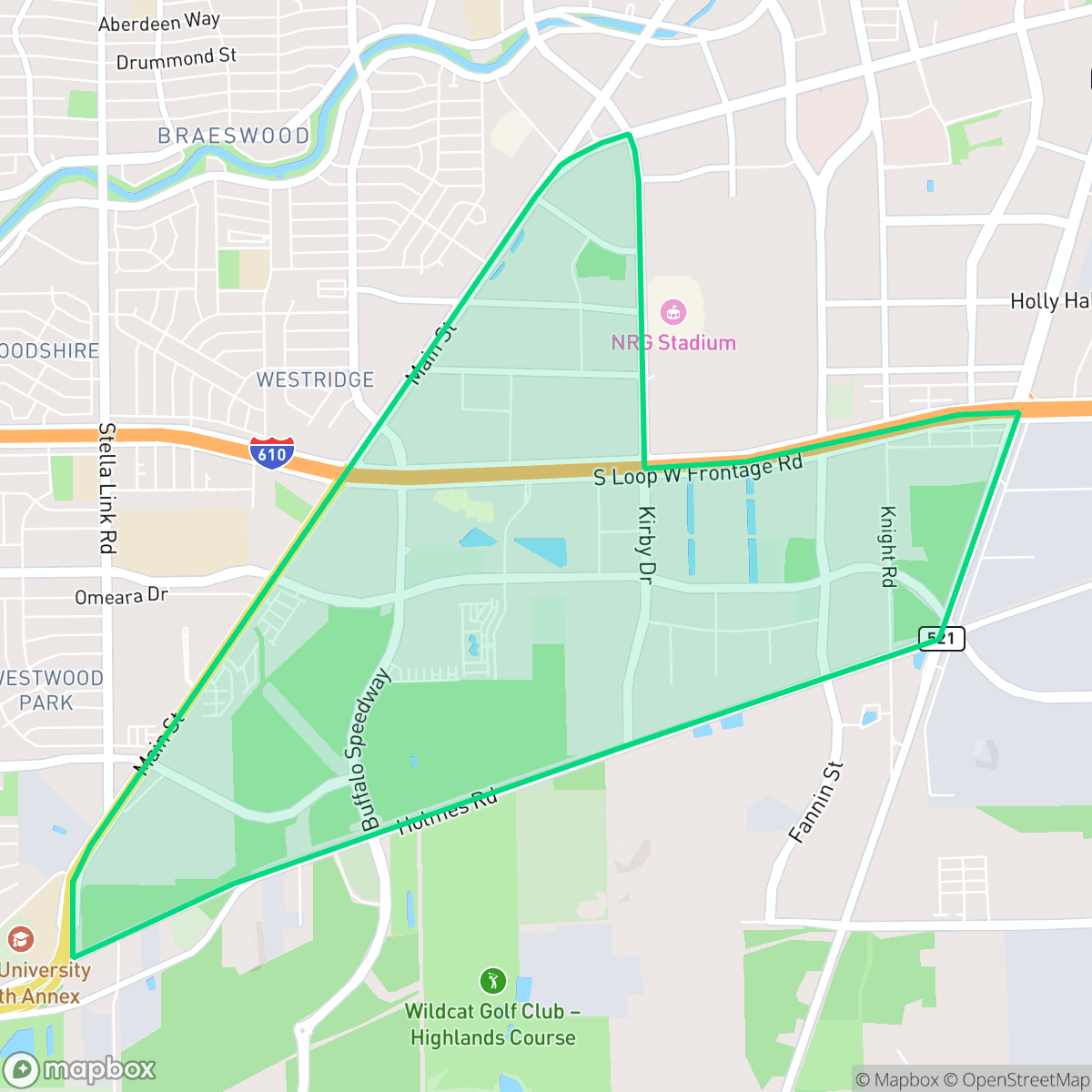
The South Main neighborhood of Houston, Texas, historically developed along South Main Street, which served as a major highway into the city before the construction of the Southwest Freeway. During the mid-20th century, the area became a hub for local entertainment. It was home to Playland Park (1940–1967), Texas's first amusement park and a famous midget-car racing track where legendary driver A.J. Foyt began his career, as well as the South Main Drive-In, Houston's first drive-in theater. In 1968, Judge Roy Hofheinz opened the iconic AstroWorld theme park just south of Loop 610 as part of his Astrodomain complex. Although AstroWorld closed in 2005, the South Main Super Neighborhood remains a key corridor. Today, the South Main Alliance works to revitalize the area, which is now dominated by large multi-family residential complexes.
The neighborhood functions as a high-density transit corridor characterized by a blend of multi-family apartment complexes and industrial logistics hubs. The landscape is dominated by large paved surfaces, warehouses, and commercial footprints, creating a distinct suburban-industrial environment. While the area lacks a traditional pedestrian-friendly core, it provides convenient access to major Houston thoroughfares and maintains a relatively high level of flood safety compared to other parts of the city.
Prospective residents should note that the area is highly car-dependent, with fragmented sidewalks and significant noise pollution stemming from heavy road traffic. The presence of nearby industrial sites and environmental contamination zones necessitates awareness regarding air and soil quality. While public green space is limited, the neighborhood offers a stable residential option for those prioritizing commute access over walkability or quiet surroundings. The local schooling landscape is mixed, featuring both volatile district-run options and high-performing charter alternatives.
Neighborhood Scores Across 15 Qualities
Close proximity to neighbors is common due to a mix of high-density apartments and tightly packed single-family homes. According to iHuus data, this lack of buffer between residences is more pronounced here than in most other parts of Houston.
Navigating the area on foot can be difficult because large highways and expansive parking lots create significant barriers between blocks. While some residential clusters feature sidewalk networks, overall walkability is below the Houston average according to iHuus data.
Standard tract housing and high-density apartment blocks characterize the landscape, providing a consistent but unadorned visual environment. According to iHuus data, the area's visual variety is slightly below the Houston average.
Large public sports fields and parks in the northeast quadrant offer ample green space for pets. However, much of the surrounding greenery is limited to private backyards or parking medians, making the area slightly less dog friendly than the Houston average according to iHuus data.
Large-scale warehouses, industrial parks, and expansive paved surfaces characterize much of the landscape. This mix of developed commercial zones and undeveloped patches aligns with the typical urban-rural balance found across Houston.
Low levels of social activity and a heavy reliance on vehicles characterize this area, making it less lively than the Houston average. Most dining and essential services are scattered among industrial and warehouse zones, which often requires driving to reach local destinations.
Frequent disturbances from nearby railroad tracks and heavy freeway traffic characterize this area. This level of acoustic activity is notably higher than the Houston city average, according to iHuus data.
Air quality in this area fluctuates between acceptable and unhealthy levels, presenting occasional concerns for sensitive groups. According to iHuus data, the local air quality is slightly better than the Houston average.
Active commercial warehouses and logistics hubs contribute to higher levels of truck traffic and noise than the Houston average. Residents should be aware of proximity to certain heavy equipment storage and identified EPA Superfund sites which may impact local environmental conditions.
Health insurance accessibility is significantly higher than the Houston average, according to iHuus data. Most residents in South Main have access to comprehensive health coverage.
Voting patterns and census indicators in South Main reflect a much more liberal political leaning than the Houston average, according to iHuus data.
Residents live alongside a balanced blend of young professionals, families, and older adults. This demographic spread is slightly lower than the Houston average, according to iHuus data.
Residual flood risk exists within the area, though safety levels remain higher than the Houston average according to iHuus data.
Address-Level Insights for South Main


iHuus Neighborhood Intelligence Insights
Get address-level neighborhood insights for South Main
- Street-level scores — see how individual blocks compare, not just neighborhood averages
- Micro-zone boundaries — identify quiet pockets, flood boundaries, and walkable clusters before you visit
- 15 dimensions in full — walkability, noise, air quality, school quality, insurance coverage, population age profile, urban/rural index, and more
- Boundary risk alerts — know if your address sits near a block boundary where scores drop, the kind of detail no listing will ever mention
- School insights — individual school ratings and insights, not just district-level data
- Compare before you commit — side-by-side data across neighborhoods, down to block precision
No credit card required
Compare with Any Neighborhood
| Dimension | South Main | Acres Home |
|---|---|---|
| 🚶 Walkabilityavg 7.08 | ||
| 🔊 Acoustic Comfortavg 4.14 | ||
| 🤫 Privacy Indexavg 5.34 | ||
| 🎨 Visual Appealavg 6.42 | ||
| 🐕 Dog Friendlinessavg 6.33 | ||
| 🗺️ Urban-Rural Indexavg 6.64 | ||
| ✨ Neighborhood Vibeavg 4.4 | ||
| 🏥 Health Insurance Coverageavg 5.46 | ||
| 🌿 Air Qualityavg 3.58 | ||
| 🏭 Industrial Proximityavg 6.9 | ||
| 🌊 Flood Safetyavg 6.27 | ||
| 🗳️ Ideological Leanavg 6.39 | ||
| 👥 Population Age Profileavg 4.6 | ||
| 🔥 Fire Safety | ||
| 🏫 School Quality |
South Main Rankings
School Districts Serving South Main
School Insights for South Main
Below average outcomes; significant attendance and academic challenges.
School Insights
See what's really behind every school rating near South Main
- Individual school ratings — each school's own score with outcome context, not just a district average
- Enrollment & class size data — student-to-teacher ratio and how it compares to the state average
- Full demographics breakdown — ethnicity and gender composition for every school in the enrollment zone
- Every school in the district — all schools within the enrollment boundary ranked by rating, not just the closest one
- Grade levels & benchmarks — elementary through high school, with below/above state-average flags
No credit card required