South Belt - Ellington, Houston
Updated · 68,188 residents
South Belt-Ellington is a dense suburban community defined by its proximity to Ellington Airport and a consistent grid of mid-century residential tracts. While the area offers access to highly-rated schools and extensive green corridors, residents should expect a car-dependent lifestyle and a landscape characterized by closely spaced homes and nearby industrial activity.
Key Highlights
About South Belt - Ellington
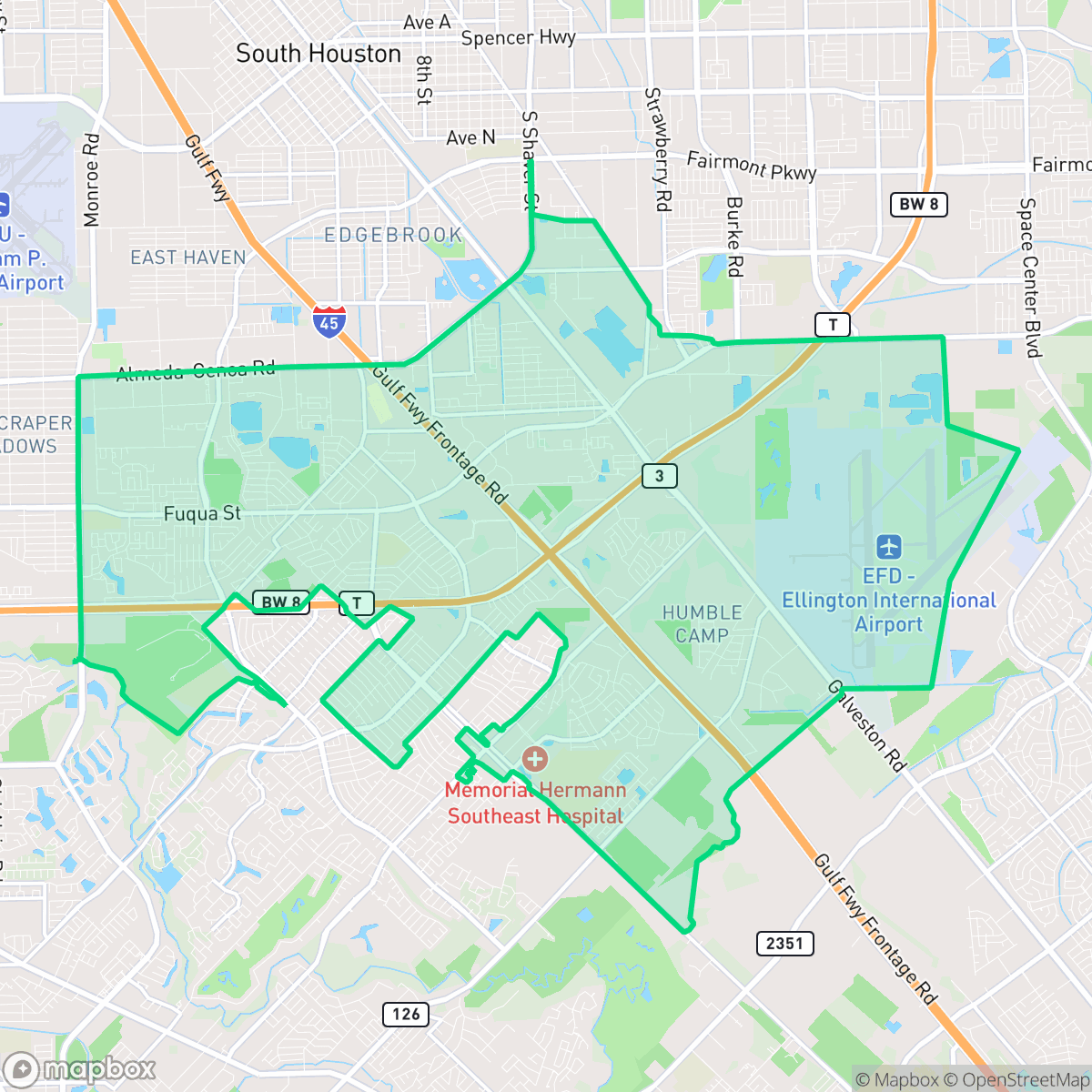
Located in southeast Houston, the South Belt-Ellington neighborhood transitioned from 19th-century farming and ranching pastureland to a booming mid-century suburb. Its rapid development began in the 1960s, spearheaded by the Ayrshire Development Corporation to house personnel for the nearby NASA Manned Spacecraft Center. This era established subdivisions like Sagemont and Beverly Hills. In the 1980s, the community faced a major environmental crisis when toxic waste from Brio Refining Inc. forced the demolition of 677 homes in the South Bend subdivision, creating the Brio Superfund site. The local newspaper, the South Belt-Ellington Leader (co-founded by Marie Flickinger), played a pivotal role in advocating for safer remediation of the site. Today, the neighborhood is anchored by the historic Ellington Airport on its eastern edge.
The area serves as a significant residential hub in southeast Houston, characterized by a uniform suburban layout that balances dense single-family tracts with essential commercial corridors. Residents benefit from a robust network of schools, including several top-rated institutions that anchor the community's appeal for families. The landscape is marked by consistent sidewalk coverage and accessible green spaces, such as drainage corridors and local parks, which provide necessary recreational areas for pets and pedestrians alike.
Living here requires a reliance on personal vehicles, as the neighborhood's layout prioritizes car-based transit over pedestrian access to local businesses. Prospective residents should note that the area experiences moderate noise levels from regional road traffic and aviation operations, reflecting its position near major logistical infrastructure. According to iHuus data, the neighborhood provides a stable, if quiet, suburban environment that is well-suited for those seeking proximity to regional employment centers without the high-density bustle of the inner city.
Neighborhood Scores Across 15 Qualities
Residential spacing varies from dense apartment clusters with shared walls to suburban lots with moderate buffers. This level of density is roughly in line with the Houston average, providing a mix of closely packed housing and detached homes with some separation between neighbors.
Sidewalks are present on many residential streets and near apartment complexes, though major highways and high-traffic arterial roads can limit pedestrian connectivity. While local walking is possible, the area is slightly less walkable than the Houston average due to car-centric infrastructure near main thoroughfares.
Visual variety ranges from affluent pockets with large homes and private pools to denser areas featuring standard tract housing and apartment complexes. This landscape is largely consistent with the broader Houston area in terms of overall aesthetic appeal.
Green drainage corridors, school fields, and wide grassy verges offer reliable walking space for pets. While these features provide good local options, the overall level of dog friendliness is slightly below the Houston average according to iHuus data.
A blend of suburban residential tracts and expansive industrial or utility landscapes creates a setting that is slightly more open than the Houston average. Residents will find a mix of established housing clusters alongside significant open land and large-scale infrastructure.
Suburban blocks and heavy industrial zones create a serene, low-density environment with a steady rhythm of residential life. While some local dining and essential services are available, the area is largely car-dependent and lacks a high concentration of commercial activity compared to the city average.
Frequent noise from nearby freeway traffic and railroad proximity characterizes the area. According to iHuus data, acoustic comfort is slightly below the Houston average.
Air quality levels in this area fluctuate between acceptable and unhealthy, remaining notably higher than the Houston average according to iHuus data. Residents in sensitive groups may experience occasional concern during certain periods.
Residential life is largely uninterrupted by heavy industry, though residents may encounter noise or traffic from nearby airport operations and utility infrastructure. The area maintains a slightly lower industrial presence than the Houston average, consisting mostly of light commercial use and scattered logistics hubs.
Health insurance access for residents is roughly in line with the Houston average. According to iHuus data, coverage levels in this area are moderate.
Political leanings in this area are split relatively evenly between conservative and liberal perspectives. This distribution is notably more balanced than the more liberal leaning average found across Houston.
Residents live alongside a balanced mix of young adults, families, and seniors. According to iHuus data, this demographic spread is largely in line with the broader Houston area.
Flood risk levels in this area are roughly comparable to the Houston average. According to iHuus data, a detailed FEMA flood study has not yet been completed for this specific location.
Address-Level Insights for South Belt - Ellington


iHuus Neighborhood Intelligence Insights
Get address-level neighborhood insights for South Belt - Ellington
- Street-level scores — see how individual blocks compare, not just neighborhood averages
- Micro-zone boundaries — identify quiet pockets, flood boundaries, and walkable clusters before you visit
- 15 dimensions in full — walkability, noise, air quality, school quality, insurance coverage, population age profile, urban/rural index, and more
- Boundary risk alerts — know if your address sits near a block boundary where scores drop, the kind of detail no listing will ever mention
- School insights — individual school ratings and insights, not just district-level data
- Compare before you commit — side-by-side data across neighborhoods, down to block precision
No credit card required
Compare with Any Neighborhood
| Dimension | South Belt - Ellington | Acres Home |
|---|---|---|
| 🚶 Walkabilityavg 7.08 | ||
| 🔊 Acoustic Comfortavg 4.14 | ||
| 🤫 Privacy Indexavg 5.34 | ||
| 🎨 Visual Appealavg 6.42 | ||
| 🐕 Dog Friendlinessavg 6.33 | ||
| 🗺️ Urban-Rural Indexavg 6.64 | ||
| ✨ Neighborhood Vibeavg 4.4 | ||
| 🏥 Health Insurance Coverageavg 5.46 | ||
| 🌿 Air Qualityavg 3.58 | ||
| 🏭 Industrial Proximityavg 6.9 | ||
| 🌊 Flood Safetyavg 6.27 | ||
| 🗳️ Ideological Leanavg 6.39 | ||
| 👥 Population Age Profileavg 4.6 | ||
| 🔥 Fire Safety | ||
| 🏫 School Quality |
South Belt - Ellington Rankings
School Districts Serving South Belt - Ellington
School Insights for South Belt - Ellington
Below average outcomes; significant attendance and academic challenges.
School Insights
See what's really behind every school rating near South Belt - Ellington
- Individual school ratings — each school's own score with outcome context, not just a district average
- Enrollment & class size data — student-to-teacher ratio and how it compares to the state average
- Full demographics breakdown — ethnicity and gender composition for every school in the enrollment zone
- Every school in the district — all schools within the enrollment boundary ranked by rating, not just the closest one
- Grade levels & benchmarks — elementary through high school, with below/above state-average flags
No credit card required