Sharpstown, Houston
Updated · 93,084 residents
Sharpstown is a culturally diverse Houston neighborhood defined by its mid-century architecture and a thriving commercial scene along Bellaire Boulevard. The area offers a dense, suburban environment with a wide range of educational options, though residents should expect a car-dependent lifestyle and limited privacy due to high housing density.
Key Highlights
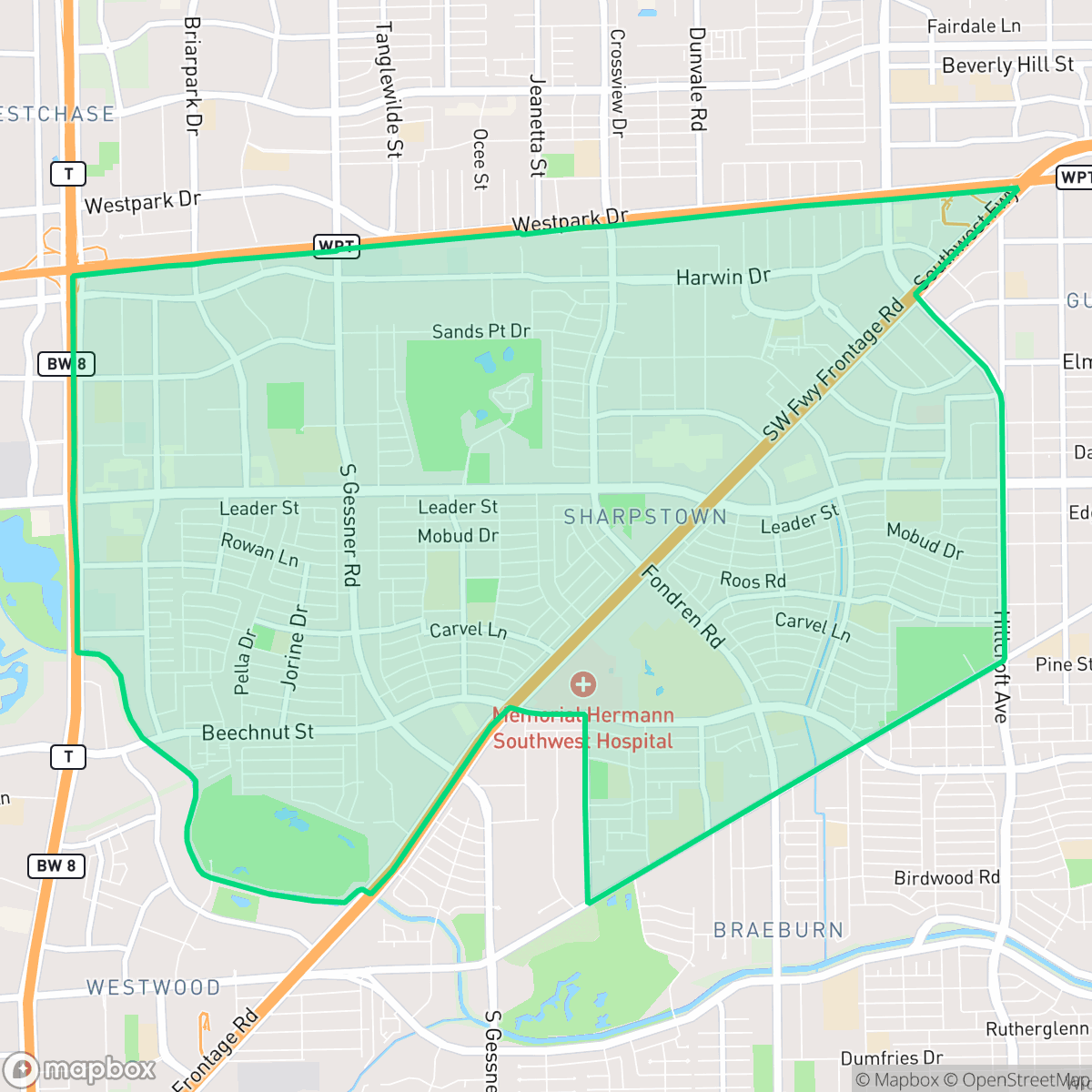
About Sharpstown
Dedicated in 1955 by developer Frank Sharp, Sharpstown was Houston’s first master-planned, automobile-centered community, serving as a national prototype for suburban design. To connect the neighborhood directly to downtown, Sharp donated a 300-foot-wide strip of land for the construction of the Southwest Freeway. This highway provided easy access to the community's centerpiece, Sharpstown Center (now PlazAmericas), which opened in 1961 as Houston's first air-conditioned, enclosed shopping mall. Architecturally defined by post-World War II bungalows and mid-century modern homes, the neighborhood weathered the infamous 1970s Sharpstown political scandal. Today, Sharpstown has evolved into a highly diverse cultural hub, with thriving Asian-owned businesses, supermarkets, and restaurants revitalizing the commercial corridors along Bellaire Boulevard.
The neighborhood functions as a dense suburban hub characterized by a blend of single-family homes, apartment complexes, and active commercial corridors. It maintains a distinct identity through its varied residential landscape, which ranges from mid-century bungalows to modern multi-family units, and its role as a regional destination for diverse culinary and retail experiences. Green spaces, including local parks and school athletic fields, provide necessary recreational outlets, while the proximity to major thoroughfares ensures connectivity despite the high-density layout. According to iHuus data, the area maintains a consistent suburban feel with significant tree canopy coverage throughout its residential grids.
Prospective residents should consider that the area is primarily car-dependent, as the fragmented sidewalk network and large parking lots often prioritize vehicle travel over pedestrian convenience. While the neighborhood offers a vibrant living environment, it features relatively low privacy due to close housing setbacks and high-density apartment clusters. The area is best suited for those seeking a central location with access to diverse cultural amenities and a wide range of educational options, provided they are comfortable with a bustling, high-traffic suburban setting.
Neighborhood Scores Across 15 Qualities
Residential spacing varies from closely packed apartment clusters with shared walls to single-family homes with modest yard buffers. According to iHuus data, the level of separation between neighbors is slightly lower than the Houston average.
Residential streets feature a consistent sidewalk network and low traffic, though large parking lots and major highway intersections create notable barriers for pedestrians. Walking accessibility is slightly below the Houston average due to fragmented paths in more commercial zones.
Uniform rooflines and modest residential lots characterize this area, which sits slightly below the city average for visual variety. The landscape consists primarily of middle-class tract housing and dense apartment complexes with shared amenities.
Abundant green corridors, golf course verges, and large sports fields provide ample walking areas for pets. This access to open space and tree-lined paths is slightly above the Houston average, according to iHuus data.
A variety of multi-family apartments, single-family homes, and commercial warehouses create a developed suburban landscape. This level of density is consistent with the average found throughout Houston.
A variety of international restaurants and social hubs provide a lively atmosphere that is more active than the Houston average. While many dining and service options are accessible, most residents will find the area largely car-dependent due to the suburban layout.
Steady sounds from nearby busy streets contribute to a consistent level of ambient noise. This acoustic environment is typical for the area and aligns with the city average.
Frequent unhealthy air quality levels pose a significant risk to sensitive groups. According to iHuus data, the air quality in this area is lower than the Houston average.
Industrial presence is minimal across much of the neighborhood, which is primarily composed of residential, institutional, and recreational zones. While some large-scale warehouses and commercial distribution centers along highway corridors may contribute to localized truck traffic, the overall level of industrial proximity is slightly higher than the Houston average.
Health insurance coverage is significantly lower than the Houston average, which may impact access to local medical services. Residents should be aware that a small portion of the population holds active coverage according to iHuus data.
Political leaning in this area tends toward liberal, showing a slightly more progressive tilt than the Houston average according to iHuus data.
Residents live alongside a balanced distribution of young adults, families, and older individuals. This demographic spread is largely consistent with the broader Houston area, according to iHuus data.
Flood safety levels in this area are below the Houston average because FEMA has not yet completed a detailed flood study for this specific location. Residents should exercise caution and stay informed, as the current risk level remains undetermined according to iHuus data.
Address-Level Insights for Sharpstown


iHuus Neighborhood Intelligence Insights
Get address-level neighborhood insights for Sharpstown
- Street-level scores — see how individual blocks compare, not just neighborhood averages
- Micro-zone boundaries — identify quiet pockets, flood boundaries, and walkable clusters before you visit
- 15 dimensions in full — walkability, noise, air quality, school quality, insurance coverage, population age profile, urban/rural index, and more
- Boundary risk alerts — know if your address sits near a block boundary where scores drop, the kind of detail no listing will ever mention
- School insights — individual school ratings and insights, not just district-level data
- Compare before you commit — side-by-side data across neighborhoods, down to block precision
No credit card required
Compare with Any Neighborhood
| Dimension | Sharpstown | Acres Home |
|---|---|---|
| 🚶 Walkabilityavg 7.08 | ||
| 🔊 Acoustic Comfortavg 4.14 | ||
| 🤫 Privacy Indexavg 5.34 | ||
| 🎨 Visual Appealavg 6.42 | ||
| 🐕 Dog Friendlinessavg 6.33 | ||
| 🗺️ Urban-Rural Indexavg 6.64 | ||
| ✨ Neighborhood Vibeavg 4.4 | ||
| 🏥 Health Insurance Coverageavg 5.46 | ||
| 🌿 Air Qualityavg 3.58 | ||
| 🏭 Industrial Proximityavg 6.9 | ||
| 🌊 Flood Safetyavg 6.27 | ||
| 🗳️ Ideological Leanavg 6.39 | ||
| 👥 Population Age Profileavg 4.6 | ||
| 🔥 Fire Safety | ||
| 🏫 School Quality |
Sharpstown Rankings
School Districts Serving Sharpstown
School Insights for Sharpstown
Below average outcomes; significant attendance and academic challenges.
School Insights
See what's really behind every school rating near Sharpstown
- Individual school ratings — each school's own score with outcome context, not just a district average
- Enrollment & class size data — student-to-teacher ratio and how it compares to the state average
- Full demographics breakdown — ethnicity and gender composition for every school in the enrollment zone
- Every school in the district — all schools within the enrollment boundary ranked by rating, not just the closest one
- Grade levels & benchmarks — elementary through high school, with below/above state-average flags
No credit card required