Settegast, Houston
Updated · 4,103 residents
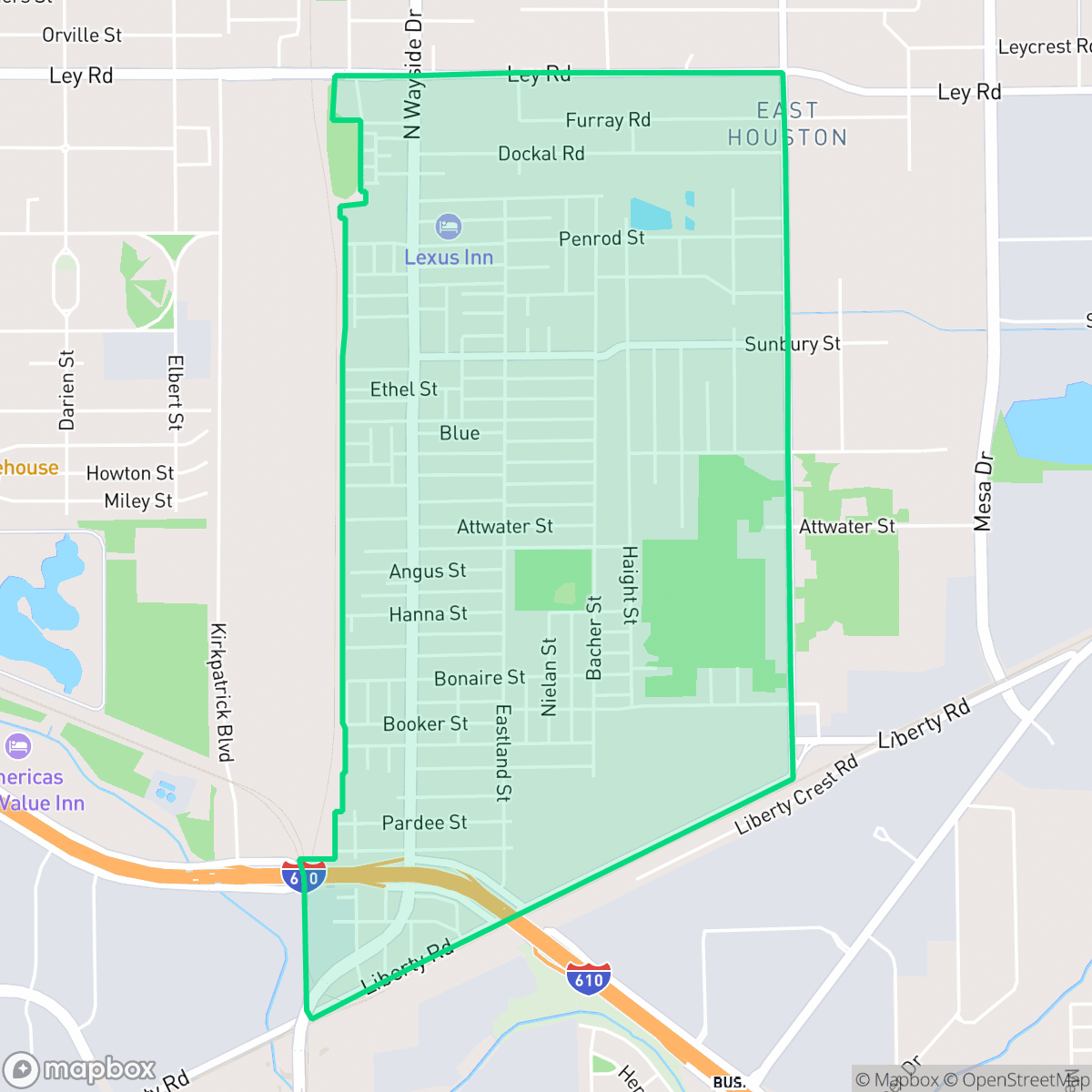
Settegast is a quiet, rurban neighborhood in northeast Houston defined by its proximity to the expansive Union Pacific rail yard and a mix of low-density residential lots. The area is characterized by its industrial surroundings and car-dependent layout, offering residents a secluded environment with significant green space.
Key Highlights
About Settegast
Settegast, located in northeast Houston, was first developed in 1892 by German land speculators William J. and Julius J. Settegast. In the 1940s, it was platted as a planned community and quickly became a haven for African American families seeking homeownership amid systemic segregation. Annexed by Houston in 1949, Settegast evolved into a "rurban" neighborhood characterized by modest wood-frame homes on spacious lots, where residents historically kept livestock. The community was home to segregated schools like B.C. Elmore High School and was the original birthplace of Lakewood Church. Despite facing decades of municipal neglect and infrastructure challenges highlighted in the landmark 1966 "Settegast Report," the neighborhood maintains a close-knit identity bordered by the Union Pacific Settegast Yard.
The area functions as a low-density transition zone where residential streets meet large-scale logistics and industrial infrastructure. Residents experience a notably quiet environment, as the neighborhood maintains a suburban feel despite the presence of heavy freight corridors and warehouse facilities. The landscape is marked by scattered housing and significant tree canopy, creating a distinct visual identity that separates it from more densely developed parts of Houston.
Living here requires a high degree of car dependency, as the neighborhood lacks traditional walkability and local commercial services. While the area benefits from favorable flood safety ratings, prospective residents should be aware of challenges regarding air quality and the proximity to active industrial operations. It is best suited for those who prioritize a secluded, low-density lifestyle and are comfortable with the logistical realities of living near a major freight hub.
Neighborhood Scores Across 15 Qualities
Residential spacing is mixed, providing more buffer between neighbors than the Houston average. According to iHuus data, the area offers a moderate level of separation between properties.
Quiet residential streets allow for low-traffic walking, though the lack of sidewalks makes it less walkable than the Houston average. According to iHuus data, the area is better suited for walking near homes rather than for navigating long distances on foot.
Dense housing layouts and minimal greenery characterize the area, providing significantly less visual variety than the Houston average. According to iHuus data, the landscape is primarily functional with small yards and few ornamental amenities.
Limited access to public parks and a lack of wide green verges make this area less ideal for dog owners. According to iHuus data, the availability of pet-friendly outdoor space is below the Houston average.
Open land and wooded tracts are interspersed with large-scale industrial warehouses and rail yards. This landscape offers more open space than the typical Houston urban environment, according to iHuus data.
Low-density residential streets and industrial corridors create a subdued atmosphere with significantly less social activity than the Houston average. Most local services and dining options are sparse and primarily accessible by car due to the presence of warehouses and freight railways.
A steady hum of local traffic persists near busy thoroughfares, though acoustic levels remain more favorable than the Houston average according to iHuus data.
Frequent periods of unhealthy air levels pose significant risks to sensitive groups. This air quality is noticeably worse than the Houston average, according to iHuus data.
Large-scale logistics hubs, active rail yards, and heavy manufacturing facilities are integrated with residential areas. According to iHuus data, this level of industrial activity is lower than the Houston average, resulting in a landscape that blends residential life with significant commercial and transport operations.
Health insurance coverage rates in this area are notably lower than the Houston average. Residents may face challenges accessing employer-sponsored or private medical coverage according to iHuus data.
Voting patterns and census indicators show a notably liberal leaning, which is significantly more pronounced than the Houston average according to iHuus data.
A balanced demographic of young adults, families, and older residents characterizes this area. This age distribution is largely consistent with the broader Houston average according to iHuus data.
Flood risk in this area is notably higher than the Houston average due to its location within the 500 year floodplain. According to iHuus data, residents may encounter some residual flood risk during extreme weather events.
Address-Level Insights for Settegast


iHuus Neighborhood Intelligence Insights
Get address-level neighborhood insights for Settegast
- Street-level scores — see how individual blocks compare, not just neighborhood averages
- Micro-zone boundaries — identify quiet pockets, flood boundaries, and walkable clusters before you visit
- 15 dimensions in full — walkability, noise, air quality, school quality, insurance coverage, population age profile, urban/rural index, and more
- Boundary risk alerts — know if your address sits near a block boundary where scores drop, the kind of detail no listing will ever mention
- School insights — individual school ratings and insights, not just district-level data
- Compare before you commit — side-by-side data across neighborhoods, down to block precision
No credit card required
Compare with Any Neighborhood
| Dimension | Settegast | Acres Home |
|---|---|---|
| 🚶 Walkabilityavg 7.08 | ||
| 🔊 Acoustic Comfortavg 4.14 | ||
| 🤫 Privacy Indexavg 5.34 | ||
| 🎨 Visual Appealavg 6.42 | ||
| 🐕 Dog Friendlinessavg 6.33 | ||
| 🗺️ Urban-Rural Indexavg 6.64 | ||
| ✨ Neighborhood Vibeavg 4.4 | ||
| 🏥 Health Insurance Coverageavg 5.46 | ||
| 🌿 Air Qualityavg 3.58 | ||
| 🏭 Industrial Proximityavg 6.9 | ||
| 🌊 Flood Safetyavg 6.27 | ||
| 🗳️ Ideological Leanavg 6.39 | ||
| 👥 Population Age Profileavg 4.6 | ||
| 🔥 Fire Safety | ||
| 🏫 School Quality |
Settegast Rankings
School Districts Serving Settegast
School Insights for Settegast
Below average outcomes; significant attendance and academic challenges.
School Insights
See what's really behind every school rating near Settegast
- Individual school ratings — each school's own score with outcome context, not just a district average
- Enrollment & class size data — student-to-teacher ratio and how it compares to the state average
- Full demographics breakdown — ethnicity and gender composition for every school in the enrollment zone
- Every school in the district — all schools within the enrollment boundary ranked by rating, not just the closest one
- Grade levels & benchmarks — elementary through high school, with below/above state-average flags
No credit card required