Second Ward, Houston
Updated · 16,285 residents
Second Ward is a historically rich neighborhood known for its deep Mexican-American roots, vibrant cultural landmarks, and a unique blend of industrial and residential spaces. While the area offers a strong sense of community, residents experience a dense, car-dependent environment with limited privacy and proximity to industrial activity.
Key Highlights
About Second Ward
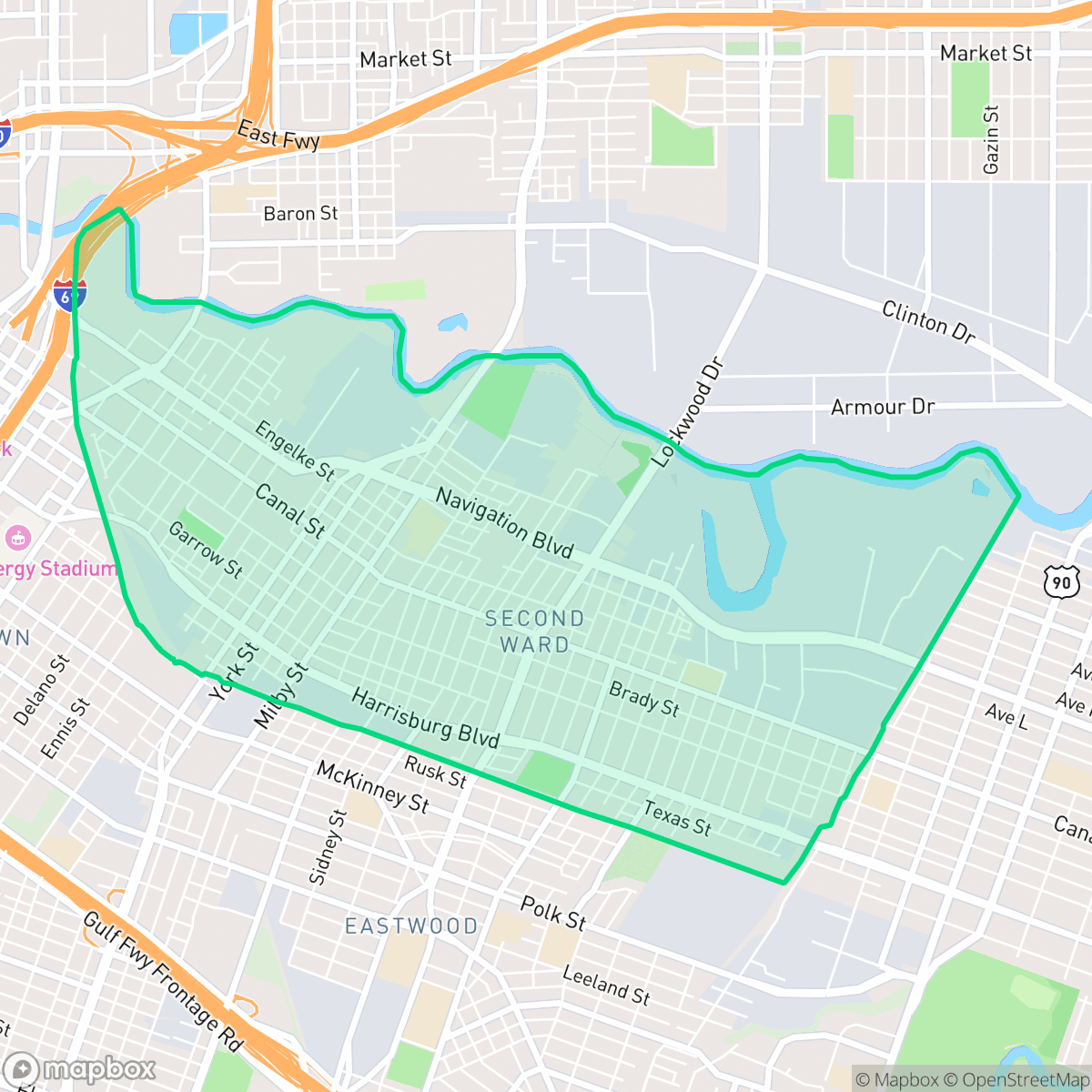
Established in 1839 as one of Houston’s original four wards, the Second Ward (historically *Das Zweiter* in German) evolved from a 19th-century German-American hub into one of the city's most iconic Mexican-American neighborhoods, affectionately known as *Segundo Barrio*. Initially home to Frost Town—Houston's first suburb—the neighborhood underwent a demographic shift in the early 20th century. By the 1920s, Mexican-Americans became the majority, establishing vibrant cultural anchors. Key landmarks include Our Lady of Guadalupe Catholic Church, founded in 1911 as Houston's first Spanish-language Catholic parish, and the cultural arts center Talento Bilingüe de Houston. Architecturally, the neighborhood features a blend of 1920s Art Deco structures, historic homes, and industrial warehouses near Buffalo Bayou that have been converted into modern lofts.
The neighborhood is characterized by a dense grid of homes, warehouses, and light industrial sites that reflect its evolution from a 19th-century German hub to a center of Mexican-American culture. Residents benefit from proximity to local dining favorites like The Original Ninfa's on Navigation and various taquerias, alongside green spaces such as Antonio Marron Park. The area maintains an active, urban feel where historic architecture meets modern residential development, creating a distinct visual and social landscape.
Living in this area requires navigating specific trade-offs, as the infrastructure is primarily designed for vehicle use rather than pedestrians. Sidewalks are often inconsistent, and the presence of heavy industrial zones and major highways contributes to a noise level averaging 59 decibels. While the neighborhood offers access to high-performing schools like East Early College High School, the broader school district faces significant operational challenges. It is best suited for those who prioritize cultural heritage and a central location over the privacy and quiet of a traditional suburban setting.
Neighborhood Scores Across 15 Qualities
Residential and commercial structures are often tightly packed with minimal separation between buildings. This lack of private setbacks results in a lower level of privacy compared to the Houston average, according to iHuus data.
Large highways, elevated rail lines, and industrial zones create significant barriers to walking. While some residential streets are quiet, the sidewalk network is much less continuous than the Houston average.
Dense clusters of townhomes and apartment complexes define the landscape, which lacks the greenery and expansive private amenities found throughout the rest of Houston. Residential lots are typically small and closely packed near industrial zones, according to iHuus data.
Public green space and walking verges are sparse across much of the area, making it less dog friendly than the Houston average. Most greenery is restricted to private, fenced yards or narrow riverbank trails near heavy infrastructure.
Dense industrial zones and rail infrastructure dominate the landscape, creating a more built-up environment than the typical Houston suburb. This mix of warehouses and residential lots results in a lower concentration of green space compared to the city average.
Suburban blocks and industrial zones create a subdued atmosphere with a steady rhythm of dining and essential services. This level of activity is slightly lower than the city average, characterized by a mix of quiet green spaces and car-dependent streets.
Frequent noise from nearby highways and railroad tracks is a common characteristic here. According to iHuus data, acoustic comfort in this area is lower than the Houston average.
Frequent unhealthy air quality levels pose significant risks to sensitive groups; according to iHuus data, conditions in this area are slightly worse than the Houston average.
Heavy industrial zones, large warehouses, and a nearby EPA Superfund site contribute to a landscape with more industrial activity than the Houston average. Residents may encounter increased truck traffic, rail corridors, and potential environmental considerations related to ground and water contamination.
Health insurance access is roughly in line with the Houston average. According to iHuus data, a significant portion of the population remains uninsured.
Voting patterns and census indicators show a significantly more liberal political leaning than the Houston average, according to iHuus data.
A balanced mix of young adults, families, and older residents characterizes the area. According to iHuus data, this age distribution is slightly more varied than the Houston average.
Residual flood risk exists within this area due to its location in the 500-year floodplain, though safety levels remain higher than the Houston average according to iHuus data.
Address-Level Insights for Second Ward


iHuus Neighborhood Intelligence Insights
Get address-level neighborhood insights for Second Ward
- Street-level scores — see how individual blocks compare, not just neighborhood averages
- Micro-zone boundaries — identify quiet pockets, flood boundaries, and walkable clusters before you visit
- 15 dimensions in full — walkability, noise, air quality, school quality, insurance coverage, population age profile, urban/rural index, and more
- Boundary risk alerts — know if your address sits near a block boundary where scores drop, the kind of detail no listing will ever mention
- School insights — individual school ratings and insights, not just district-level data
- Compare before you commit — side-by-side data across neighborhoods, down to block precision
No credit card required
Compare with Any Neighborhood
| Dimension | Second Ward | Acres Home |
|---|---|---|
| 🚶 Walkabilityavg 7.08 | ||
| 🔊 Acoustic Comfortavg 4.14 | ||
| 🤫 Privacy Indexavg 5.34 | ||
| 🎨 Visual Appealavg 6.42 | ||
| 🐕 Dog Friendlinessavg 6.33 | ||
| 🗺️ Urban-Rural Indexavg 6.64 | ||
| ✨ Neighborhood Vibeavg 4.4 | ||
| 🏥 Health Insurance Coverageavg 5.46 | ||
| 🌿 Air Qualityavg 3.58 | ||
| 🏭 Industrial Proximityavg 6.9 | ||
| 🌊 Flood Safetyavg 6.27 | ||
| 🗳️ Ideological Leanavg 6.39 | ||
| 👥 Population Age Profileavg 4.6 | ||
| 🔥 Fire Safety | ||
| 🏫 School Quality |
Second Ward Rankings
School Districts Serving Second Ward
School Insights for Second Ward
Below average outcomes; significant attendance and academic challenges.
School Insights
See what's really behind every school rating near Second Ward
- Individual school ratings — each school's own score with outcome context, not just a district average
- Enrollment & class size data — student-to-teacher ratio and how it compares to the state average
- Full demographics breakdown — ethnicity and gender composition for every school in the enrollment zone
- Every school in the district — all schools within the enrollment boundary ranked by rating, not just the closest one
- Grade levels & benchmarks — elementary through high school, with below/above state-average flags
No credit card required