Park Place, Houston
Updated · 9,905 residents
Park Place is a quiet, semi-rural enclave in southeast Houston characterized by mature trees and a mix of historic homes and modest residential blocks. While the area offers a peaceful atmosphere, residents experience notable noise from nearby transit corridors and rely heavily on personal vehicles due to fragmented pedestrian infrastructure.
Key Highlights
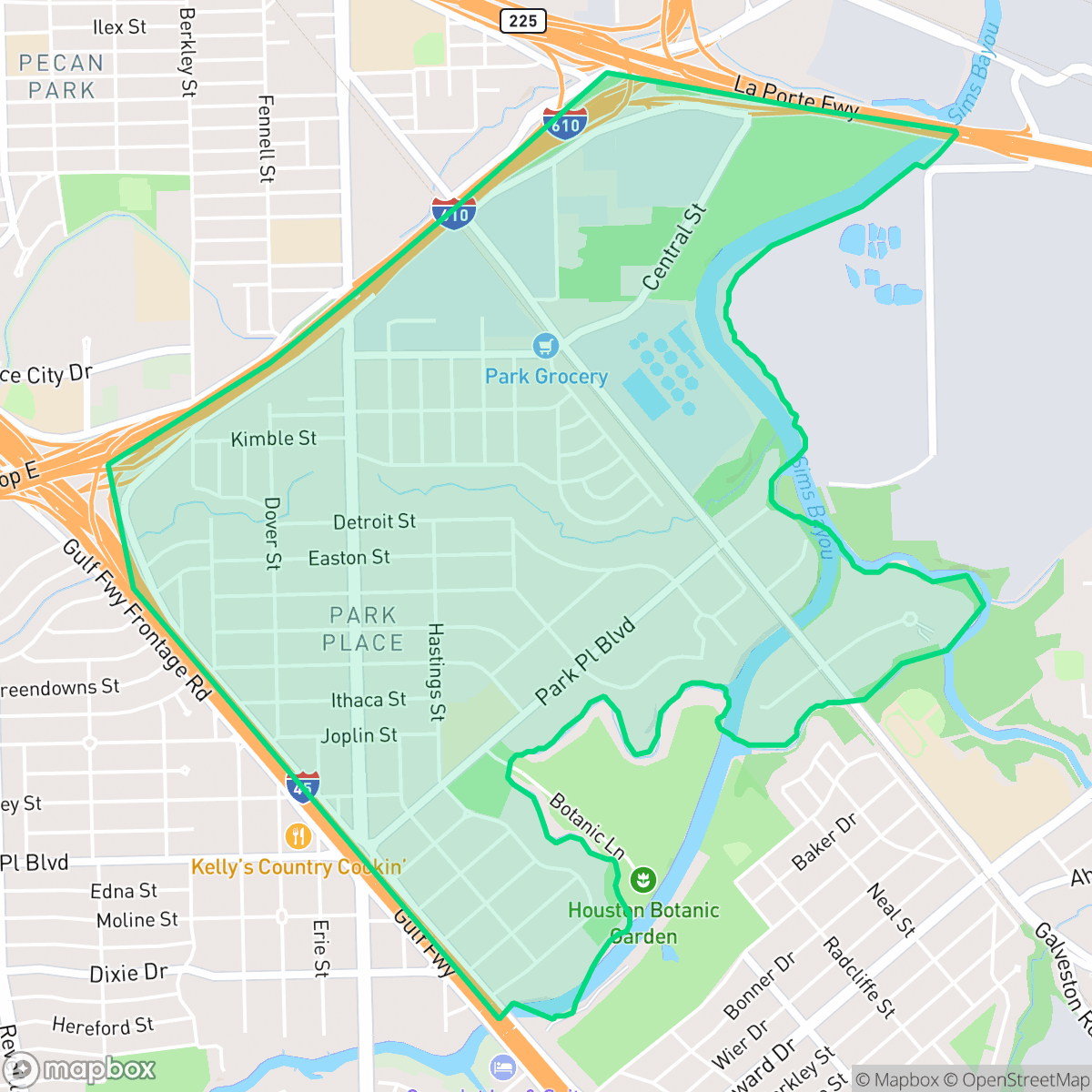
About Park Place
Park Place, located in southeast Houston, was an independent municipality until its voluntary consolidation with the city in 1927. Originally characterized by large estates along Broadway and Park Place Boulevards, the area underwent significant transformation as deed restrictions lapsed, leading to the replacement of many historic homes with apartments and small businesses. Despite this, the neighborhood retains pockets of its early 20th-century character, particularly in wooded sections adjacent to Sims Bayou and along side streets lined with mature pecan trees dating back to the 1920s. Key historic landmarks include Park Place Elementary, established in 1915, and St. Christopher Church, founded in 1924. The neighborhood also reflects a diverse cultural history, notably hosting St. Joseph Village, a long-standing condominium complex with a significant Vietnamese population.
The area maintains a distinct identity through its blend of early 20th-century residential pockets and industrial logistics hubs. The landscape is defined by standard tract housing and mid-range apartments, providing a consistent, if modest, visual aesthetic. While the neighborhood benefits from proximity to wooded areas near Sims Bayou, the presence of heavy industrial facilities and warehouses creates a landscape that is both semi-rural and utility-focused. According to iHuus data, the area offers a quiet, subdued rhythm of life that appeals to those who prefer a suburban pace over the density of the city center.
Living in the area requires navigating specific trade-offs, particularly regarding environmental and infrastructure factors. Residents often face challenges with air quality and high noise levels from surrounding highways and rail lines. Access to healthcare remains limited for many in the community, and the local school district is currently experiencing significant institutional volatility. Despite these hurdles, the neighborhood remains a diverse community that attracts a balanced mix of young professionals, families, and seniors seeking a residential setting within reach of Houston's major employment centers.
Neighborhood Scores Across 15 Qualities
Residential spacing offers a moderate level of separation between neighbors, which is slightly higher than the Houston average. Most homes feature detached structures with small private yards that provide some buffer from adjacent properties.
Major highway interchanges and high-traffic arterials create significant barriers for pedestrians. While some residential streets offer quiet paths toward parks, overall walkability is below the Houston average due to missing sidewalks and fragmented connectivity.
Standard tract housing and mid-range apartments define the landscape, featuring uniform rooflines and small yards. This visual profile is less diverse than the Houston average, with very few luxury amenities or private pools visible according to iHuus data.
Most vegetation is contained within private fenced yards, though a large public park with walking trails provides significant nearby access. According to iHuus data, the availability of wide, grassy sidewalk verges is slightly below the Houston average.
Open land and woodland areas are interspersed with significant utility infrastructure and industrial warehouses. This landscape features a slightly more semi-rural character than much of the Houston area, according to iHuus data.
Suburban blocks and industrial corridors provide a steady but subdued rhythm of life, matching the city average for liveliness. Residents will find a mix of green spaces and scattered local eateries, though many destinations require a car due to the area's heavy industrial and warehouse surroundings.
Frequent acoustic disturbances from nearby highways and rail lines characterize this area. According to iHuus data, the noise levels here are higher than the Houston average.
Frequent unhealthy air quality levels pose a significant risk to sensitive groups. According to iHuus data, the air quality in Park Place is notably worse than the Houston average.
Heavy industrial facilities, including warehouses and wastewater treatment plants, are present alongside residential areas, making the level of industrial proximity higher than the Houston average. According to iHuus data, residents may encounter increased truck traffic and proximity to large-scale logistics hubs.
Access to health insurance is significantly lower here than the Houston average. According to iHuus data, a small portion of the local population maintains active coverage.
Political leanings in this area trend more liberal than the Houston average, according to iHuus data.
Residents live alongside a balanced mix of young professionals, families, and seniors. This demographic spread is slightly lower than the Houston average, according to iHuus data.
Residual flood risk exists within the area due to its location in a 500-year floodplain, though safety levels are slightly higher than the Houston average according to iHuus data.
Address-Level Insights for Park Place


iHuus Neighborhood Intelligence Insights
Get address-level neighborhood insights for Park Place
- Street-level scores — see how individual blocks compare, not just neighborhood averages
- Micro-zone boundaries — identify quiet pockets, flood boundaries, and walkable clusters before you visit
- 15 dimensions in full — walkability, noise, air quality, school quality, insurance coverage, population age profile, urban/rural index, and more
- Boundary risk alerts — know if your address sits near a block boundary where scores drop, the kind of detail no listing will ever mention
- School insights — individual school ratings and insights, not just district-level data
- Compare before you commit — side-by-side data across neighborhoods, down to block precision
No credit card required
Compare with Any Neighborhood
| Dimension | Park Place | Acres Home |
|---|---|---|
| 🚶 Walkabilityavg 7.08 | ||
| 🔊 Acoustic Comfortavg 4.14 | ||
| 🤫 Privacy Indexavg 5.34 | ||
| 🎨 Visual Appealavg 6.42 | ||
| 🐕 Dog Friendlinessavg 6.33 | ||
| 🗺️ Urban-Rural Indexavg 6.64 | ||
| ✨ Neighborhood Vibeavg 4.4 | ||
| 🏥 Health Insurance Coverageavg 5.46 | ||
| 🌿 Air Qualityavg 3.58 | ||
| 🏭 Industrial Proximityavg 6.9 | ||
| 🌊 Flood Safetyavg 6.27 | ||
| 🗳️ Ideological Leanavg 6.39 | ||
| 👥 Population Age Profileavg 4.6 | ||
| 🔥 Fire Safety | ||
| 🏫 School Quality |
Park Place Rankings
School Districts Serving Park Place
School Insights for Park Place
Below average outcomes; significant attendance and academic challenges.
School Insights
See what's really behind every school rating near Park Place
- Individual school ratings — each school's own score with outcome context, not just a district average
- Enrollment & class size data — student-to-teacher ratio and how it compares to the state average
- Full demographics breakdown — ethnicity and gender composition for every school in the enrollment zone
- Every school in the district — all schools within the enrollment boundary ranked by rating, not just the closest one
- Grade levels & benchmarks — elementary through high school, with below/above state-average flags
No credit card required