Ost - South Union, Houston
Updated · 24,264 residents
Ost - South Union is a dense, established residential community characterized by its modest mid-century architecture and grid-based street layout. While the area offers a quiet, suburban atmosphere, residents rely primarily on personal vehicles for daily errands due to limited commercial density. According to iHuus data, the neighborhood provides a stable flood safety profile, though it remains influenced by nearby industrial logistics infrastructure.
Key Highlights
About Ost - South Union
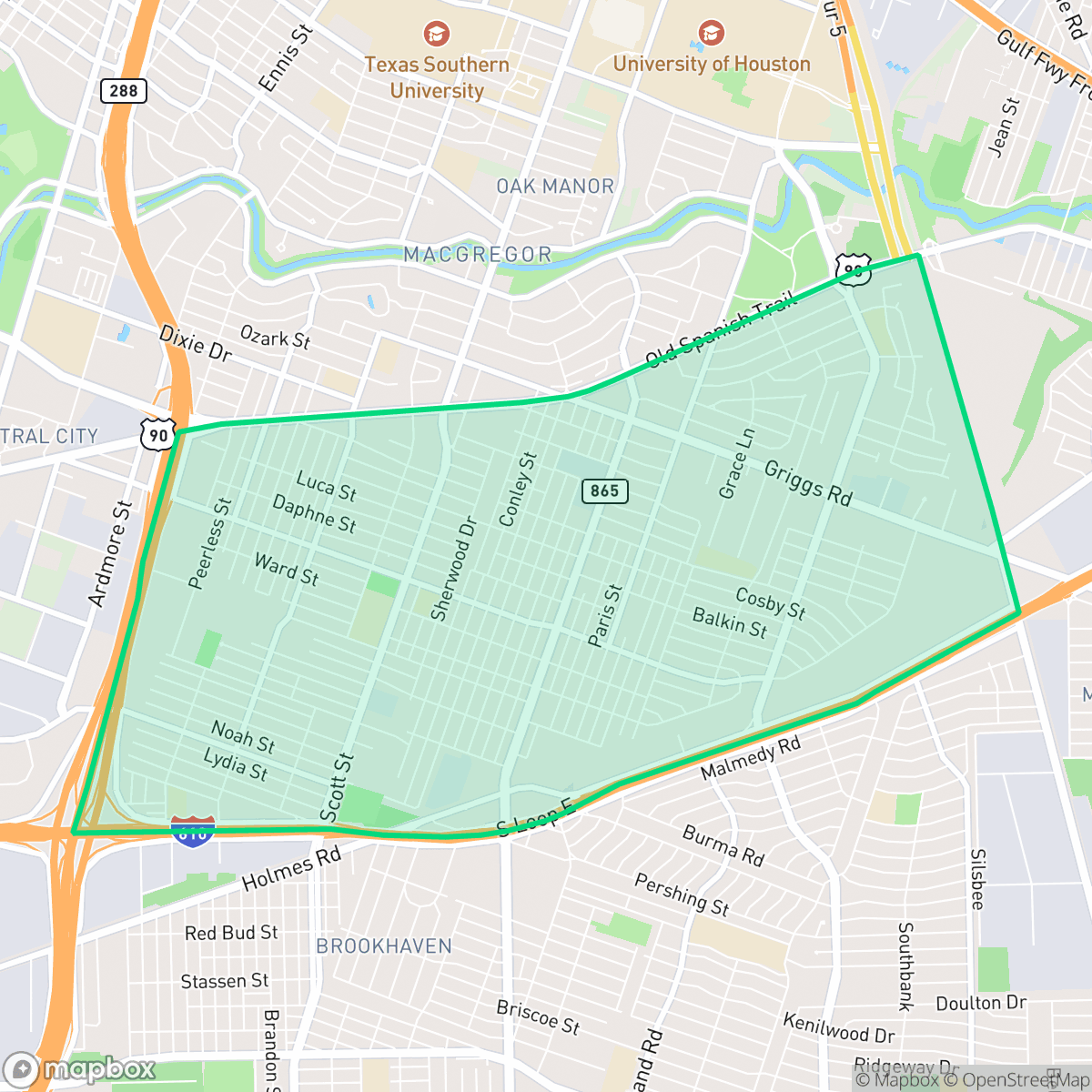
Located inside Houston’s Loop 610, the Greater OST (Old Spanish Trail)/South Union neighborhood first developed in the late 1940s and 1950s. Originally a majority-white area composed of post-World War II subdivisions like LaSalette Place and Scott Terrace, integration in the late 1960s transformed it into a thriving, middle-class African American community. The neighborhood is architecturally defined by modest ranch-style and minimal traditional homes. A major local landmark is the Palm Center on Griggs Road; opened in September 1955, it is celebrated as Houston’s first outdoor shopping mall. Historically, the area was famous for spectacular, themed Christmas light displays along Yellowstone Street. Today, local institutions like the Shrine of the Black Madonna and the Park at Palm Center continue to anchor the community’s rich cultural identity.
The area functions as a dense, suburban landscape defined by its grid-patterned streets and modest single-family homes. It maintains a distinct identity through local institutions like the Shrine of the Black Madonna and the historic Palm Center. The neighborhood is characterized by a quiet, steady rhythm, with a mix of residential zones and light industrial facilities, including warehouses and logistics hubs that support the local economy.
Prospective residents should note that the neighborhood is primarily car-dependent, as few retail services are within comfortable walking distance. While the area offers a peaceful environment, it is situated near major transit corridors and industrial sites, which contribute to moderate ambient noise levels and air quality considerations. The local school landscape is varied, featuring high-performing charter options alongside the broader Houston Independent School District. It is best suited for those seeking an established, community-focused environment with proximity to major Houston transit routes and a strong sense of local cultural heritage.
Neighborhood Scores Across 15 Qualities
Housing density is slightly higher than the Houston average, featuring a mix of detached homes and townhomes with varying distances between neighbors. Some residential sections feature narrow gaps between structures, though many areas maintain standard suburban setbacks.
Walking is possible on low-traffic residential streets, but the lack of continuous sidewalks and the presence of large industrial barriers make this area less walkable than much of Houston. Significant highway interchanges and heavy industrial blocks can also obstruct safe pedestrian movement.
Simple, boxy rooflines and modest yard spaces define the visual landscape here. This area features standard tract housing and multi-family structures that are less visually varied than the Houston average.
Public green space is relatively scarce, with most greenery consisting of private backyards rather than accessible parks. According to iHuus data, this area offers fewer walking opportunities for pets compared to the Houston average.
Residential clusters and multi-family units are closely integrated with large-scale warehouses and major transit corridors. This layout offers a suburban feel that is largely in line with the broader Houston area.
Limited local businesses and a prevalence of warehouses and freight corridors create a subdued atmosphere that is less active than the Houston average. Most essential services and dining options require a car, as walking access to shops is sparse throughout the area.
Frequent traffic and transit noise from nearby freeways and railroad tracks characterize the area. According to iHuus data, acoustic comfort in this neighborhood is lower than the Houston city average.
Air quality levels fluctuate between acceptable and unhealthy, presenting occasional concerns for sensitive groups. According to iHuus data, the air quality in this area is slightly better than the Houston average.
Active commercial and logistics operations, including rail yards and warehouses, bring notable truck traffic and noise to certain pockets of the area. This level of industrial proximity is higher than the Houston average, with some residents also residing near large-scale storage facilities and an EPA Superfund site.
Health insurance coverage in this area is slightly below the Houston average. Residents may find fewer options for local coverage compared to other parts of the city, according to iHuus data.
Voting patterns and census indicators show a significantly more liberal leaning than the Houston average, according to iHuus data.
Residents live alongside a balanced mix of young professionals, families, and older adults. According to iHuus data, this age distribution is slightly more varied than the Houston average.
Residual flood risk exists within the area, though the neighborhood maintains a higher level of safety than the Houston average according to iHuus data.
Address-Level Insights for Ost - South Union


iHuus Neighborhood Intelligence Insights
Get address-level neighborhood insights for Ost - South Union
- Street-level scores — see how individual blocks compare, not just neighborhood averages
- Micro-zone boundaries — identify quiet pockets, flood boundaries, and walkable clusters before you visit
- 15 dimensions in full — walkability, noise, air quality, school quality, insurance coverage, population age profile, urban/rural index, and more
- Boundary risk alerts — know if your address sits near a block boundary where scores drop, the kind of detail no listing will ever mention
- School insights — individual school ratings and insights, not just district-level data
- Compare before you commit — side-by-side data across neighborhoods, down to block precision
No credit card required
Compare with Any Neighborhood
| Dimension | Ost - South Union | Acres Home |
|---|---|---|
| 🚶 Walkabilityavg 7.08 | ||
| 🔊 Acoustic Comfortavg 4.14 | ||
| 🤫 Privacy Indexavg 5.34 | ||
| 🎨 Visual Appealavg 6.42 | ||
| 🐕 Dog Friendlinessavg 6.33 | ||
| 🗺️ Urban-Rural Indexavg 6.64 | ||
| ✨ Neighborhood Vibeavg 4.4 | ||
| 🏥 Health Insurance Coverageavg 5.46 | ||
| 🌿 Air Qualityavg 3.58 | ||
| 🏭 Industrial Proximityavg 6.9 | ||
| 🌊 Flood Safetyavg 6.27 | ||
| 🗳️ Ideological Leanavg 6.39 | ||
| 👥 Population Age Profileavg 4.6 | ||
| 🔥 Fire Safety | ||
| 🏫 School Quality |
Ost - South Union Rankings
School Districts Serving Ost - South Union
School Insights for Ost - South Union
Below average outcomes; significant attendance and academic challenges.
School Insights
See what's really behind every school rating near Ost - South Union
- Individual school ratings — each school's own score with outcome context, not just a district average
- Enrollment & class size data — student-to-teacher ratio and how it compares to the state average
- Full demographics breakdown — ethnicity and gender composition for every school in the enrollment zone
- Every school in the district — all schools within the enrollment boundary ranked by rating, not just the closest one
- Grade levels & benchmarks — elementary through high school, with below/above state-average flags
No credit card required