Northside Village, Houston
Updated · 30,377 residents
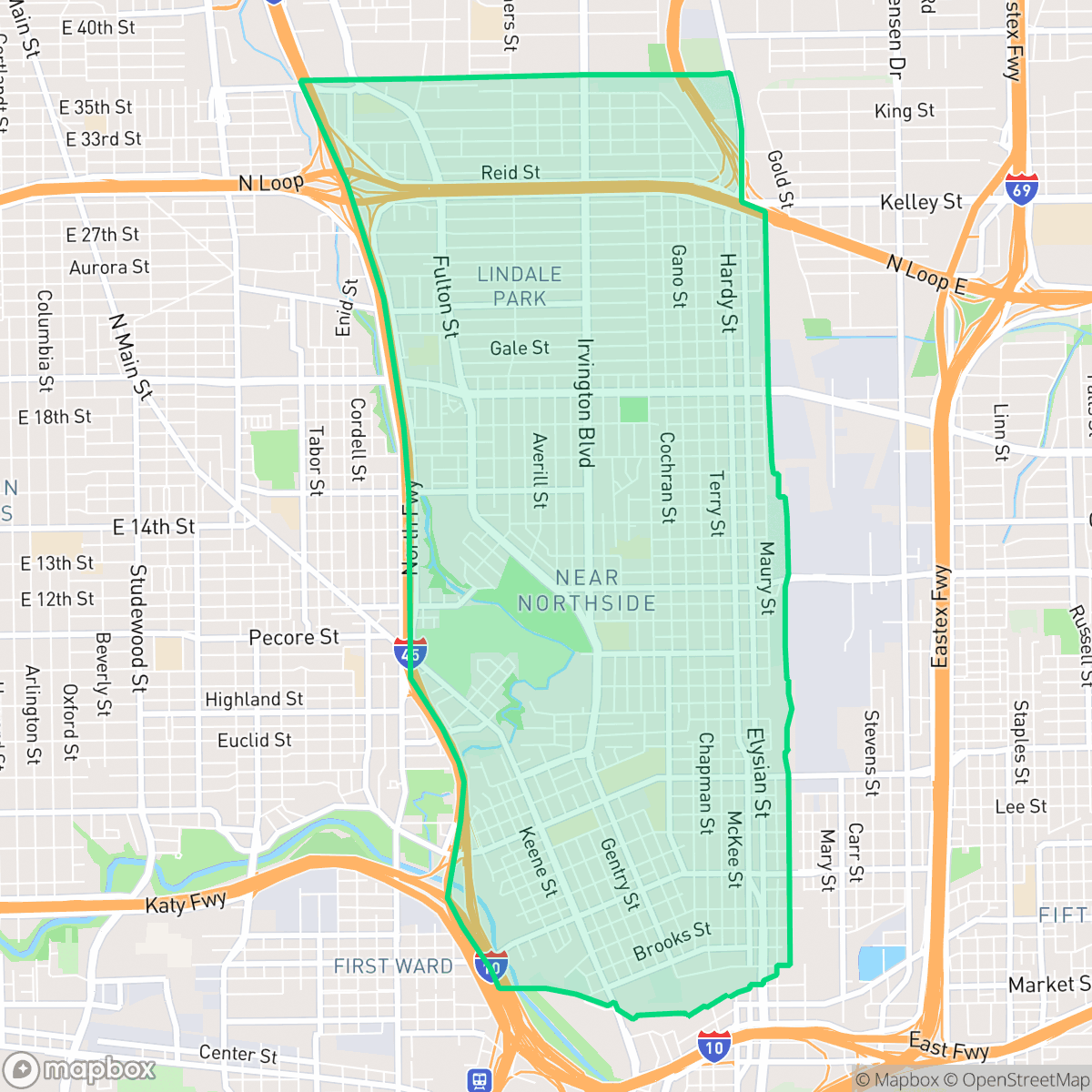
Northside Village is a historically significant, dense residential community characterized by its traditional grid layout and proximity to industrial corridors. While the area offers relatively high flood safety and access to diverse local dining, residents experience limited privacy due to closely spaced housing and consistent noise from nearby traffic and rail lines.
Key Highlights
About Northside Village
Developed in the 1880s following the expansion of the nearby Hardy Rail Yards, Houston’s Near Northside (also known as Northside Village) began as a working-class enclave for European immigrants before evolving into a predominantly Hispanic community after World War II. The neighborhood’s historic building stock features early-20th-century bungalows, the 1911 Southern Pacific Hospital, and the 1924 Jefferson Davis Hospital (now the Elder Street Artist Lofts). In 1954, the construction of the Elysian Viaduct physically altered the community, and a portion of the neighborhood was listed on the National Register of Historic Places in 2011 to protect its remaining historic homes. Culturally, Northside Village is anchored by Moody Park, the site of the historic 1978 Moody Park Riots, which catalyzed significant local police reforms and galvanized the city’s Mexican-American civil rights movement.
The neighborhood functions as a dense urban grid that balances single-family residential blocks with pockets of light industrial activity and warehouse space. It maintains a distinct identity through its modest architectural style, featuring compact lots and simple, functional home designs. Residents benefit from a variety of local taquerias and casual eateries scattered throughout the area, though the layout remains largely car-dependent due to fragmented sidewalk networks and the presence of major thoroughfares that create pedestrian barriers.
Prospective residents should consider the trade-offs of living in a central, industrial-adjacent location. While the community provides better-than-average flood protection, the proximity to rail infrastructure and heavy traffic contributes to a higher noise profile. According to iHuus data, the area is well-suited for those prioritizing central access and cultural heritage over seclusion or expansive private green space, as public park access is limited compared to neighboring districts.
Neighborhood Scores Across 15 Qualities
Residential spacing is roughly average for Houston, featuring a mix of detached homes and denser multi-family structures. Many houses sit close to property lines, which can limit visual privacy between neighbors.
Residential streets are generally quiet and navigable, but a fragmented sidewalk network and nearby highway corridors create significant barriers for pedestrians. According to iHuus data, walkability in this area is lower than the Houston average.
Standard tract housing and small-lot homes define the local landscape, which features simple rooflines and limited private greenery. This area lacks the lush landscaping and luxury amenities found more frequently across the city.
Public park access and wide sidewalk verges are below the Houston average. Most greenery is contained within private, fenced backyards rather than accessible public areas.
A blend of residential grids and industrial warehouses characterizes this area, which maintains a density slightly lower than the Houston average. Residents will find a landscape of single-family homes interspersed with significant logistics and transportation infrastructure.
A tranquil, suburban atmosphere prevails here, characterized by light industrial units and warehouses. While various dining options and services are available, the area is less active than the Houston average and relies heavily on vehicle travel.
Frequent sounds from nearby freeway traffic and rail lines characterize the area. According to iHuus data, acoustic comfort is lower than the Houston average.
Air quality levels in this area experience periodic fluctuations between acceptable and unhealthy conditions. According to iHuus data, these conditions are notably better than the average seen across Houston.
Light commercial activity and service-oriented businesses are interspersed with residential areas, though the presence of a nearby EPA Superfund site may involve environmental considerations regarding soil and groundwater. This level of industrial proximity is notably lower than the Houston average, as the area lacks the massive logistics hubs and heavy freight traffic found elsewhere in the city.
Health insurance access among residents is slightly below the Houston average. According to iHuus data, a notable portion of the population lacks coverage.
Political leanings in this area are notably more liberal than the Houston average, according to iHuus data.
Residents live alongside a balanced mix of young professionals, families, and seniors. According to iHuus data, this demographic distribution is slightly more varied than the typical Houston profile.
Residual flood risk exists within the area, though safety levels remain above the Houston average according to iHuus data.
Address-Level Insights for Northside Village


iHuus Neighborhood Intelligence Insights
Get address-level neighborhood insights for Northside Village
- Street-level scores — see how individual blocks compare, not just neighborhood averages
- Micro-zone boundaries — identify quiet pockets, flood boundaries, and walkable clusters before you visit
- 15 dimensions in full — walkability, noise, air quality, school quality, insurance coverage, population age profile, urban/rural index, and more
- Boundary risk alerts — know if your address sits near a block boundary where scores drop, the kind of detail no listing will ever mention
- School insights — individual school ratings and insights, not just district-level data
- Compare before you commit — side-by-side data across neighborhoods, down to block precision
No credit card required
Compare with Any Neighborhood
| Dimension | Northside Village | Acres Home |
|---|---|---|
| 🚶 Walkabilityavg 7.08 | ||
| 🔊 Acoustic Comfortavg 4.14 | ||
| 🤫 Privacy Indexavg 5.34 | ||
| 🎨 Visual Appealavg 6.42 | ||
| 🐕 Dog Friendlinessavg 6.33 | ||
| 🗺️ Urban-Rural Indexavg 6.64 | ||
| ✨ Neighborhood Vibeavg 4.4 | ||
| 🏥 Health Insurance Coverageavg 5.46 | ||
| 🌿 Air Qualityavg 3.58 | ||
| 🏭 Industrial Proximityavg 6.9 | ||
| 🌊 Flood Safetyavg 6.27 | ||
| 🗳️ Ideological Leanavg 6.39 | ||
| 👥 Population Age Profileavg 4.6 | ||
| 🔥 Fire Safety | ||
| 🏫 School Quality |
Northside Village Rankings
School Districts Serving Northside Village
School Insights for Northside Village
Below average outcomes; significant attendance and academic challenges.
School Insights
See what's really behind every school rating near Northside Village
- Individual school ratings — each school's own score with outcome context, not just a district average
- Enrollment & class size data — student-to-teacher ratio and how it compares to the state average
- Full demographics breakdown — ethnicity and gender composition for every school in the enrollment zone
- Every school in the district — all schools within the enrollment boundary ranked by rating, not just the closest one
- Grade levels & benchmarks — elementary through high school, with below/above state-average flags
No credit card required