Neartown - Montrose, Houston
Updated · 32,904 residents
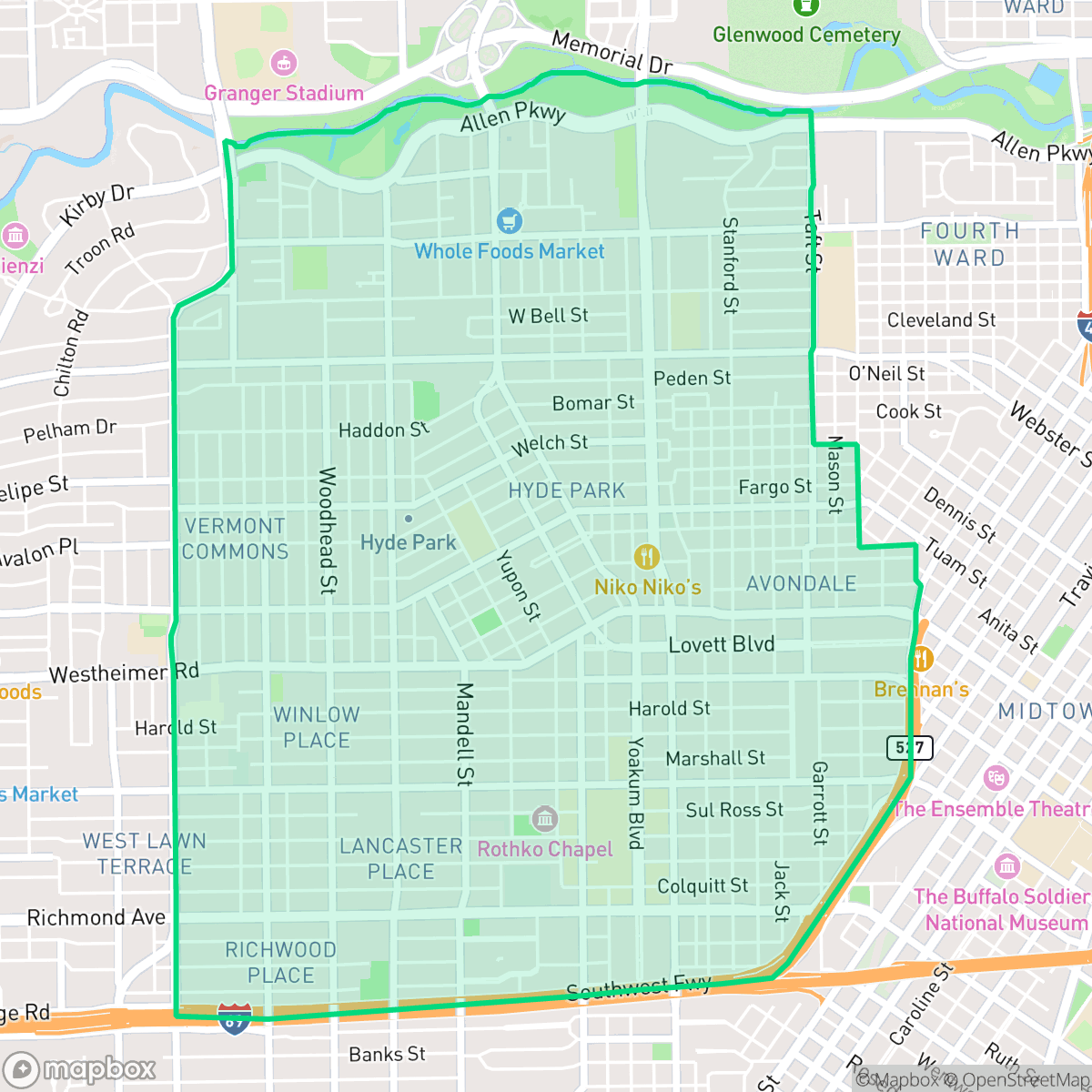
Neartown - Montrose is a highly walkable urban district defined by its dense grid of historic homes, modern townhouses, and vibrant cultural institutions. Residents benefit from high health insurance coverage and a lively atmosphere, though the area features tightly packed residential lots with limited privacy and moderate noise levels from road traffic.
Key Highlights
About Neartown - Montrose
Platted in 1911 by developer J. W. Link, Neartown - Montrose was originally envisioned as a premier streetcar suburb featuring wide, landscaped boulevards. Its historic architectural stock ranges from grand mansions, like the Link-Lee Mansion, to Craftsman, Prairie, and Colonial Revival bungalows. To protect the area's distinct character, residents formed the Neartown Association in 1963. By the 1970s and 1980s, the neighborhood evolved into Houston’s bohemian epicenter and the heart of its LGBT community. It became famous for the Westheimer Street Festival and historic venues like the Numbers nightclub. Today, Montrose remains a major cultural hub, anchored by world-renowned landmarks such as the Menil Collection and the non-denominational Rothko Chapel.
Neartown - Montrose is a dense, centrally located urban hub characterized by a mix of historic bungalows and modern residential infill. The area maintains a high degree of walkability, with a consistent grid of sidewalks providing easy access to local dining, galleries, and public spaces like the Menil Collection. Its urban fabric is marked by a blend of multi-story apartments and closely spaced single-family homes, creating a high-energy environment that consistently ranks well for social activity and cultural engagement. According to iHuus data, the neighborhood stands out for its strong health insurance coverage and lack of industrial hazards, making it a stable choice for those seeking an active, urban lifestyle.
Potential residents should note that the neighborhood prioritizes connectivity over seclusion, as many properties share walls or sit on narrow lots with minimal yard buffers. While the area is free from industrial activity, residents may experience moderate noise levels from local road traffic. The local school landscape is served by the Houston Independent School District, which offers access to high-performing magnet programs despite broader institutional challenges. This area is well-suited for those who value a pedestrian-oriented lifestyle and proximity to the city center over the privacy of a traditional suburban lot.
Neighborhood Scores Across 15 Qualities
Residential spacing is quite tight due to many shared-wall townhomes and closely packed apartments, making privacy lower than the Houston average. Some detached houses provide more separation through tree buffers, but much of the area features high-density living with very narrow gaps between structures.
Dense sidewalk networks and frequent crosswalks make navigating the area on foot easy. This level of pedestrian connectivity is significantly higher than the Houston average, although the central freeway remains a notable barrier to movement.
Upscale residential architecture and manicured landscaping create a visually pleasing environment that is notably more attractive than the Houston average. The area features a mix of modern luxury apartment complexes, custom homes with private pools, and well-maintained institutional grounds.
Tree-lined sidewalks and small local parks provide adequate walking areas for pets, though the density of townhomes means public green space is somewhat limited compared to the city average. Many residential blocks feature grass verges and shaded paths, according to iHuus data.
Residential streets and green spaces exist in equal measure to developed blocks. This area is less densely urbanized than the Houston average, featuring a blend of multi-story apartments and detached single-family homes.
Diverse dining, galleries, and social hubs create a constant sense of movement that is significantly more vibrant than the Houston average. Residents can experience a dense mix of mid-rise urban centers and lush green spaces, though some areas remain car-dependent due to proximity to major highways.
Steady traffic noise from nearby busy thoroughfares is common here, though acoustic comfort remains slightly higher than the Houston average according to iHuus data.
Air quality levels fluctuate between acceptable and unhealthy, posing occasional concerns for sensitive groups. According to iHuus data, the air quality in this area is slightly better than the Houston city average.
Industrial activity and warehouses are absent from this area. Residents can expect an environment consisting exclusively of residential, commercial, and institutional spaces, which is significantly cleaner of heavy industry than the Houston average.
Health insurance enrollment among residents is significantly higher than the Houston average, according to iHuus data. This indicates a well-covered population with greater access to medical services.
Political leanings in this area are significantly more liberal than the Houston average. Residents will find a community characterized by a strong progressive majority.
Residents live alongside a balanced mix of young professionals, families, and older adults. This demographic variety is slightly more widespread than the average found across Houston.
Some residual flood risk exists because parts of the area fall within a 500-year floodplain, though the safety level remains above the Houston city average according to iHuus data.
Address-Level Insights for Neartown - Montrose


iHuus Neighborhood Intelligence Insights
Get address-level neighborhood insights for Neartown - Montrose
- Street-level scores — see how individual blocks compare, not just neighborhood averages
- Micro-zone boundaries — identify quiet pockets, flood boundaries, and walkable clusters before you visit
- 15 dimensions in full — walkability, noise, air quality, school quality, insurance coverage, population age profile, urban/rural index, and more
- Boundary risk alerts — know if your address sits near a block boundary where scores drop, the kind of detail no listing will ever mention
- School insights — individual school ratings and insights, not just district-level data
- Compare before you commit — side-by-side data across neighborhoods, down to block precision
No credit card required
Compare with Any Neighborhood
| Dimension | Neartown - Montrose | Acres Home |
|---|---|---|
| 🚶 Walkabilityavg 7.08 | ||
| 🔊 Acoustic Comfortavg 4.14 | ||
| 🤫 Privacy Indexavg 5.34 | ||
| 🎨 Visual Appealavg 6.42 | ||
| 🐕 Dog Friendlinessavg 6.33 | ||
| 🗺️ Urban-Rural Indexavg 6.64 | ||
| ✨ Neighborhood Vibeavg 4.4 | ||
| 🏥 Health Insurance Coverageavg 5.46 | ||
| 🌿 Air Qualityavg 3.58 | ||
| 🏭 Industrial Proximityavg 6.9 | ||
| 🌊 Flood Safetyavg 6.27 | ||
| 🗳️ Ideological Leanavg 6.39 | ||
| 👥 Population Age Profileavg 4.6 | ||
| 🔥 Fire Safety | ||
| 🏫 School Quality |
Neartown - Montrose Rankings
School Districts Serving Neartown - Montrose
School Insights for Neartown - Montrose
Below average outcomes; significant attendance and academic challenges.
School Insights
See what's really behind every school rating near Neartown - Montrose
- Individual school ratings — each school's own score with outcome context, not just a district average
- Enrollment & class size data — student-to-teacher ratio and how it compares to the state average
- Full demographics breakdown — ethnicity and gender composition for every school in the enrollment zone
- Every school in the district — all schools within the enrollment boundary ranked by rating, not just the closest one
- Grade levels & benchmarks — elementary through high school, with below/above state-average flags
No credit card required