Near Northwest, Houston
Updated · 73,359 residents
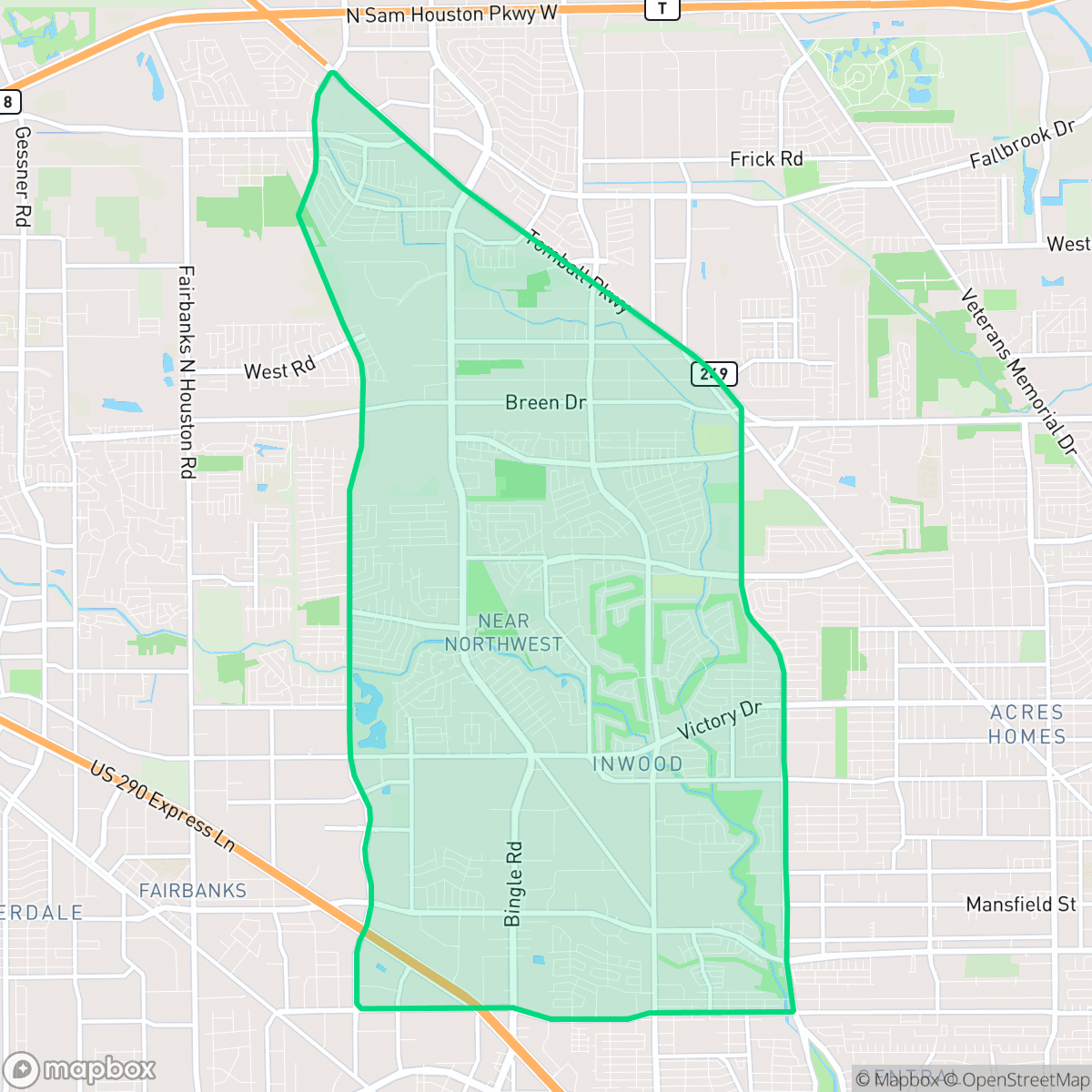
Near Northwest is a sprawling 16-square-mile district defined by its mix of mid-century residential architecture and active industrial logistics corridors. While the area offers residents consistent sidewalk access and proximity to the scenic White Oak Bayou, it remains a largely car-dependent environment with a quiet, suburban pace.
Key Highlights
About Near Northwest
The Near Northwest district in Houston, Texas, is a 16-square-mile area managed by the Near Northwest Management District, established in 2001. Historically, the area along White Oak Bayou was settled by German-American farmers in the 1860s, notably the Fuchs family, who owned much of the land for a century. In the 1960s and 1970s, the area transformed into a residential hub with mid-century modern subdivisions like Inwood Forest, which were originally developed for oil company executives. Today, Near Northwest is characterized by a mix of mid-century and modern homes, extensive green spaces like Alabonson Park, and the scenic White Oak Bayou Trail, which serves as a central recreational landmark for the community.
The neighborhood serves as a significant residential and industrial hub in Houston, balancing quiet suburban pockets with large-scale logistics infrastructure. Residents benefit from a network of connected streets and consistent sidewalk access, which supports moderate walkability throughout the area. The landscape is characterized by a blend of mid-century tract housing and denser multi-family developments, often situated near expansive green spaces like Alabonson Park. According to iHuus data, the area maintains a distinct suburban feel that integrates industrial zones, creating a unique environment where residential life frequently borders warehouse and distribution centers.
Prospective residents should consider the area's car-dependent nature, as daily errands and local services often require driving despite the presence of pedestrian infrastructure. While the neighborhood provides ample green verges and park access for pet owners, the presence of heavy logistics hubs and freight corridors contributes to localized road noise and truck traffic. The educational landscape is diverse, spanning multiple school districts with varying performance levels, which may influence housing choices. This area is best suited for those seeking a functional, residential setting that offers a balance of green space and accessibility to major regional transport routes.
Neighborhood Scores Across 15 Qualities
Residential spacing fluctuates between closely packed townhomes and detached houses with moderate yard buffers. This level of density is roughly aligned with the Houston average, according to iHuus data.
Connected residential streets and sidewalks provide safe pedestrian access throughout much of the area, though connectivity can be interrupted by large highway interchanges and industrial zones. Overall, the walkability is slightly below the Houston average.
Visual interest varies across the area, ranging from manicured lawns and private pools in affluent pockets to standard tract housing and industrial blocks. This level of visual appeal is slightly below the Houston average according to iHuus data.
Extensive drainage corridors, green verges, and nearby parkland provide ample space for pet owners. According to iHuus data, these accessible natural areas make the neighborhood slightly more dog friendly than the Houston average.
Residential pockets transition frequently into large-scale warehouse districts and industrial corridors. This landscape offers a suburban feel that is slightly more open than the typical Houston urban density.
Local activity is primarily concentrated around major highways and industrial corridors, making most daily errands and dining destinations dependent on a vehicle. While some pockets offer walkable social hubs, the overall energy and frequency of amenities are lower than the Houston average.
Steady sounds from nearby busy streets are common here, which is roughly in line with the city average according to iHuus data.
Air quality levels fluctuate between acceptable and unhealthy, presenting occasional concerns for sensitive groups. This area maintains a slightly better air quality profile than the Houston average, according to iHuus data.
Logistics hubs, warehouses, and rail infrastructure create pockets of increased truck traffic and noise. This level of industrial proximity is lower than the Houston average, as many areas remain primarily residential or light commercial.
Health insurance enrollment among residents is lower than the Houston average, according to iHuus data. This indicates a higher proportion of uninsured individuals living in the area.
Political leanings in this area are notably more liberal than the Houston average. Residents will find a predominantly progressive community with a modest presence of opposing viewpoints, according to iHuus data.
Residents live alongside a balanced mix of young professionals, families, and seniors. This demographic spread is largely consistent with the broader Houston area, according to iHuus data.
Flood safety levels in this area are lower than the Houston average because FEMA has not yet completed a detailed flood study for this specific location. Residents should exercise caution as the precise level of risk remains undetermined according to iHuus data.
Address-Level Insights for Near Northwest


iHuus Neighborhood Intelligence Insights
Get address-level neighborhood insights for Near Northwest
- Street-level scores — see how individual blocks compare, not just neighborhood averages
- Micro-zone boundaries — identify quiet pockets, flood boundaries, and walkable clusters before you visit
- 15 dimensions in full — walkability, noise, air quality, school quality, insurance coverage, population age profile, urban/rural index, and more
- Boundary risk alerts — know if your address sits near a block boundary where scores drop, the kind of detail no listing will ever mention
- School insights — individual school ratings and insights, not just district-level data
- Compare before you commit — side-by-side data across neighborhoods, down to block precision
No credit card required
Compare with Any Neighborhood
| Dimension | Near Northwest | Acres Home |
|---|---|---|
| 🚶 Walkabilityavg 7.08 | ||
| 🔊 Acoustic Comfortavg 4.14 | ||
| 🤫 Privacy Indexavg 5.34 | ||
| 🎨 Visual Appealavg 6.42 | ||
| 🐕 Dog Friendlinessavg 6.33 | ||
| 🗺️ Urban-Rural Indexavg 6.64 | ||
| ✨ Neighborhood Vibeavg 4.4 | ||
| 🏥 Health Insurance Coverageavg 5.46 | ||
| 🌿 Air Qualityavg 3.58 | ||
| 🏭 Industrial Proximityavg 6.9 | ||
| 🌊 Flood Safetyavg 6.27 | ||
| 🗳️ Ideological Leanavg 6.39 | ||
| 👥 Population Age Profileavg 4.6 | ||
| 🔥 Fire Safety | ||
| 🏫 School Quality |
Near Northwest Rankings
School Districts Serving Near Northwest
School Insights for Near Northwest
Below average outcomes; significant attendance and academic challenges.
School Insights
See what's really behind every school rating near Near Northwest
- Individual school ratings — each school's own score with outcome context, not just a district average
- Enrollment & class size data — student-to-teacher ratio and how it compares to the state average
- Full demographics breakdown — ethnicity and gender composition for every school in the enrollment zone
- Every school in the district — all schools within the enrollment boundary ranked by rating, not just the closest one
- Grade levels & benchmarks — elementary through high school, with below/above state-average flags
No credit card required