Midtown, Houston
Updated · 7,841 residents
Midtown is a high-energy, dense urban hub in Houston known for its exceptional walkability and vibrant nightlife. Residents enjoy a concrete-dominant landscape filled with modern townhomes, diverse dining options, and proximity to major city landmarks, though the area experiences notable traffic noise and limited private green space.
Key Highlights
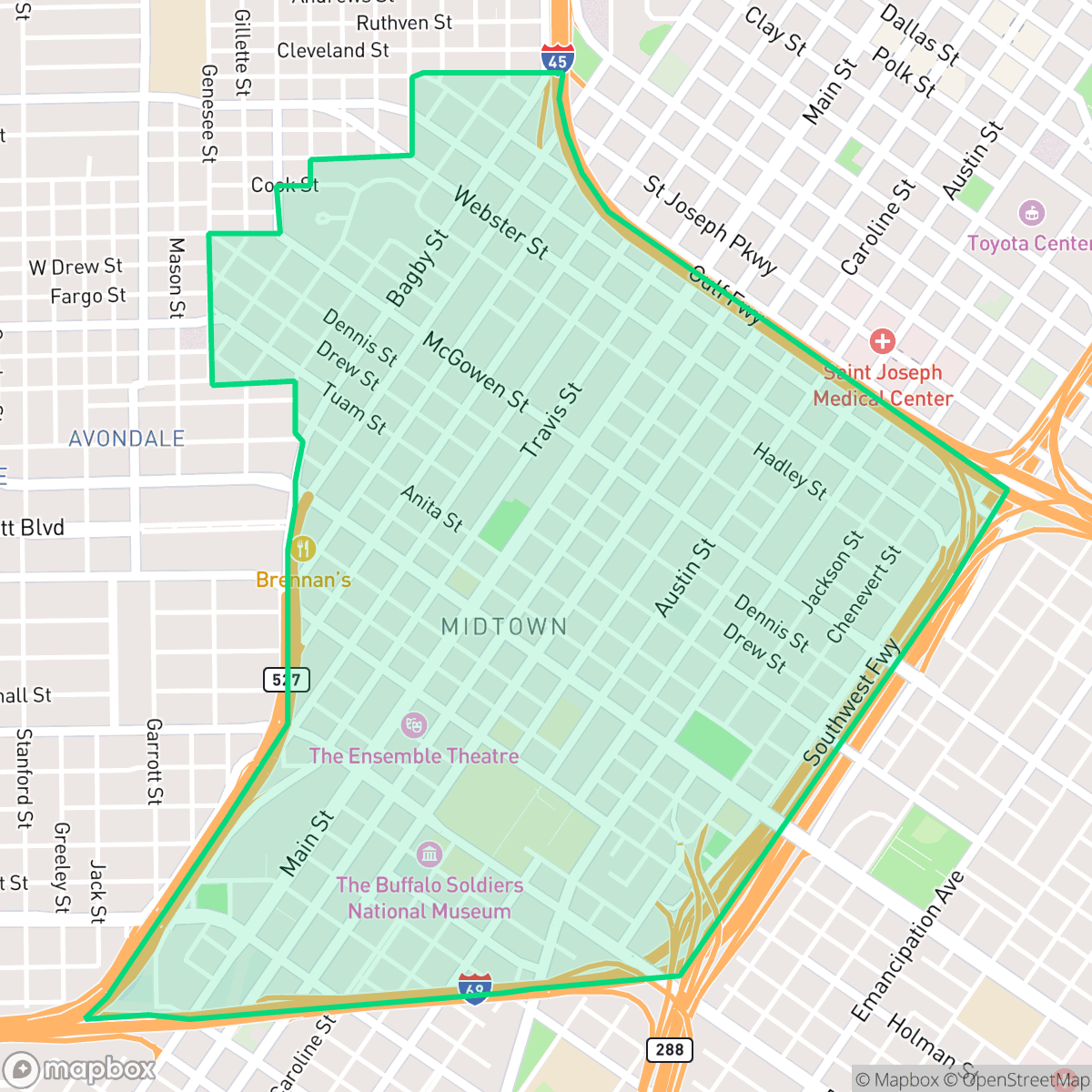
About Midtown
Established in the late 19th century as a fashionable Victorian-style residential neighborhood, Midtown was originally divided between Houston's Third and Fourth Wards. By the early 20th century, encroaching commercial development and heavy traffic drove affluent residents away, leaving behind a mix of aging homes, low-rise commercial buildings, and historic landmarks like Isabella Court. For decades, the area's stability was anchored by local churches and the Houston Community College Central campus, housed in the historic San Jacinto High School building. In the 1970s, Vietnamese immigrants transformed the area, establishing a vibrant "Little Saigon" business district along Milam, Webster, Fannin, and San Jacinto streets. The formation of the Midtown Redevelopment Authority in the early 1990s sparked a major renaissance, converting Midtown into a dense, walkable, and arts-focused urban core.
This neighborhood is defined by its dense, transit-oriented layout, featuring a mix of high-rise apartment complexes and modern townhome developments. As a primary social center for the city, the area offers a wide array of international dining, bars, and cultural venues that contribute to its high level of daily activity. The consistent grid-based street network and well-maintained sidewalks make it one of the most accessible areas in Houston for pedestrians, providing seamless navigation between residential blocks and commercial clusters.
Living in this environment requires adjusting to a fast-paced urban rhythm, as the proximity to major highways results in elevated noise levels and a dense, concrete-focused aesthetic. While the area offers excellent access to city amenities, those seeking quiet, expansive yards or high levels of privacy may find the tightly packed residential structures challenging. It is best suited for individuals who prioritize convenience, walkability, and a central location over suburban tranquility.
Neighborhood Scores Across 15 Qualities
Dense apartment blocks and shared-wall townhomes create a more crowded living environment than the Houston average. According to iHuus data, residents may experience less separation between neighboring structures due to the prevalence of high-density housing.
A consistent sidewalk network and a structured grid pattern offer better pedestrian connectivity than the Houston average. While the central freeway acts as a significant barrier, pedestrian bridges and well-connected residential blocks facilitate easy movement within the neighborhood.
Landscapes vary from affluent pockets with mature landscaping and private pools to dense clusters of modern townhomes. According to iHuus data, the visual variety in Midtown sits slightly above the Houston city average.
Access to large public parks and green spaces is below the Houston average. While some residential streets feature tree canopies and grass verges, much of the area consists of dense townhomes with limited dedicated pet areas according to iHuus data.
Residential streets and green spaces exist in equal measure, creating a landscape that is less densely urban than the Houston average. According to iHuus data, the area features a transition between mid-rise apartment blocks and established single-family homes.
Dense clusters of high-rises, diverse dining options, and active social hubs create a much more energetic atmosphere than the Houston average. Residents can access a wide variety of restaurants and cultural landmarks within a highly active, concrete-dominant landscape.
Frequent acoustic disturbances from nearby railroad tracks and heavy freeway traffic characterize the area. According to iHuus data, noise levels in Midtown are higher than the typical Houston average.
Air quality in Midtown fluctuates between acceptable and unhealthy levels, though it remains better than the Houston average according to iHuus data. Sensitive groups should remain cautious during days when pollutants are more prevalent.
Industrial presence is minimal in this area, as the neighborhood consists almost entirely of residential, commercial, and institutional structures. According to iHuus data, this lack of warehouses or hazardous facilities is notably lower than the Houston average.
Health insurance coverage among Midtown residents is notably higher than the Houston city average, according to iHuus data.
Voting patterns and census indicators show a significantly more liberal political leaning than the Houston average. According to iHuus data, this area is characterized by a highly progressive demographic profile.
Residents live alongside a balanced mix of young professionals, families, and seniors. This age distribution is slightly more varied than the typical profile seen across Houston.
Flood risk in this area is notably higher than the Houston average due to its location within a 500-year floodplain. According to iHuus data, residents should account for some residual flood risk during extreme weather events.
Address-Level Insights for Midtown


iHuus Neighborhood Intelligence Insights
Get address-level neighborhood insights for Midtown
- Street-level scores — see how individual blocks compare, not just neighborhood averages
- Micro-zone boundaries — identify quiet pockets, flood boundaries, and walkable clusters before you visit
- 15 dimensions in full — walkability, noise, air quality, school quality, insurance coverage, population age profile, urban/rural index, and more
- Boundary risk alerts — know if your address sits near a block boundary where scores drop, the kind of detail no listing will ever mention
- School insights — individual school ratings and insights, not just district-level data
- Compare before you commit — side-by-side data across neighborhoods, down to block precision
No credit card required
Compare with Any Neighborhood
| Dimension | Midtown | Acres Home |
|---|---|---|
| 🚶 Walkabilityavg 7.08 | ||
| 🔊 Acoustic Comfortavg 4.14 | ||
| 🤫 Privacy Indexavg 5.34 | ||
| 🎨 Visual Appealavg 6.42 | ||
| 🐕 Dog Friendlinessavg 6.33 | ||
| 🗺️ Urban-Rural Indexavg 6.64 | ||
| ✨ Neighborhood Vibeavg 4.4 | ||
| 🏥 Health Insurance Coverageavg 5.46 | ||
| 🌿 Air Qualityavg 3.58 | ||
| 🏭 Industrial Proximityavg 6.9 | ||
| 🌊 Flood Safetyavg 6.27 | ||
| 🗳️ Ideological Leanavg 6.39 | ||
| 👥 Population Age Profileavg 4.6 | ||
| 🔥 Fire Safety | ||
| 🏫 School Quality |
Midtown Rankings
School Districts Serving Midtown
School Insights for Midtown
Below average outcomes; significant attendance and academic challenges.
School Insights
See what's really behind every school rating near Midtown
- Individual school ratings — each school's own score with outcome context, not just a district average
- Enrollment & class size data — student-to-teacher ratio and how it compares to the state average
- Full demographics breakdown — ethnicity and gender composition for every school in the enrollment zone
- Every school in the district — all schools within the enrollment boundary ranked by rating, not just the closest one
- Grade levels & benchmarks — elementary through high school, with below/above state-average flags
No credit card required