Meyerland Area, Houston
Updated · 24,635 residents
Meyerland is a historic, affluent community defined by its mid-century modern architecture and deep cultural roots. The area provides a quiet, residential environment with high-performing local schools and a consistent sidewalk network that makes it notably walkable for a suburban setting.
Key Highlights
About Meyerland Area
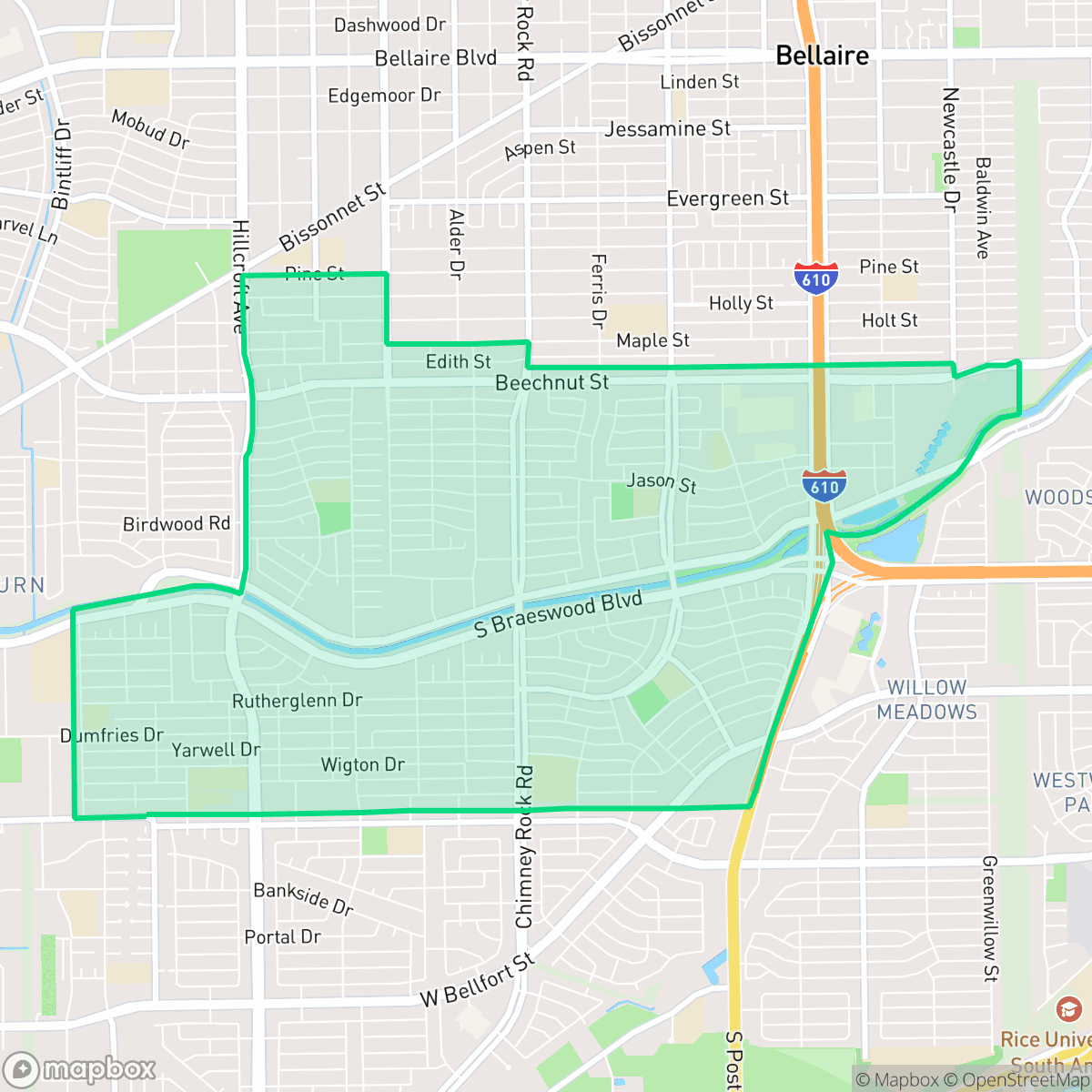
Developed in 1955 by George Meyer on 1,200 acres of former rice fields, the Meyerland Area in southwest Houston began as one of the city's premier deed-restricted, mid-century suburban developments. Its grand opening featured a ribbon-cutting ceremony by then-Vice President Richard Nixon. The neighborhood originally showcased mid-century modern and ranch-style homes, including designs by renowned architects like Philip Johnson. Culturally, Meyerland serves as the historic heart of Houston’s Jewish community, hosting key institutions such as the Evelyn Rubenstein Jewish Community Center, Congregation Beth Israel, and Congregation Beth Yeshurun, the nation's largest Conservative synagogue. Centered around Brays Bayou, the area is also anchored by the historic Meyerland Plaza shopping center, which opened in 1957 and remains a local commercial landmark.
The neighborhood balances a serene, suburban landscape with proximity to essential retail and civic institutions. Residents benefit from a high density of private swimming pools and well-manicured properties, contributing to a strong visual appeal. According to iHuus data, the area maintains a distinct residential character, free from heavy industrial hazards, and is served by well-regarded local schools such as Herod Elementary and Meyerland Middle.
Despite these benefits, the area presents specific trade-offs for prospective residents. The neighborhood faces significant challenges regarding flood safety, requiring careful consideration of property-specific risk. While the local schools are highly rated, they operate within the broader Houston Independent School District, which currently faces institutional instability. Additionally, residents should expect moderate noise levels from nearby road traffic, though the overall environment remains quiet compared to more central urban districts. It is best suited for families and professionals seeking a stable, established community who are prepared to navigate the area's environmental and institutional complexities.
Neighborhood Scores Across 15 Qualities
Residential spacing varies between detached homes with private yards and denser apartment sections. According to iHuus data, privacy buffers are slightly higher than the Houston average due to the mix of moderate-density housing and larger lot footprints.
Pedestrian infrastructure is well-developed here, featuring a comprehensive sidewalk network and scenic trails along the bayou. According to iHuus data, the connectivity and safety of these routes are notably higher than the Houston average.
Manicured landscapes and a high density of private swimming pools create a visually polished environment that is more aesthetically pleasing than the Houston average. According to iHuus data, the area features many large, well-maintained homes with expansive driveways and complex architectural details.
Extensive canal-side trails and large sports complexes provide ample public space for pets, offering more walking options than the Houston average. While many homes feature private fenced yards, some residential streets have narrow sidewalk verges that can limit space for public strolls.
A mix of single-family homes and apartment complexes creates a dense suburban environment that is very similar to the Houston average. Large tree canopies and integrated commercial strips provide a balanced distribution of greenery and infrastructure across the area.
Suburban streets and green spaces dominate the landscape, offering a serene environment with a steady but limited rhythm of local services. While some dining and essential amenities are reachable on foot, the area lacks the high density of activity found in more urban parts of the city.
Steady traffic sounds from nearby busy streets are present, though the acoustic environment remains slightly more tranquil than the Houston average according to iHuus data.
Frequent unhealthy air quality levels pose significant risks to sensitive groups. According to iHuus data, conditions in this area are worse than the Houston city average.
Residential and light commercial zones dominate the area, offering much less exposure to heavy industrial activity than the Houston average. While a wastewater treatment facility exists on the periphery, the neighborhood is largely free of large warehouses or industrial hazards according to iHuus data.
Health insurance enrollment among residents is notably higher than the Houston average, according to iHuus data.
Political leanings in this area are split nearly evenly between conservative and liberal perspectives, reflecting a distribution that is very similar to the Houston average.
A balanced mix of young professionals, established families, and older adults resides here, representing a demographic spread slightly more varied than the Houston average. According to iHuus data, this variety creates a multi-generational residential environment.
Significant flood risk exists here as the area is located within a 100-year floodplain, which is notably higher than the Houston average. Residents should expect that flood insurance is typically required for properties in this neighborhood according to iHuus data.
Address-Level Insights for Meyerland Area


iHuus Neighborhood Intelligence Insights
Get address-level neighborhood insights for Meyerland Area
- Street-level scores — see how individual blocks compare, not just neighborhood averages
- Micro-zone boundaries — identify quiet pockets, flood boundaries, and walkable clusters before you visit
- 15 dimensions in full — walkability, noise, air quality, school quality, insurance coverage, population age profile, urban/rural index, and more
- Boundary risk alerts — know if your address sits near a block boundary where scores drop, the kind of detail no listing will ever mention
- School insights — individual school ratings and insights, not just district-level data
- Compare before you commit — side-by-side data across neighborhoods, down to block precision
No credit card required
Compare with Any Neighborhood
| Dimension | Meyerland Area | Acres Home |
|---|---|---|
| 🚶 Walkabilityavg 7.08 | ||
| 🔊 Acoustic Comfortavg 4.14 | ||
| 🤫 Privacy Indexavg 5.34 | ||
| 🎨 Visual Appealavg 6.42 | ||
| 🐕 Dog Friendlinessavg 6.33 | ||
| 🗺️ Urban-Rural Indexavg 6.64 | ||
| ✨ Neighborhood Vibeavg 4.4 | ||
| 🏥 Health Insurance Coverageavg 5.46 | ||
| 🌿 Air Qualityavg 3.58 | ||
| 🏭 Industrial Proximityavg 6.9 | ||
| 🌊 Flood Safetyavg 6.27 | ||
| 🗳️ Ideological Leanavg 6.39 | ||
| 👥 Population Age Profileavg 4.6 | ||
| 🔥 Fire Safety | ||
| 🏫 School Quality |
Meyerland Area Rankings
School Districts Serving Meyerland Area
School Insights for Meyerland Area
Below average outcomes; significant attendance and academic challenges.
School Insights
See what's really behind every school rating near Meyerland Area
- Individual school ratings — each school's own score with outcome context, not just a district average
- Enrollment & class size data — student-to-teacher ratio and how it compares to the state average
- Full demographics breakdown — ethnicity and gender composition for every school in the enrollment zone
- Every school in the district — all schools within the enrollment boundary ranked by rating, not just the closest one
- Grade levels & benchmarks — elementary through high school, with below/above state-average flags
No credit card required