Medical Center Area, Houston
Updated · 6,009 residents
The Medical Center Area is an exceptionally walkable urban district defined by its dense collection of world-class clinical facilities and high-rise research centers. While it offers a professional environment with high access to healthcare, residents experience limited privacy and noticeable road noise.
Key Highlights
About Medical Center Area
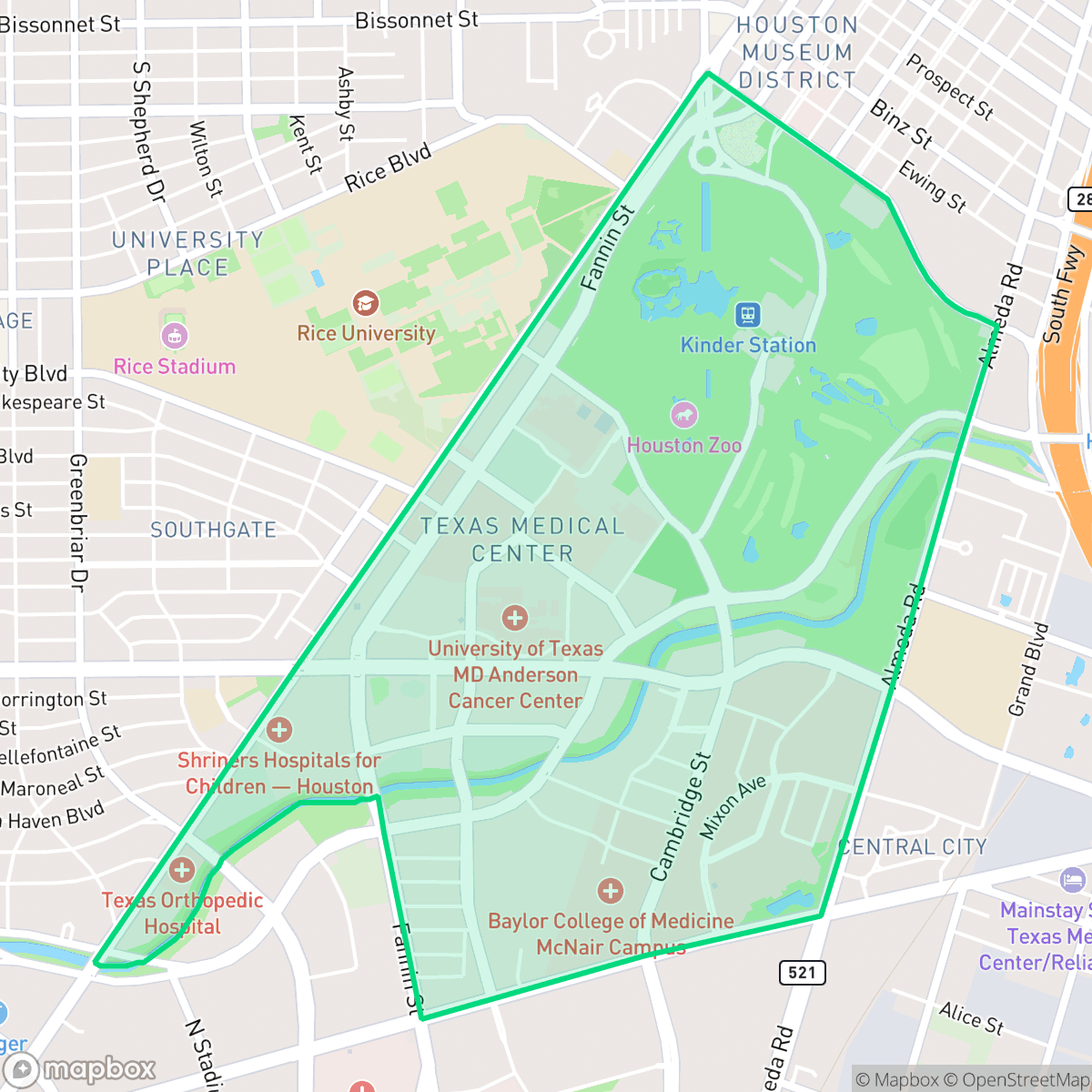
Houston’s Medical Center Area neighborhood traces its origins to the 1925 opening of Hermann Hospital, built on land donated by philanthropist George Hermann. In 1943, Houston voters approved the sale of 134 acres of city land adjacent to Hermann Park to the M.D. Anderson Foundation, established by cotton merchant Monroe Dunaway Anderson. Formally established in 1945, the Texas Medical Center (TMC) grew rapidly after World War II, attracting Baylor College of Medicine from Dallas and establishing world-renowned institutions like the M.D. Anderson Cancer Center and Texas Children's Hospital. Bordered by Brays Bayou and Hermann Park, this neighborhood has evolved from a forested park tract into the world's largest medical district, characterized by high-rise clinical facilities, research centers, and a dense, urban professional community.
The neighborhood functions as a high-density professional hub, characterized by its massive clinical and research footprint. Beyond the medical facilities, the area features pockets of calm, suburban-style blocks near Brays Bayou and Hermann Park that offer green space and recreational paths. According to iHuus data, the area maintains a high level of walkability, allowing commuters to navigate between professional hubs and local dining spots with ease.
Living here requires balancing the convenience of a central location with the trade-offs of an urban environment. Noise levels are elevated due to constant road traffic, and the density of the area results in lower privacy for residents. While the neighborhood boasts high health insurance coverage, prospective families should note the volatility within the local Houston Independent School District. It is best suited for medical professionals and urban dwellers who prioritize proximity to work and transit over quiet, secluded residential living.
Neighborhood Scores Across 15 Qualities
Residential spacing varies significantly between dense apartment complexes and detached homes with garden buffers. According to iHuus data, the level of separation between neighbors is roughly in line with the Houston average.
Pedestrian-oriented layouts and continuous sidewalks make navigating much of the area easy on foot, which is notably more walkable than much of Houston. While many streets offer clear paths and green space connections, certain high-speed highways can act as significant barriers to movement.
Manicured landscapes, high-end institutional architecture, and luxury residential complexes provide a highly polished aesthetic that is notably more visually appealing than the Houston average. According to iHuus data, the area features prominent greenery and well-maintained grounds throughout the district.
Extensive public parks, canal greenways, and wide grassy verges provide ample space for pets. According to iHuus data, the availability of connected green spaces and walking paths in this area is significantly higher than the Houston average.
Streetscapes offer a blend of institutional high-rises and residential greenery, making the area less dense than the Houston average. According to iHuus data, the environment provides an even distribution of built structures and open green spaces.
A varied mix of mid-rise urban pockets and quiet suburban blocks creates a rhythm that is more active than the Houston average. While some areas feature dense clusters of cafes and dining, other sections remain car-dependent with limited walkable amenities.
Frequent traffic and transit sounds from nearby highways and rail lines contribute to a louder environment than the Houston average, according to iHuus data.
Air quality levels fluctuate between acceptable and unhealthy, presenting occasional concerns for sensitive groups. This area performs better than the Houston city average according to iHuus data.
Minimal industrial activity defines most of the area, offering a cleaner environment than the Houston average. Some pockets near storage facilities may experience heavy freight traffic or proximity to an EPA Superfund site, according to iHuus data.
Health insurance accessibility is exceptionally high for residents, significantly surpassing the Houston average according to iHuus data.
Voting patterns and census indicators show a significantly more liberal leaning than the Houston average, according to iHuus data.
A balanced mix of young professionals, families, and seniors resides here, reflecting an age distribution that is largely consistent with the Houston average according to iHuus data.
Flood risk in this area is slightly higher than the Houston average due to its location within a 500-year floodplain. Residents should be aware of some residual flood risk according to iHuus data.
Address-Level Insights for Medical Center Area


iHuus Neighborhood Intelligence Insights
Get address-level neighborhood insights for Medical Center Area
- Street-level scores — see how individual blocks compare, not just neighborhood averages
- Micro-zone boundaries — identify quiet pockets, flood boundaries, and walkable clusters before you visit
- 15 dimensions in full — walkability, noise, air quality, school quality, insurance coverage, population age profile, urban/rural index, and more
- Boundary risk alerts — know if your address sits near a block boundary where scores drop, the kind of detail no listing will ever mention
- School insights — individual school ratings and insights, not just district-level data
- Compare before you commit — side-by-side data across neighborhoods, down to block precision
No credit card required
Compare with Any Neighborhood
| Dimension | Medical Center Area | Acres Home |
|---|---|---|
| 🚶 Walkabilityavg 7.08 | ||
| 🔊 Acoustic Comfortavg 4.14 | ||
| 🤫 Privacy Indexavg 5.34 | ||
| 🎨 Visual Appealavg 6.42 | ||
| 🐕 Dog Friendlinessavg 6.33 | ||
| 🗺️ Urban-Rural Indexavg 6.64 | ||
| ✨ Neighborhood Vibeavg 4.4 | ||
| 🏥 Health Insurance Coverageavg 5.46 | ||
| 🌿 Air Qualityavg 3.58 | ||
| 🏭 Industrial Proximityavg 6.9 | ||
| 🌊 Flood Safetyavg 6.27 | ||
| 🗳️ Ideological Leanavg 6.39 | ||
| 👥 Population Age Profileavg 4.6 | ||
| 🔥 Fire Safety | ||
| 🏫 School Quality |
Medical Center Area Rankings
School Districts Serving Medical Center Area
School Insights for Medical Center Area
Below average outcomes; significant attendance and academic challenges.
School Insights
See what's really behind every school rating near Medical Center Area
- Individual school ratings — each school's own score with outcome context, not just a district average
- Enrollment & class size data — student-to-teacher ratio and how it compares to the state average
- Full demographics breakdown — ethnicity and gender composition for every school in the enrollment zone
- Every school in the district — all schools within the enrollment boundary ranked by rating, not just the closest one
- Grade levels & benchmarks — elementary through high school, with below/above state-average flags
No credit card required