Mahatma Gandhi District, Houston
Updated · 851 residents
The Mahatma Gandhi District serves as a prominent South Asian commercial hub in southwest Houston, defined by its dense collection of specialized grocers, jewelry boutiques, and diverse restaurants. While the area offers a vibrant culinary scene, residents experience significant noise from heavy road traffic and limited walkability. The neighborhood consists primarily of closely packed multi-family housing and commercial strip malls.
Key Highlights
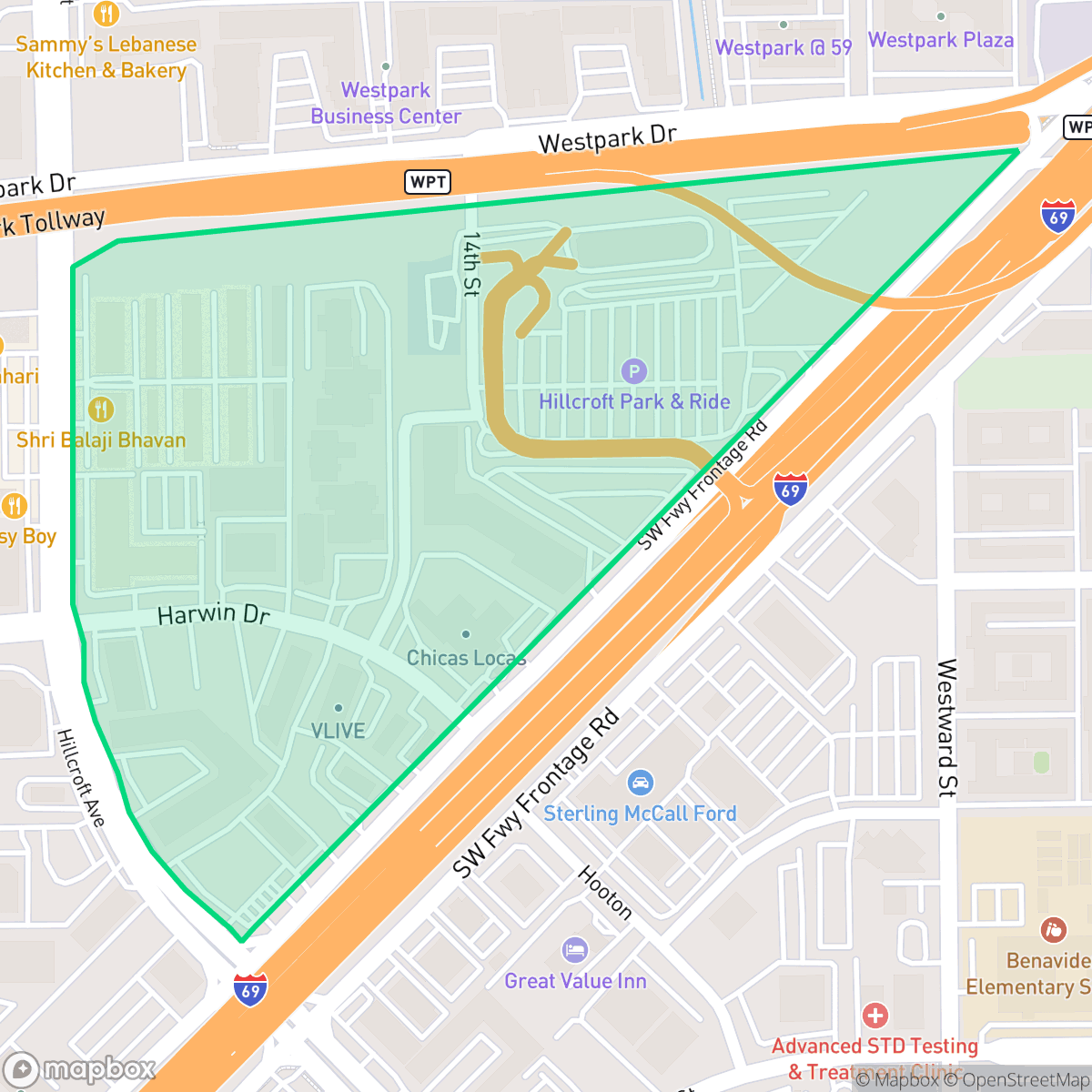
About Mahatma Gandhi District
The Mahatma Gandhi District in southwest Houston, popularly known as Little India, evolved from farmland into a vibrant South Asian commercial hub beginning in the early 1980s. The neighborhood's transformation started in 1983 when Rupa Vyas relocated her grocery, Jay Stores, to the Hillcroft Avenue area, followed in 1985 by the opening of Raja Sweets by the Gahunia family. These pioneering businesses, along with others like India Grocers, established a bustling enclave of South Asian restaurants, sari shops, and jewelry stores along the Hillcroft and Harwin Drive corridors. Following years of advocacy by the India Culture Center, Houston Mayor Annise Parker officially designated the area as the Mahatma Gandhi District on January 16, 2010, installing distinctive red-trimmed street signs featuring Gandhi's visage to recognize its cultural and economic significance.
The area is characterized by its high-density mix of residential apartments and commercial infrastructure along the Hillcroft and Harwin corridors. It maintains a distinct identity as a center for South Asian commerce, featuring a variety of independent businesses that draw visitors from across the city. The landscape is dominated by utilitarian architecture, with large parking lots and proximity to major highway systems that facilitate regional access but contribute to the neighborhood's industrial feel. Those considering the area should note that it is primarily car-dependent, as the street layout and heavy traffic patterns make pedestrian travel difficult. The environment is notably loud due to consistent road noise, and the limited green space provides few options for outdoor recreation or pet owners. While the district benefits from relatively high flood safety, prospective residents should be aware of the challenges regarding local noise levels, air quality, and the broader institutional instability within the local school district.
Neighborhood Scores Across 15 Qualities
Closely spaced buildings and shared walls in apartments characterize the area. This level of density and proximity between structures is significantly higher than the Houston average, according to iHuus data.
Large highways and expansive commercial parking lots create significant obstacles for pedestrians. According to iHuus data, the lack of consistent sidewalks and heavy traffic makes walking much less convenient here than in most other parts of the city.
Residential views consist primarily of standard multi-family structures and commercial warehouses. This landscape is slightly less visually diverse than the Houston average, featuring boxy roof geometries and shared amenities.
Minimal green space and a lack of large public parks make it difficult to find open areas for exercise. According to iHuus data, the neighborhood offers much less accessible vegetation for dogs than the Houston average.
A blend of dense apartment complexes and commercial strip malls exists alongside more open terrain. This landscape is comparable to the broader Houston area in terms of its urban-to-rural balance.
A varied mix of dining options and amenities provides more activity than the city average. While some blocks feature lively commercial hubs, much of the area remains car-dependent with a blend of industrial and suburban elements.
Frequent disturbances from heavy rail and nearby airport flight paths create a much noisier environment than most of Houston. According to iHuus data, this lack of acoustic comfort makes the area unsuitable for those sensitive to loud, persistent sound.
Frequent unhealthy air quality levels pose a significant risk to sensitive groups. According to iHuus data, the air quality in this area is notably worse than the Houston city average.
Light industrial and commercial units exist alongside residential developments, creating a landscape of mixed-use activity. According to iHuus data, this level of industrial proximity is slightly lower than the Houston city average.
Health insurance access is significantly lower than the Houston average. Residents may face challenges accessing employer-sponsored or private medical coverage within the area.
Political leanings in this area are notably more liberal than the Houston average, according to iHuus data.
Residents live alongside a varied mix of young adults, families, and seniors. According to iHuus data, this demographic spread is slightly more varied than the Houston average.
Some residual flood risk exists within this area as it falls within a 500-year floodplain, though safety levels remain slightly above the Houston average according to iHuus data.
Address-Level Insights for Mahatma Gandhi District


iHuus Neighborhood Intelligence Insights
Get address-level neighborhood insights for Mahatma Gandhi District
- Street-level scores — see how individual blocks compare, not just neighborhood averages
- Micro-zone boundaries — identify quiet pockets, flood boundaries, and walkable clusters before you visit
- 15 dimensions in full — walkability, noise, air quality, school quality, insurance coverage, population age profile, urban/rural index, and more
- Boundary risk alerts — know if your address sits near a block boundary where scores drop, the kind of detail no listing will ever mention
- School insights — individual school ratings and insights, not just district-level data
- Compare before you commit — side-by-side data across neighborhoods, down to block precision
No credit card required
Compare with Any Neighborhood
| Dimension | Mahatma Gandhi District | Acres Home |
|---|---|---|
| 🚶 Walkabilityavg 7.08 | ||
| 🔊 Acoustic Comfortavg 4.14 | ||
| 🤫 Privacy Indexavg 5.34 | ||
| 🎨 Visual Appealavg 6.42 | ||
| 🐕 Dog Friendlinessavg 6.33 | ||
| 🗺️ Urban-Rural Indexavg 6.64 | ||
| ✨ Neighborhood Vibeavg 4.4 | ||
| 🏥 Health Insurance Coverageavg 5.46 | ||
| 🌿 Air Qualityavg 3.58 | ||
| 🏭 Industrial Proximityavg 6.9 | ||
| 🌊 Flood Safetyavg 6.27 | ||
| 🗳️ Ideological Leanavg 6.39 | ||
| 👥 Population Age Profileavg 4.6 | ||
| 🔥 Fire Safety | ||
| 🏫 School Quality |
Mahatma Gandhi District Rankings
School Districts Serving Mahatma Gandhi District
School Insights for Mahatma Gandhi District
Below average outcomes; significant attendance and academic challenges.
School Insights
See what's really behind every school rating near Mahatma Gandhi District
- Individual school ratings — each school's own score with outcome context, not just a district average
- Enrollment & class size data — student-to-teacher ratio and how it compares to the state average
- Full demographics breakdown — ethnicity and gender composition for every school in the enrollment zone
- Every school in the district — all schools within the enrollment boundary ranked by rating, not just the closest one
- Grade levels & benchmarks — elementary through high school, with below/above state-average flags
No credit card required