Macgregor, Houston
Updated · 18,767 residents
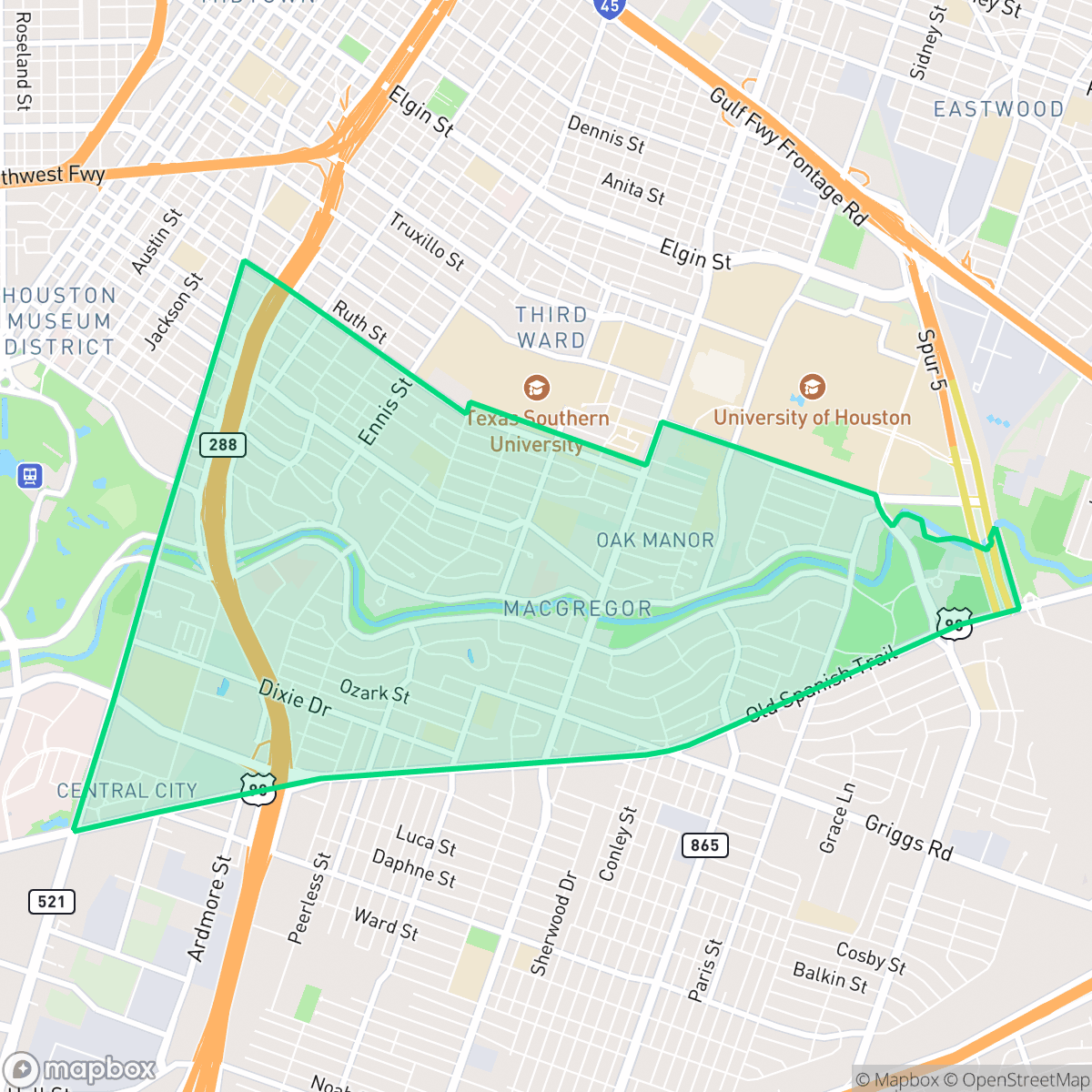
Macgregor is a historically significant Houston neighborhood defined by its diverse architectural styles and proximity to Brays Bayou. The area offers high walkability and access to green spaces like Macgregor Park, though residents should expect a dense residential environment with moderate levels of road traffic noise.
Key Highlights
About Macgregor
The MacGregor neighborhood in southeast Houston began developing in the 1920s on land donated by the estate of businessman Henry F. MacGregor. Straddling Brays Bayou, the area encompasses historic subdivisions like Timbercrest, University Oaks, and Riverside Terrace. Known from the 1930s to the 1950s as the "Jewish River Oaks" due to its affluent Jewish population, MacGregor transitioned in the mid-1950s into a premier community for prominent African-American professionals, educators, and politicians. The neighborhood is celebrated for its diverse architecture, featuring Tudor, Art Deco, and Mid-Century Modern designs. Local landmarks include the 83-acre MacGregor Park, designed by the landscape architecture firm Hare & Hare, and the historic Groovey Grill Restaurant, which opened in 1944 and hosted numerous national celebrities.
The neighborhood maintains a dense, urban character shaped by a consistent grid of streets and proximity to the University of Houston. Its layout supports a high level of walkability, allowing residents to access local schools and the expansive Macgregor Park on foot. While the area is primarily residential, its proximity to major thoroughfares and the university campus creates a steady, active rhythm throughout the day.
Prospective residents should consider that the neighborhood features tightly packed housing with limited privacy, reflecting its dense suburban design. While the community benefits from high health insurance coverage rates and access to top-rated schools like Energy Institute High School, it is important to note the environmental trade-offs, including moderate road traffic noise and lower air quality ratings. The area is best suited for those who value proximity to academic and recreational hubs over secluded living.
Neighborhood Scores Across 15 Qualities
Residential spacing varies across the area, with some closely packed houses offering limited separation between neighbors. According to iHuus data, this level of privacy is roughly consistent with the Houston average.
Residential streets feature a consistent sidewalk network and low traffic volumes that make walking to local schools and parks easy. According to iHuus data, this level of accessibility is higher than the Houston average, though the nearby highway serves as a notable barrier to movement.
Residential views consist primarily of middle-class tract housing with uniform lot sizes and standard rooflines. This level of visual variety is roughly in line with the Houston average, according to iHuus data.
Access to nearby bayou trails, large university lawns, and golf course areas provides ample space for pets to exercise. Residents benefit from slightly more accessible green space for walking than the Houston average, according to iHuus data.
Residential streets and green spaces exist in roughly equal measure, though the area feels slightly less dense than the Houston average. According to iHuus data, the landscape features a blend of single-family homes, multi-family complexes, and notable pockets of industrial or institutional use.
A blend of quiet residential streets and active dining pockets creates a social rhythm that is more vibrant than the Houston average. While some areas near major highways offer energetic hubs and diverse eateries, many parts of the neighborhood remain peaceful and suburban with limited walking access to shops.
Steady noise from nearby busy streets creates a consistent hum that is slightly higher than the Houston average. According to iHuus data, this acoustic environment is typical for an area with active local transit corridors.
Air quality levels in Macgregor are slightly better than the Houston average, though residents should remain mindful of days that may be unhealthy for sensitive groups. According to iHuus data, the area experiences a mix of acceptable and concerning air conditions.
Predominantly residential and commercial landscapes characterize this area, offering much less industrial exposure than the Houston average. While most parts of the neighborhood are free from heavy industry, some residents near rail corridors or utility plants may encounter localized noise and freight activity.
Health insurance accessibility is notably higher than the Houston average, according to iHuus data. This indicates a more robust level of medical coverage among the local population.
Voting patterns and census indicators reflect a strong liberal leaning, which is notably more progressive than the Houston average according to iHuus data.
Residents live alongside a balanced mix of young adults, families, and older populations. This demographic spread is roughly aligned with the broader Houston average according to iHuus data.
Flood risk in this area is difficult to determine because FEMA has not completed a detailed study, placing it below the Houston average for flood safety. According to iHuus data, the lack of precise mapping means residents should exercise caution during heavy rain events.
Address-Level Insights for Macgregor


iHuus Neighborhood Intelligence Insights
Get address-level neighborhood insights for Macgregor
- Street-level scores — see how individual blocks compare, not just neighborhood averages
- Micro-zone boundaries — identify quiet pockets, flood boundaries, and walkable clusters before you visit
- 15 dimensions in full — walkability, noise, air quality, school quality, insurance coverage, population age profile, urban/rural index, and more
- Boundary risk alerts — know if your address sits near a block boundary where scores drop, the kind of detail no listing will ever mention
- School insights — individual school ratings and insights, not just district-level data
- Compare before you commit — side-by-side data across neighborhoods, down to block precision
No credit card required
Compare with Any Neighborhood
| Dimension | Macgregor | Acres Home |
|---|---|---|
| 🚶 Walkabilityavg 7.08 | ||
| 🔊 Acoustic Comfortavg 4.14 | ||
| 🤫 Privacy Indexavg 5.34 | ||
| 🎨 Visual Appealavg 6.42 | ||
| 🐕 Dog Friendlinessavg 6.33 | ||
| 🗺️ Urban-Rural Indexavg 6.64 | ||
| ✨ Neighborhood Vibeavg 4.4 | ||
| 🏥 Health Insurance Coverageavg 5.46 | ||
| 🌿 Air Qualityavg 3.58 | ||
| 🏭 Industrial Proximityavg 6.9 | ||
| 🌊 Flood Safetyavg 6.27 | ||
| 🗳️ Ideological Leanavg 6.39 | ||
| 👥 Population Age Profileavg 4.6 | ||
| 🔥 Fire Safety | ||
| 🏫 School Quality |
Macgregor Rankings
School Districts Serving Macgregor
School Insights for Macgregor
Below average outcomes; significant attendance and academic challenges.
School Insights
See what's really behind every school rating near Macgregor
- Individual school ratings — each school's own score with outcome context, not just a district average
- Enrollment & class size data — student-to-teacher ratio and how it compares to the state average
- Full demographics breakdown — ethnicity and gender composition for every school in the enrollment zone
- Every school in the district — all schools within the enrollment boundary ranked by rating, not just the closest one
- Grade levels & benchmarks — elementary through high school, with below/above state-average flags
No credit card required