Lazybrook, Houston
Updated · 1,742 residents
Lazybrook is a quiet Houston neighborhood defined by its collection of mid-century ranch-style homes and direct access to the scenic White Oak Bayou. Residents enjoy a high level of walkability and a peaceful suburban atmosphere, though the area maintains a modest, low-key social scene. According to iHuus data, the community offers a stable residential environment with strong health insurance coverage for its inhabitants.
Key Highlights
About Lazybrook
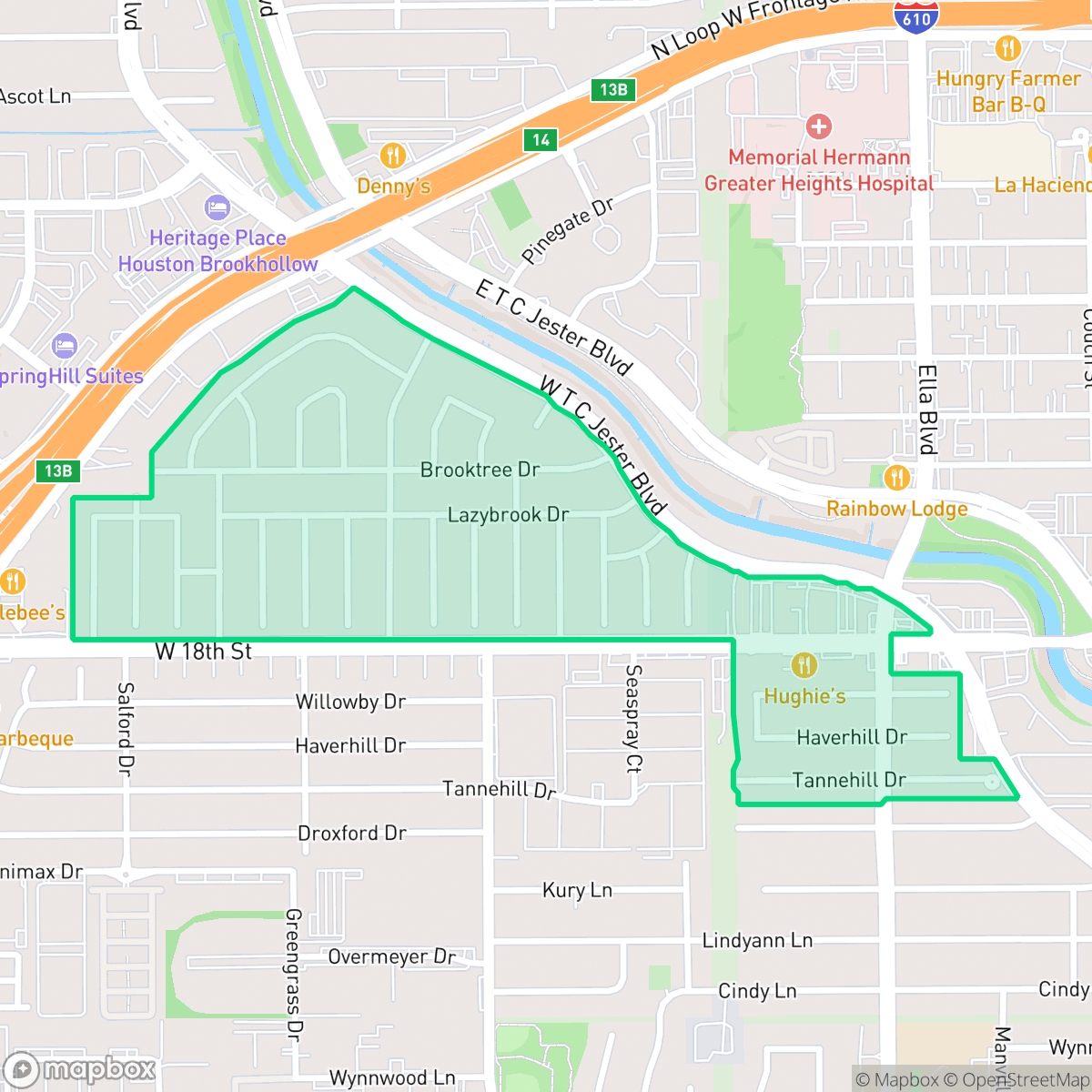
Located northwest of Downtown Houston, the Lazybrook neighborhood was originally settled by German farmers in the late 1800s. In the 1930s, the area became the site of a major oil discovery known as "Eureka," a history still preserved in the nearby Eureka railroad yard. While suburban growth boomed elsewhere after World War II, Lazybrook remained largely wooded and undeveloped until the 1950s. Developed alongside neighboring Timbergrove Manor, Lazybrook was named for its proximity to the gently flowing White Oak Bayou, which forms its eastern boundary. The neighborhood is defined by its distinct mid-century architectural character, featuring well-preserved, one-story postwar ranch-style brick homes set on spacious lots along wide, tree-lined streets.
The area serves as a tranquil enclave northwest of Downtown Houston, characterized by its wide streets and established greenery. While the neighborhood retains a suburban aesthetic, it functions as a mixed-use environment where residential life intersects with daytime commercial activity. Its location near the bayou provides natural recreational opportunities, which contributes to its appeal for those seeking a balance between city accessibility and a slower pace of life.
Prospective residents should consider the local infrastructure and institutional landscape when evaluating the area. While the neighborhood scores well for walkability and acoustic comfort, it faces challenges regarding flood safety and the broader volatility of the Houston Independent School District. The area is best suited for individuals or families who prioritize an established residential character and proximity to major city corridors over a high-density entertainment district.
Neighborhood Scores Across 15 Qualities
Residential spacing varies between shared apartment walls and houses positioned close to one another. This level of density is roughly in line with the Houston average, according to iHuus data.
Sidewalks are available along many residential streets, though connectivity is occasionally interrupted by large commercial blocks. Pedestrian ease is slightly below the Houston average according to iHuus data.
Residential views consist of a blend of standard tract housing and apartment complexes. According to iHuus data, the area features many small private backyard pools and remains roughly in line with the Houston average for visual appeal.
Private fenced backyards are common, but sidewalks lack the wide green verges found in other parts of Houston. According to iHuus data, public park access and walkable greenery are below the city average.
A blend of single-family homes, apartments, and large warehouses creates a suburban landscape that is very similar to the Houston average. According to iHuus data, the area features frequent open land and scattered structures amid woodland or fields.
Suburban streets and light industrial zones create a subdued atmosphere that is less active than the Houston average. While various dining options are available near major highways, most amenities require a vehicle as few businesses are within walking distance.
Steady traffic sounds from nearby busy streets are present, though acoustic levels remain slightly more tranquil than the Houston average according to iHuus data.
Air quality levels fluctuate between acceptable and unhealthy for sensitive groups; according to iHuus data, conditions here are slightly better than the Houston average.
Active warehouses and heavy truck traffic contribute to moderate noise and commercial activity in certain pockets. This level of industrial proximity is slightly higher than the Houston average, according to iHuus data.
Health insurance accessibility is notably higher than the Houston average, according to iHuus data. This indicates a more widely covered resident population compared to much of the city.
Political leanings in this area are split relatively evenly between conservative and liberal perspectives, which is slightly less partisan than the Houston average according to iHuus data.
Residents live alongside a balanced mix of young adults, families, and older individuals. This age distribution is slightly more varied than the average seen across Houston.
Flood safety levels in this area are slightly below the Houston average due to a lack of detailed FEMA flood studies. According to iHuus data, the precise risk level for this neighborhood remains undetermined.
Address-Level Insights for Lazybrook


iHuus Neighborhood Intelligence Insights
Get address-level neighborhood insights for Lazybrook
- Street-level scores — see how individual blocks compare, not just neighborhood averages
- Micro-zone boundaries — identify quiet pockets, flood boundaries, and walkable clusters before you visit
- 15 dimensions in full — walkability, noise, air quality, school quality, insurance coverage, population age profile, urban/rural index, and more
- Boundary risk alerts — know if your address sits near a block boundary where scores drop, the kind of detail no listing will ever mention
- School insights — individual school ratings and insights, not just district-level data
- Compare before you commit — side-by-side data across neighborhoods, down to block precision
No credit card required
Compare with Any Neighborhood
| Dimension | Lazybrook | Acres Home |
|---|---|---|
| 🚶 Walkabilityavg 7.08 | ||
| 🔊 Acoustic Comfortavg 4.14 | ||
| 🤫 Privacy Indexavg 5.34 | ||
| 🎨 Visual Appealavg 6.42 | ||
| 🐕 Dog Friendlinessavg 6.33 | ||
| 🗺️ Urban-Rural Indexavg 6.64 | ||
| ✨ Neighborhood Vibeavg 4.4 | ||
| 🏥 Health Insurance Coverageavg 5.46 | ||
| 🌿 Air Qualityavg 3.58 | ||
| 🏭 Industrial Proximityavg 6.9 | ||
| 🌊 Flood Safetyavg 6.27 | ||
| 🗳️ Ideological Leanavg 6.39 | ||
| 👥 Population Age Profileavg 4.6 | ||
| 🔥 Fire Safety | ||
| 🏫 School Quality |
Lazybrook Rankings
School Districts Serving Lazybrook
School Insights for Lazybrook
Below average outcomes; significant attendance and academic challenges.
School Insights
See what's really behind every school rating near Lazybrook
- Individual school ratings — each school's own score with outcome context, not just a district average
- Enrollment & class size data — student-to-teacher ratio and how it compares to the state average
- Full demographics breakdown — ethnicity and gender composition for every school in the enrollment zone
- Every school in the district — all schools within the enrollment boundary ranked by rating, not just the closest one
- Grade levels & benchmarks — elementary through high school, with below/above state-average flags
No credit card required