Lazy Brook - Timbergrove, Houston
Updated · 14,757 residents
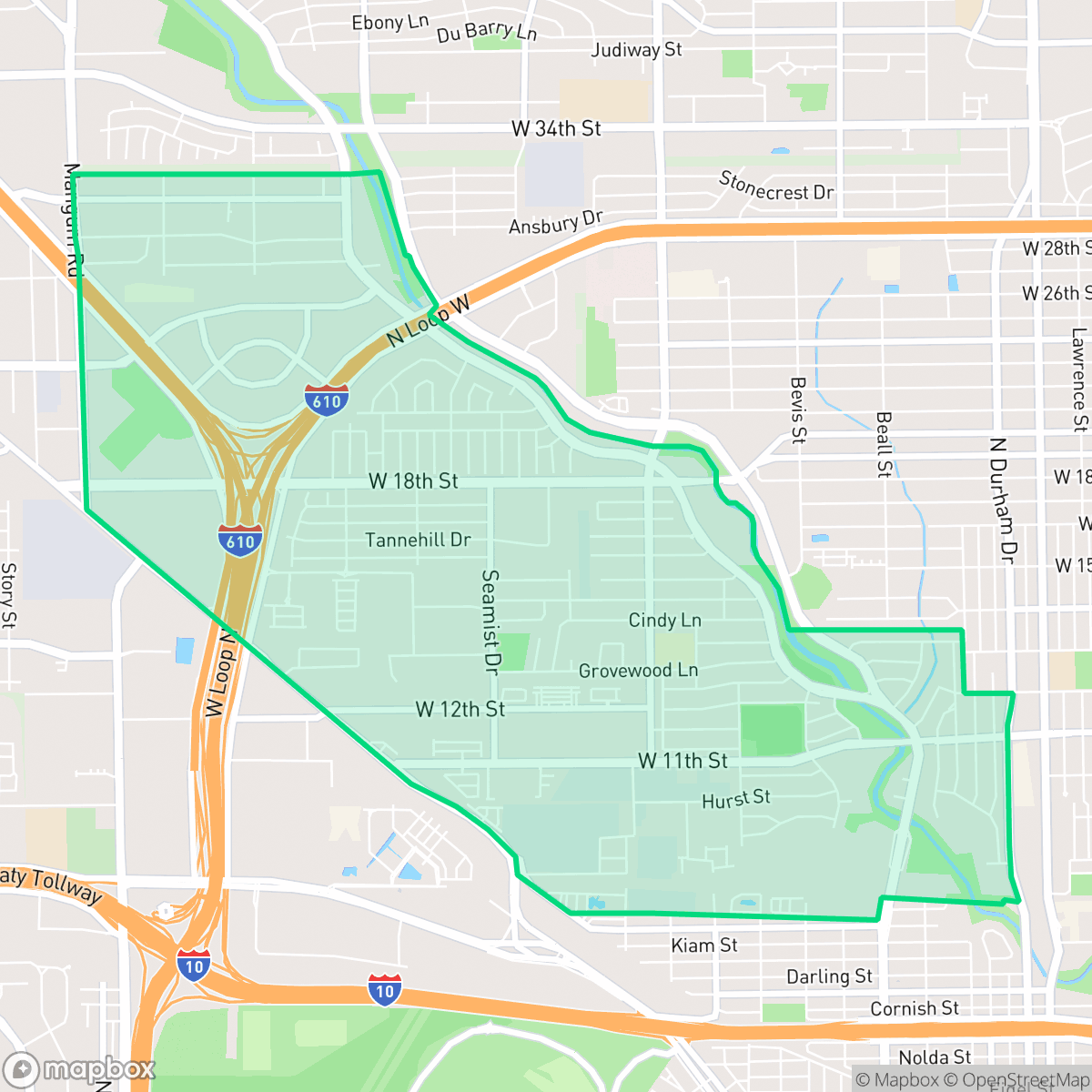
Lazy Brook - Timbergrove is a quiet, tree-lined enclave in northwest Houston known for its well-preserved mid-century modern architecture and proximity to the West White Oak Bayou Trail. While the area offers a suburban feel with ample private outdoor space, it is characterized by a car-dependent layout and a mix of residential blocks and nearby industrial logistics hubs. According to iHuus data, residents benefit from high levels of health insurance coverage, though the neighborhood experiences moderate noise levels from road traffic.
Key Highlights
About Lazy Brook - Timbergrove
Located northwest of Downtown Houston along the wooded banks of White Oak Bayou, the Lazybrook and Timbergrove Manor neighborhoods were originally settled by German farmers in the late 1800s. The area was the site of a major 1930s oil discovery known as "Eureka," a name preserved by the nearby Eureka railroad yard. Largely undeveloped until after World War II, the master-planned communities of Timbergrove Manor (named for its abundant pine trees) and Lazybrook (named for the bayou) were established in the 1950s. The neighborhood is architecturally defined by its well-preserved mid-century modern and brick ranch-style homes situated on spacious, tree-lined lots. Local landmarks and community hubs include Jaycee Park, the West 11th Street Park, and the West White Oak Bayou Trail, which offer extensive green space in this historic, close-knit enclave.
The area functions as a quiet residential pocket that balances its historic architectural character with the realities of a modern, mixed-use urban environment. Residents enjoy access to local green spaces like Jaycee Park and the West 11th Street Park, which provide essential recreational outlets in a landscape otherwise dominated by standard tract housing and apartment complexes. The community maintains a distinct identity through its mature trees and spacious lots, though the proximity to major transit corridors and industrial warehouses means that the atmosphere is frequently influenced by commercial activity and freight traffic.
Living here requires a reliance on personal vehicles, as the grid-based street system is often interrupted by large commercial blocks and industrial zones. While the neighborhood provides a stable environment with high rates of health insurance coverage, according to iHuus data, prospective residents should consider the trade-offs between the quiet, established suburban charm and the surrounding industrial presence. Families may find value in the local Sinclair Elementary School, which holds a strong rating, even as the broader school district faces ongoing institutional challenges.
Neighborhood Scores Across 15 Qualities
Residential spacing varies from detached homes with moderate yard buffers to dense townhomes with shared walls. According to iHuus data, this level of privacy is slightly lower than the Houston average due to the presence of high-density multi-unit complexes.
Sidewalk connectivity is somewhat limited by major highway barriers and active rail lines, making the area slightly less walkable than the Houston average. While secondary residential streets offer good pedestrian access, certain large commercial blocks can interrupt continuous travel.
Visual variety in this area is consistent with the Houston average, characterized primarily by standard tract housing and dense apartment complexes. Many properties feature functional amenities such as shared community pools and private backyard pools.
Fenced backyards provide ample private space for pets, though public walking options are slightly below the Houston average due to limited green verges and highway barriers. Some areas benefit from nearby canal corridors and park-like buffers according to iHuus data.
Residential blocks feature a varied landscape of single-family homes, apartment complexes, and large-scale commercial or industrial structures. This density of development is roughly in line with the typical urban-rural mix found across Houston.
A steady rhythm of residential life and light industrial uses defines this area, providing a tranquil atmosphere that is slightly below the city average for activity. While some pockets offer diverse dining options, much of the neighborhood remains car-dependent due to the sparse distribution of commercial services.
Local traffic from nearby thoroughfares creates a consistent background noise level that is roughly in line with the Houston average. According to iHuus data, this acoustic environment is typical for areas adjacent to busy street corridors.
Air quality levels are generally acceptable, though sensitive individuals may notice occasional periods of concern. According to iHuus data, the air quality in this area is slightly better than the Houston average.
Light industrial warehouses and transit corridors introduce moderate truck activity and noise near certain residential pockets. This level of industrial proximity is slightly below the Houston average, as the area primarily features local services and residential life rather than heavy industrial zones.
Health insurance accessibility is higher here than the Houston average, according to iHuus data. Most residents in this area have access to medical coverage.
Political leanings in this area lean liberal, though there is a modest presence of opposing views. This distribution is slightly more progressive than the Houston average, according to iHuus data.
Residents live alongside a diverse mix of young professionals, families, and older adults. This demographic spread is consistent with the broader Houston area, according to iHuus data.
Flood risk in this area is difficult to determine because official federal studies are currently incomplete. According to iHuus data, the level of vulnerability is slightly higher than the Houston average.
Address-Level Insights for Lazy Brook - Timbergrove


iHuus Neighborhood Intelligence Insights
Get address-level neighborhood insights for Lazy Brook - Timbergrove
- Street-level scores — see how individual blocks compare, not just neighborhood averages
- Micro-zone boundaries — identify quiet pockets, flood boundaries, and walkable clusters before you visit
- 15 dimensions in full — walkability, noise, air quality, school quality, insurance coverage, population age profile, urban/rural index, and more
- Boundary risk alerts — know if your address sits near a block boundary where scores drop, the kind of detail no listing will ever mention
- School insights — individual school ratings and insights, not just district-level data
- Compare before you commit — side-by-side data across neighborhoods, down to block precision
No credit card required
Compare with Any Neighborhood
| Dimension | Lazy Brook - Timbergrove | Acres Home |
|---|---|---|
| 🚶 Walkabilityavg 7.08 | ||
| 🔊 Acoustic Comfortavg 4.14 | ||
| 🤫 Privacy Indexavg 5.34 | ||
| 🎨 Visual Appealavg 6.42 | ||
| 🐕 Dog Friendlinessavg 6.33 | ||
| 🗺️ Urban-Rural Indexavg 6.64 | ||
| ✨ Neighborhood Vibeavg 4.4 | ||
| 🏥 Health Insurance Coverageavg 5.46 | ||
| 🌿 Air Qualityavg 3.58 | ||
| 🏭 Industrial Proximityavg 6.9 | ||
| 🌊 Flood Safetyavg 6.27 | ||
| 🗳️ Ideological Leanavg 6.39 | ||
| 👥 Population Age Profileavg 4.6 | ||
| 🔥 Fire Safety | ||
| 🏫 School Quality |
Lazy Brook - Timbergrove Rankings
School Districts Serving Lazy Brook - Timbergrove
School Insights for Lazy Brook - Timbergrove
Below average outcomes; significant attendance and academic challenges.
School Insights
See what's really behind every school rating near Lazy Brook - Timbergrove
- Individual school ratings — each school's own score with outcome context, not just a district average
- Enrollment & class size data — student-to-teacher ratio and how it compares to the state average
- Full demographics breakdown — ethnicity and gender composition for every school in the enrollment zone
- Every school in the district — all schools within the enrollment boundary ranked by rating, not just the closest one
- Grade levels & benchmarks — elementary through high school, with below/above state-average flags
No credit card required