Lawndale - Wayside, Houston
Updated · 16,865 residents
Lawndale-Wayside is a diverse Greater East End neighborhood defined by its mix of historic residential pockets and active industrial corridors. Residents benefit from excellent access to green spaces and dog-friendly parks, though the area remains largely car-dependent with noticeable road noise and industrial proximity.
Key Highlights
About Lawndale - Wayside
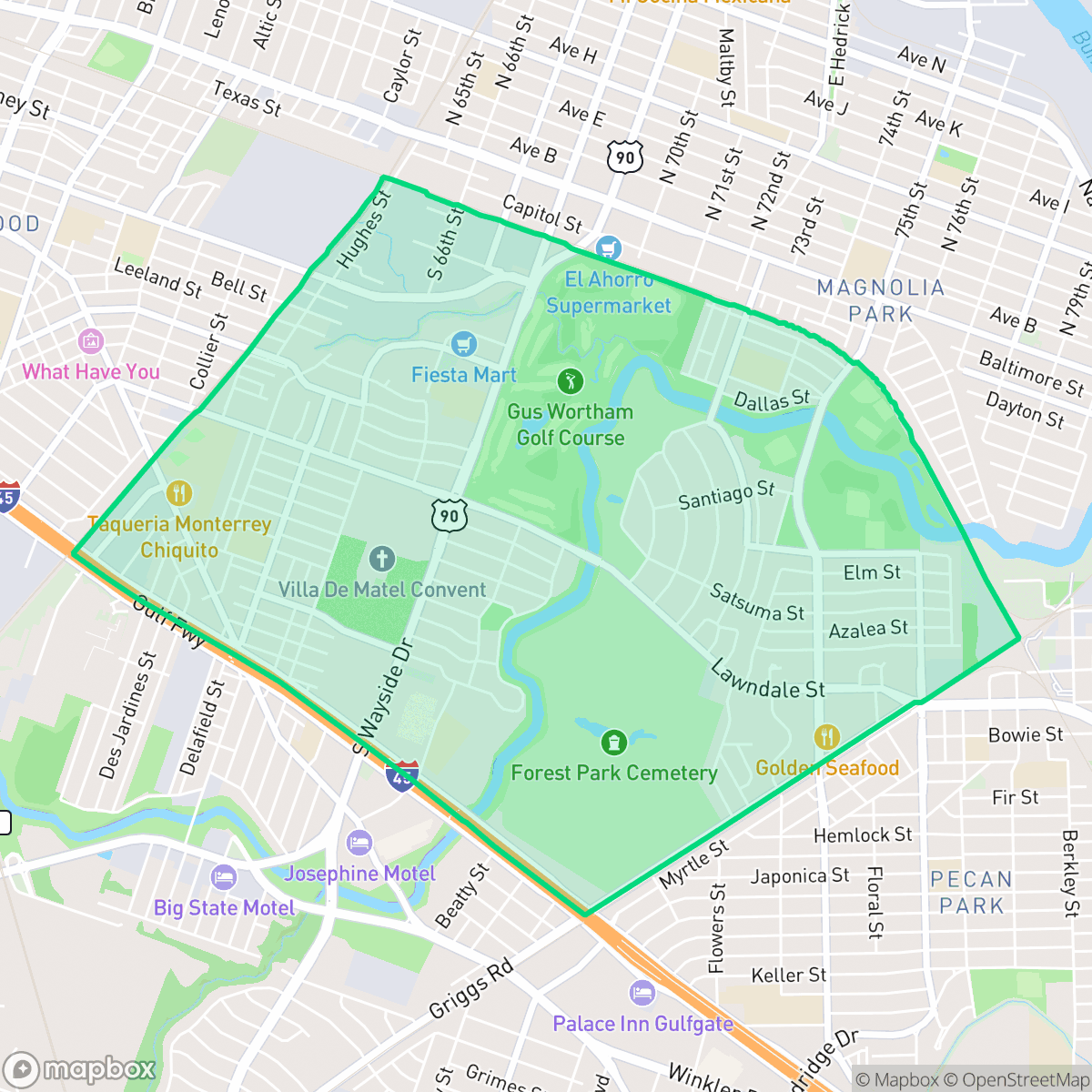
Located in Houston's Greater East End, the Lawndale-Wayside neighborhood originated as a prestigious early 20th-century enclave. Its history is anchored by the historic Wortham Golf Center, which opened in 1908 as the original home of the Houston Country Club and remains the oldest 18-hole golf course in Texas. The neighborhood is characterized by its 1900s-style bungalows, heavily wooded lots, and winding, scenic streets. Key local landmarks that define its scenic and cultural character include the historic Villa de Matel convent, the sprawling Forest Park Cemetery, and Mason Park along Buffalo Bayou. These wooded preserves and green spaces have helped Lawndale-Wayside maintain its historic charm and park-like atmosphere amidst the surrounding urban landscape.
The neighborhood functions as a dense suburban landscape where residential blocks often sit alongside active logistics hubs and light industrial zones. Daily life is punctuated by a variety of local dining options, ranging from neighborhood taquerias to established bakeries, which contribute to a unique local character. While the area maintains a calm suburban feel in its interior streets, the proximity to major highways and rail lines creates a consistent background of road traffic noise. The neighborhood is best suited for those who prioritize proximity to the city center and access to established green spaces over quiet, low-density living. Prospective residents should be prepared for a car-dependent lifestyle, as most daily errands require driving despite the presence of some walkable pockets near central parks. Families may find value in specific high-performing local schools, though the broader educational landscape within the district remains complex. Overall, the area offers a pragmatic, accessible environment for those comfortable with a blend of industrial and residential life.
Neighborhood Scores Across 15 Qualities
Residential spacing is varied, with many homes featuring closely packed structures and minimal side buffers. This density is slightly higher than the Houston average, resulting in less separation between neighboring properties.
Pedestrian connectivity is limited by a major highway that acts as a barrier and by fragmented sidewalks throughout the area. While some low-traffic streets remain navigable, walking ease is below the Houston average according to iHuus data.
Standard tract housing and small apartment complexes characterize the area, which features limited greenery and fewer luxury amenities than the Houston average. According to iHuus data, the landscape consists primarily of uniform, boxy rooflines and dense, narrow lots.
Large river-bend parkland and connected trails provide significant green space for pets. According to iHuus data, the availability of public trails and connected green spaces in this area is slightly above the Houston average.
A diverse landscape of residential grids, large-scale warehouses, and rail infrastructure characterizes this area. According to iHuus data, the density of built environments and industrial zones is consistent with the broader Houston average.
A variety of local dining and social hubs provide more activity than the city average, though the industrial and highway-adjacent layout makes a vehicle necessary for most trips. According to iHuus data, the area features a mix of lively pockets and quiet suburban blocks near railway corridors.
Steady sounds from nearby busy streets are present, though acoustic comfort is slightly higher than the Houston average according to iHuus data.
Frequent unhealthy air quality levels pose a significant risk to sensitive groups. According to iHuus data, the air quality in this area is notably worse than the Houston average.
Residential pockets exist alongside logistics warehouses, rail lines, and scrap yards, resulting in an industrial density that is lower than the Houston average. Residents may encounter heavy truck traffic and noise from nearby commercial loading docks and rail infrastructure.
Access to health insurance is less common here than in the rest of Houston. According to iHuus data, residents in this area face higher rates of being uninsured compared to the city average.
Political leanings in this area are notably more liberal than the Houston average. According to iHuus data, the community maintains a strong liberal majority with a small presence of opposing viewpoints.
A balanced range of young adults, families, and seniors resides here, reflecting a demographic spread that is slightly more varied than the Houston average according to iHuus data.
Flood risk levels in this area remain undetermined because official federal studies are not yet complete; according to iHuus data, this level of uncertainty is slightly higher than the Houston average.
Address-Level Insights for Lawndale - Wayside


iHuus Neighborhood Intelligence Insights
Get address-level neighborhood insights for Lawndale - Wayside
- Street-level scores — see how individual blocks compare, not just neighborhood averages
- Micro-zone boundaries — identify quiet pockets, flood boundaries, and walkable clusters before you visit
- 15 dimensions in full — walkability, noise, air quality, school quality, insurance coverage, population age profile, urban/rural index, and more
- Boundary risk alerts — know if your address sits near a block boundary where scores drop, the kind of detail no listing will ever mention
- School insights — individual school ratings and insights, not just district-level data
- Compare before you commit — side-by-side data across neighborhoods, down to block precision
No credit card required
Compare with Any Neighborhood
| Dimension | Lawndale - Wayside | Acres Home |
|---|---|---|
| 🚶 Walkabilityavg 7.08 | ||
| 🔊 Acoustic Comfortavg 4.14 | ||
| 🤫 Privacy Indexavg 5.34 | ||
| 🎨 Visual Appealavg 6.42 | ||
| 🐕 Dog Friendlinessavg 6.33 | ||
| 🗺️ Urban-Rural Indexavg 6.64 | ||
| ✨ Neighborhood Vibeavg 4.4 | ||
| 🏥 Health Insurance Coverageavg 5.46 | ||
| 🌿 Air Qualityavg 3.58 | ||
| 🏭 Industrial Proximityavg 6.9 | ||
| 🌊 Flood Safetyavg 6.27 | ||
| 🗳️ Ideological Leanavg 6.39 | ||
| 👥 Population Age Profileavg 4.6 | ||
| 🔥 Fire Safety | ||
| 🏫 School Quality |
Lawndale - Wayside Rankings
School Districts Serving Lawndale - Wayside
School Insights for Lawndale - Wayside
Below average outcomes; significant attendance and academic challenges.
School Insights
See what's really behind every school rating near Lawndale - Wayside
- Individual school ratings — each school's own score with outcome context, not just a district average
- Enrollment & class size data — student-to-teacher ratio and how it compares to the state average
- Full demographics breakdown — ethnicity and gender composition for every school in the enrollment zone
- Every school in the district — all schools within the enrollment boundary ranked by rating, not just the closest one
- Grade levels & benchmarks — elementary through high school, with below/above state-average flags
No credit card required