Kingwood, Houston
Updated · 69,239 residents
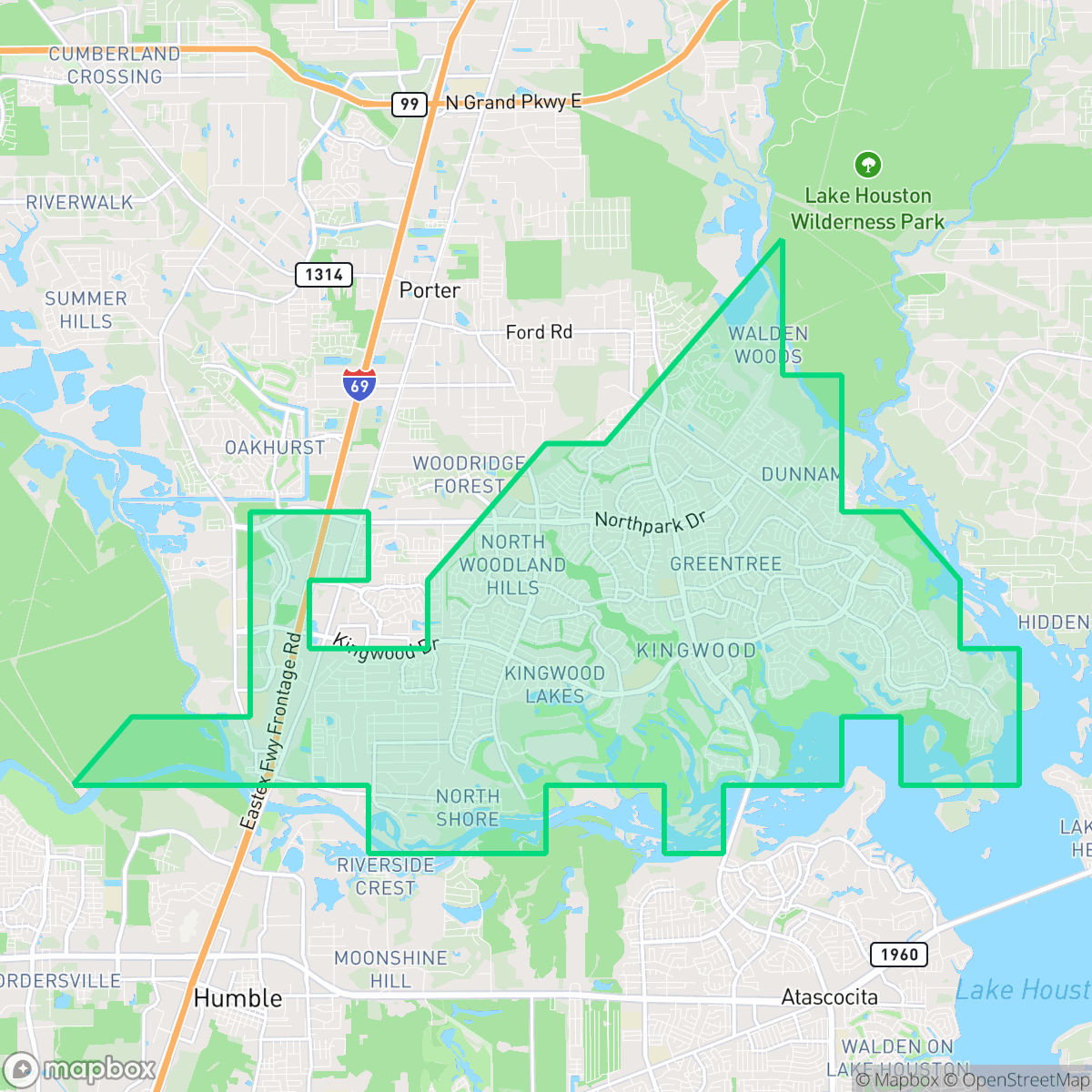
Kingwood is a heavily forested community in northeast Houston, defined by its extensive network of greenbelt trails and a quiet, suburban atmosphere. Residents benefit from high-performing schools and a visually appealing environment featuring large homes and private pools, though the area remains largely car-dependent for daily errands.
Key Highlights
About Kingwood
Kingwood, a master-planned community in northeast Houston, was established in 1970 on former Foster Lumber Company land. Its name derives from a 1967 joint venture between King Ranch and the Friendswood Development Company, an Exxon subsidiary. Developed under the vision of John Bruton Jr., Kingwood opened its first enclave, Trailwood Village, in 1971. From its inception, the neighborhood adopted the slogan "The Livable Forest" to highlight its preservation of natural surroundings. Nestled along the East Fork of the San Jacinto River and Lake Houston, the community is defined by its heavily forested character and a network of over 100 miles of greenbelt trails connecting residential villages to parks and shopping districts. Despite fierce local opposition, Kingwood was controversially annexed by the City of Houston in 1996.
The neighborhood is characterized by its dense suburban layout, where single-family homes are nestled within mature tree canopies. The area maintains a distinct visual appeal due to its large residential footprints and frequent private backyard pools. While it offers a serene, low-density environment, the community is primarily car-oriented, with most daily amenities and commercial hubs requiring a vehicle for access. The neighborhood benefits from high health insurance coverage and a robust selection of schools within the Humble Independent School District, particularly at the middle and elementary levels.
Prospective residents should note that while the area is visually striking and quiet, it faces challenges regarding acoustic comfort due to road traffic noise and limited walkability to commercial centers. The industrial proximity score reflects the presence of municipal water infrastructure and occasional large-scale logistics facilities nearby. This community is best suited for families and individuals seeking a stable, tree-lined residential environment who prioritize access to quality education and outdoor leisure over proximity to high-density urban nightlife or public transit.
Neighborhood Scores Across 15 Qualities
Residential spacing is characterized by moderate density with significant tree buffers providing separation between homes. According to iHuus data, this level of privacy is higher than the Houston average due to the presence of mature greenery and standard suburban setbacks.
Residential loops and cul-de-sacs offer a safe environment for walking, though heavy tree canopy often obscures much of the sidewalk network. According to iHuus data, the walkable infrastructure in this area is roughly comparable to the Houston average.
Large homes with complex rooflines and frequent private pools create a high level of visual interest. According to iHuus data, this neighborhood offers significantly more greenery and architectural variety than the Houston average.
Abundant green corridors and wide, quiet paths provide excellent walking opportunities for dogs. According to iHuus data, the level of access to these connected open spaces is above the Houston average.
Expansive tree canopies and open green spaces define this area, which feels significantly more rural than the Houston average. According to iHuus data, the landscape transitions between dense forestation, golf course greenery, and low-density residential pockets.
A serene and low-density atmosphere prevails, though the area lacks a central commercial core and relies heavily on vehicles for errands. While some pockets offer diverse dining and local services, the overall level of activity and social density is below the Houston average.
Frequent traffic and rail noise from nearby major thoroughfares and transit lines impact the area. According to iHuus data, acoustic comfort in this neighborhood is lower than the Houston average.
Frequent unhealthy air quality levels pose a significant risk to sensitive groups. According to iHuus data, the pollution levels here are notably worse than the Houston average.
Industrial presence is significantly lower than the Houston average, as the area is composed almost entirely of residential and light commercial zones. Aside from a few visible municipal utility structures, there are no heavy warehouses or industrial hazards detected in the vicinity.
Health insurance access is significantly higher than the Houston average, according to iHuus data. Most residents in this area have access to medical coverage.
Voting patterns and census indicators reflect a significantly more conservative political leaning than the Houston average, according to iHuus data.
Residents live alongside a balanced mix of young adults, families, and seniors. According to iHuus data, this age distribution is slightly more varied than the typical Houston profile.
Residual flood risk exists within this area as it falls within a 500-year floodplain, though safety levels are slightly higher than the Houston average according to iHuus data.
Address-Level Insights for Kingwood


iHuus Neighborhood Intelligence Insights
Get address-level neighborhood insights for Kingwood
- Street-level scores — see how individual blocks compare, not just neighborhood averages
- Micro-zone boundaries — identify quiet pockets, flood boundaries, and walkable clusters before you visit
- 15 dimensions in full — walkability, noise, air quality, school quality, insurance coverage, population age profile, urban/rural index, and more
- Boundary risk alerts — know if your address sits near a block boundary where scores drop, the kind of detail no listing will ever mention
- School insights — individual school ratings and insights, not just district-level data
- Compare before you commit — side-by-side data across neighborhoods, down to block precision
No credit card required
Compare with Any Neighborhood
| Dimension | Kingwood | Acres Home |
|---|---|---|
| 🚶 Walkabilityavg 7.08 | ||
| 🔊 Acoustic Comfortavg 4.14 | ||
| 🤫 Privacy Indexavg 5.34 | ||
| 🎨 Visual Appealavg 6.42 | ||
| 🐕 Dog Friendlinessavg 6.33 | ||
| 🗺️ Urban-Rural Indexavg 6.64 | ||
| ✨ Neighborhood Vibeavg 4.4 | ||
| 🏥 Health Insurance Coverageavg 5.46 | ||
| 🌿 Air Qualityavg 3.58 | ||
| 🏭 Industrial Proximityavg 6.9 | ||
| 🌊 Flood Safetyavg 6.27 | ||
| 🗳️ Ideological Leanavg 6.39 | ||
| 👥 Population Age Profileavg 4.6 | ||
| 🔥 Fire Safety | ||
| 🏫 School Quality |
Kingwood Rankings
School Districts Serving Kingwood
School Insights for Kingwood
Below average outcomes; significant attendance and academic challenges.
School Insights
See what's really behind every school rating near Kingwood
- Individual school ratings — each school's own score with outcome context, not just a district average
- Enrollment & class size data — student-to-teacher ratio and how it compares to the state average
- Full demographics breakdown — ethnicity and gender composition for every school in the enrollment zone
- Every school in the district — all schools within the enrollment boundary ranked by rating, not just the closest one
- Grade levels & benchmarks — elementary through high school, with below/above state-average flags
No credit card required