Kashmere Gardens, Houston
Updated · 12,138 residents
Kashmere Gardens is a northeast Houston community defined by its grid-based residential layout and significant industrial surroundings. Residents experience a quiet, car-dependent environment with limited local amenities and persistent challenges related to flood risk and environmental proximity.
Key Highlights
About Kashmere Gardens
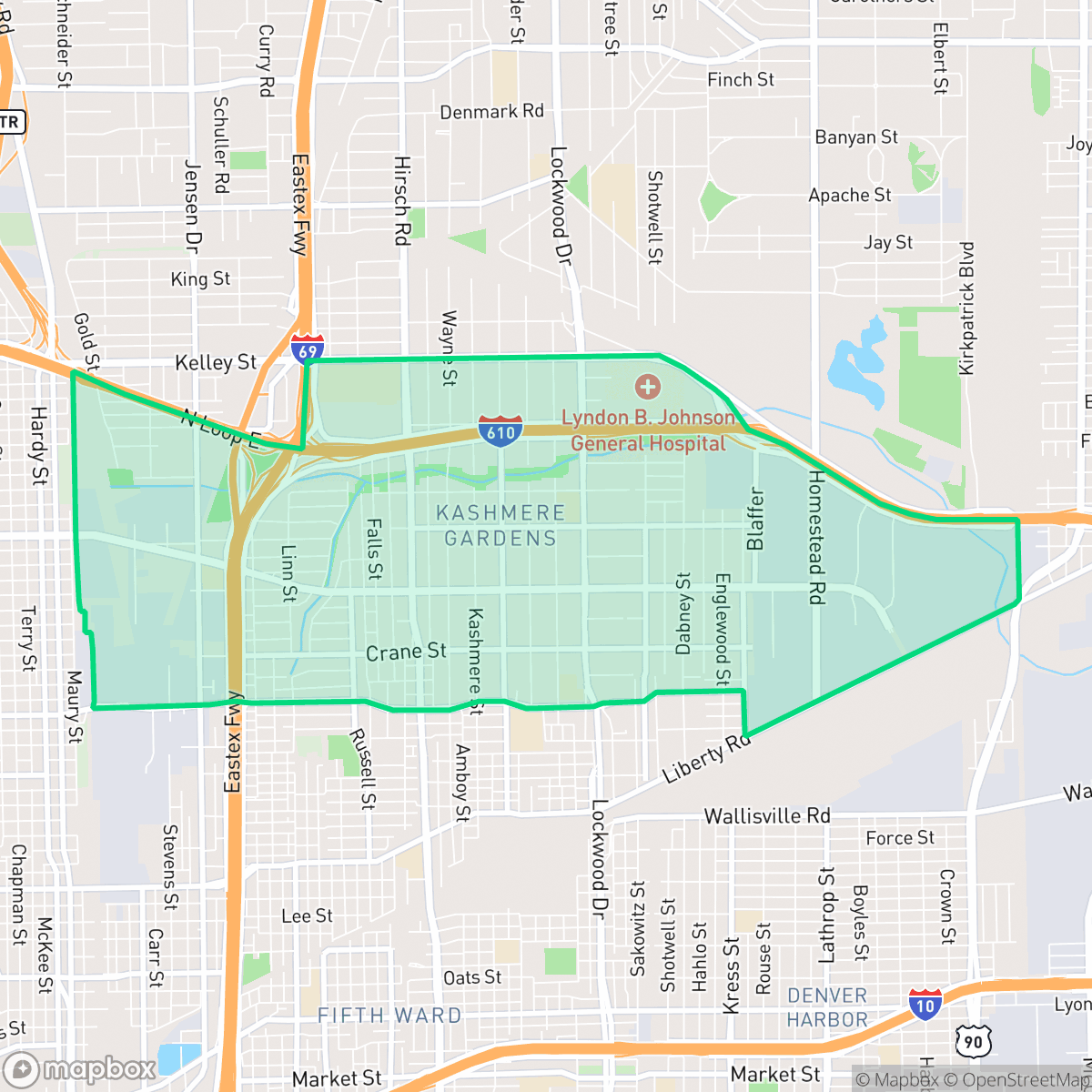
Annexed by Houston in the 1940s, Kashmere Gardens is a historically African American neighborhood in northeast Houston characterized by modest single-family homes on unusually large lots. This layout stems partly from the 1937 Houston Gardens subdivision, a New Deal Suburban Resettlement Administration project designed to create self-sufficient, subsistence-farming communities. The neighborhood has a rich legacy of civil rights activism; in 1960, Tyrone Day became the first Black student to integrate a Houston public school at Kashmere Gardens Elementary, and Kashmere High School students led major boycotts against ongoing school segregation in 1965. Bordered by industrial rail corridors, the community has faced severe environmental challenges, including extensive flooding during Hurricane Harvey in 2017 and subsequent home buyouts by the Harris County Flood Control District.
Kashmere Gardens is characterized by a dense suburban grid of single-story homes interspersed with mature tree canopy and light industrial zones. Proximity to major rail corridors and highway infrastructure defines the daily landscape, which includes localized services like Mickey Leland Memorial Park and various religious institutions. While the community maintains a calm atmosphere, the presence of heavy logistics hubs and nearby industrial sites necessitates careful consideration for those sensitive to environmental factors. Prospective residents should note the trade-offs inherent in the local infrastructure, including inconsistent sidewalk connectivity and a high vulnerability to flooding. The neighborhood is best suited for those prioritizing established residential blocks over proximity to high-density commercial centers. While the area offers a quiet setting, the reliance on personal vehicles and the limited availability of nearby retail or dining options are key factors for those evaluating the daily commute and lifestyle convenience.
Neighborhood Scores Across 15 Qualities
Residential spacing offers a moderate level of separation between neighbors, which is slightly higher than the Houston average. According to iHuus data, houses are generally situated on standard lots with small yards providing a modest buffer between structures.
Low traffic volumes on grid streets allow for safe movement, but inconsistent or missing sidewalks make walking less seamless than the Houston average. According to iHuus data, heavy tree canopy and nearby industrial zones can also obscure or interrupt pedestrian paths.
Small-lot housing and tight spacing define the landscape, which features significantly less greenery and fewer luxury amenities than the Houston average. Visible industrial rail proximity and unpaved areas contribute to a functional, utilitarian aesthetic.
Public greenery is primarily concentrated in the southeast quadrant's large park, while most other areas feature narrow sidewalk verges and private fenced yards. According to iHuus data, the accessibility of shared outdoor spaces for pets is below the Houston average.
A blend of residential pockets and large-scale logistics infrastructure defines the landscape, which is comparable to the broader Houston area. Extensive rail yards and industrial warehouses sit alongside single-family homes and mature tree canopies.
Primarily characterized by industrial zones and warehouses, this area offers a low-energy atmosphere with much less social activity than the Houston average. Residents will find limited access to local commerce, meaning most daily errands and dining options require a vehicle.
Continuous sound from nearby busy thoroughfares is a noticeable feature here. This level of acoustic activity is slightly higher than the average found across Houston.
Frequent unhealthy air quality levels pose a significant risk to sensitive groups. According to iHuus data, the pollution levels in this area are worse than the Houston average.
Significant industrial presence, including rail yards, logistics hubs, and a wastewater treatment plant, creates more heavy commercial traffic and noise than the Houston average. Residents should also be aware of a nearby EPA Superfund site with documented soil and groundwater contamination risks, according to iHuus data.
Health insurance access is notably lower than the Houston average. According to iHuus data, a significant portion of the resident population remains uninsured.
Voting patterns and census indicators show a much more liberal political leaning than the Houston average, according to iHuus data.
Residents live alongside a balanced distribution of young adults, families, and older individuals. According to iHuus data, this age profile is very similar to the broader Houston area.
Frequent flooding is a significant concern here as much of the area sits within a designated floodplain. According to iHuus data, this risk level is considerably higher than the Houston average, which may necessitate flood insurance for residents.
Address-Level Insights for Kashmere Gardens


iHuus Neighborhood Intelligence Insights
Get address-level neighborhood insights for Kashmere Gardens
- Street-level scores — see how individual blocks compare, not just neighborhood averages
- Micro-zone boundaries — identify quiet pockets, flood boundaries, and walkable clusters before you visit
- 15 dimensions in full — walkability, noise, air quality, school quality, insurance coverage, population age profile, urban/rural index, and more
- Boundary risk alerts — know if your address sits near a block boundary where scores drop, the kind of detail no listing will ever mention
- School insights — individual school ratings and insights, not just district-level data
- Compare before you commit — side-by-side data across neighborhoods, down to block precision
No credit card required
Compare with Any Neighborhood
| Dimension | Kashmere Gardens | Acres Home |
|---|---|---|
| 🚶 Walkabilityavg 7.08 | ||
| 🔊 Acoustic Comfortavg 4.14 | ||
| 🤫 Privacy Indexavg 5.34 | ||
| 🎨 Visual Appealavg 6.42 | ||
| 🐕 Dog Friendlinessavg 6.33 | ||
| 🗺️ Urban-Rural Indexavg 6.64 | ||
| ✨ Neighborhood Vibeavg 4.4 | ||
| 🏥 Health Insurance Coverageavg 5.46 | ||
| 🌿 Air Qualityavg 3.58 | ||
| 🏭 Industrial Proximityavg 6.9 | ||
| 🌊 Flood Safetyavg 6.27 | ||
| 🗳️ Ideological Leanavg 6.39 | ||
| 👥 Population Age Profileavg 4.6 | ||
| 🔥 Fire Safety | ||
| 🏫 School Quality |
Kashmere Gardens Rankings
School Districts Serving Kashmere Gardens
School Insights for Kashmere Gardens
Below average outcomes; significant attendance and academic challenges.
School Insights
See what's really behind every school rating near Kashmere Gardens
- Individual school ratings — each school's own score with outcome context, not just a district average
- Enrollment & class size data — student-to-teacher ratio and how it compares to the state average
- Full demographics breakdown — ethnicity and gender composition for every school in the enrollment zone
- Every school in the district — all schools within the enrollment boundary ranked by rating, not just the closest one
- Grade levels & benchmarks — elementary through high school, with below/above state-average flags
No credit card required