Huntington Village, Houston
Updated · 7,147 residents
Huntington Village is a dense residential community in southwest Houston known for its highly walkable street network and accessible greenway corridors. While the area offers a quiet, suburban atmosphere, residents experience limited privacy due to closely spaced housing and a mix of single-family homes and apartment complexes.
Key Highlights
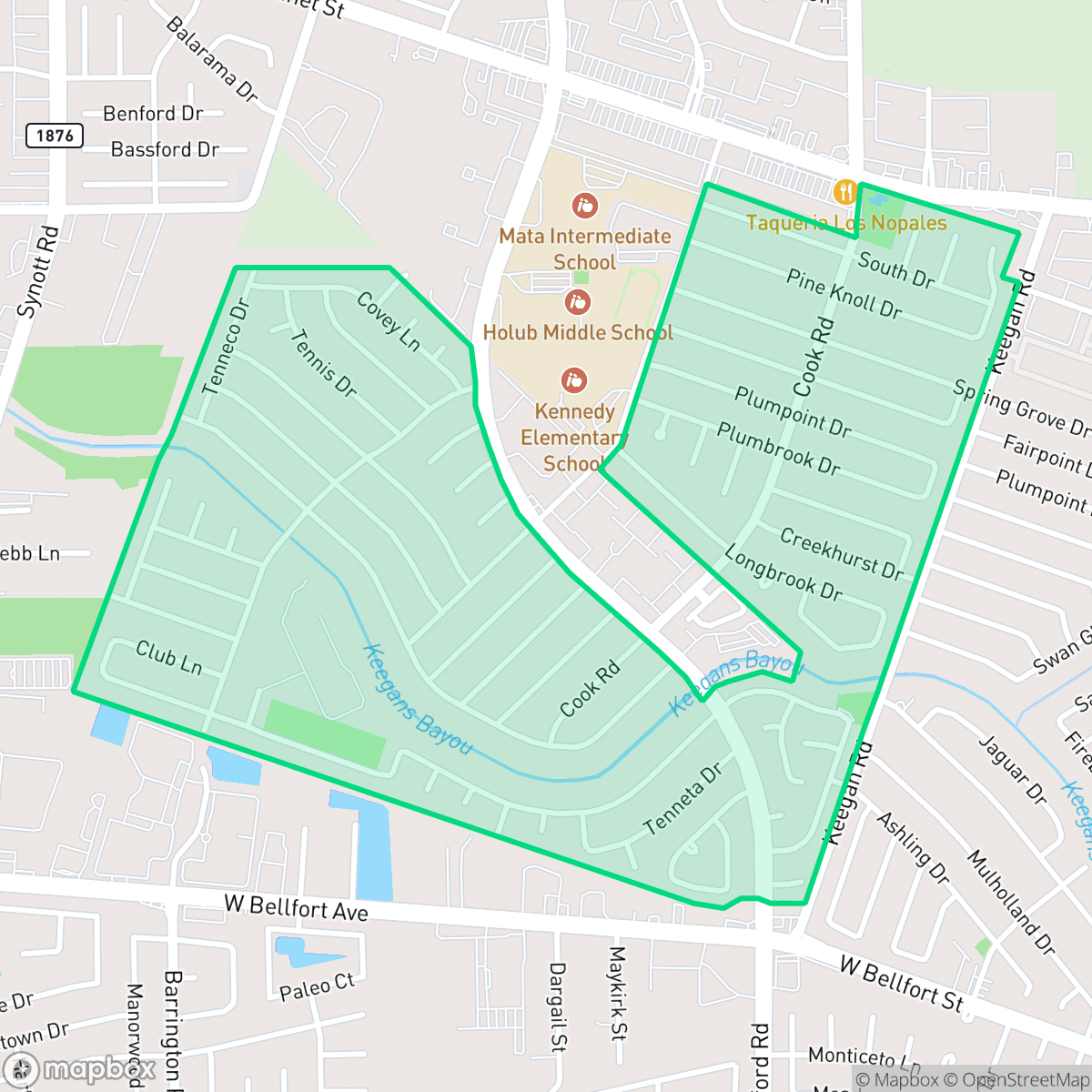
About Huntington Village
Established in the early 1970s, Huntington Village is a residential neighborhood located in the Alief area of southwest Houston. Developed primarily with single-family homes built around 1975, the subdivision was initially marketed as an appealing suburb featuring active community amenities like its local tennis center. To serve the neighborhood’s growing population, Michael Kennedy Elementary School opened in the fall of 1975, named in memory of a local student. The neighborhood is governed by the Huntington Village Community Association, which was established in 1971 and has historically maintained a highly active role in enforcing deed restrictions and managing community affairs.
The neighborhood is characterized by its established 1970s suburban layout, featuring a mix of single-family residences and multi-family apartment buildings. It provides a high level of walkability for a suburban area, with continuous sidewalks throughout the neighborhood and access to local green spaces that are well-suited for dog owners. The environment is generally quiet, though residents should be aware of the proximity to local infrastructure, including a nearby wastewater treatment plant and consistent road traffic noise.
Prospective residents often choose this area for its connectivity and established community structure, though it may be less appealing to those seeking high levels of privacy or a vibrant commercial scene. The neighborhood is served by the Alief Independent School District, which presents a range of academic outcomes across its schools. Given the density of the housing and the limited number of local businesses within walking distance, the area is best suited for those prioritizing a predictable, pedestrian-friendly environment over immediate access to retail or nightlife.
Neighborhood Scores Across 15 Qualities
Housing density varies between tightly packed apartments and more spaced suburban homes. This level of privacy is largely in line with the Houston average, though larger natural buffers can be found near the local creek.
Continuous sidewalk networks and dedicated greenway trails offer much better pedestrian connectivity than the Houston average. Most residential streets and cul-de-sacs feature wide, established paths that support safe movement for strollers and walkers.
Manicured lawns and frequent private pools contribute to a visual landscape that is slightly above the Houston average. Large homes and spacious driveways are common throughout this area, according to iHuus data.
Wide grassy utility corridors and tree-lined streets provide ample off-street space for pets. According to iHuus data, these connected green corridors and drainage trails offer much better walking opportunities than the Houston average.
Dense suburban development defines this area, featuring a mix of single-family homes, apartments, and paved infrastructure. This layout is largely consistent with the typical urban-rural balance found throughout Houston.
Primarily a subdued, residential landscape, this area offers fewer social hubs and less activity than the Houston average. Most local services and parks are reachable by foot, but the neighborhood remains largely car-oriented with limited commercial density.
Steady noise from local traffic along nearby busy streets is a common feature here. According to iHuus data, acoustic levels are slightly higher than the Houston average.
Air quality fluctuates between acceptable and unhealthy levels, presenting occasional concerns for sensitive groups. According to iHuus data, these conditions are slightly more frequent here than in the broader Houston area.
Primarily residential and light commercial, this area features a lower presence of heavy industry than the Houston average. While some warehouses and utility infrastructure are visible on the periphery, there are no significant industrial hazards nearby according to iHuus data.
Health insurance coverage in this area is below the Houston average. Residents may face more challenges accessing employer-sponsored or private plans compared to other parts of the city.
Political leanings in this area trend more liberal than the Houston average. According to iHuus data, the community maintains a liberal majority with a modest opposing presence.
Residents can expect a balanced mix of young adults, families, and older populations. According to iHuus data, this demographic spread is slightly more varied than the average seen across Houston.
Flood risk in this area remains difficult to quantify because FEMA has not finished a detailed study for this location. According to iHuus data, the level of flood safety is lower than the Houston average.
Address-Level Insights for Huntington Village


iHuus Neighborhood Intelligence Insights
Get address-level neighborhood insights for Huntington Village
- Street-level scores — see how individual blocks compare, not just neighborhood averages
- Micro-zone boundaries — identify quiet pockets, flood boundaries, and walkable clusters before you visit
- 15 dimensions in full — walkability, noise, air quality, school quality, insurance coverage, population age profile, urban/rural index, and more
- Boundary risk alerts — know if your address sits near a block boundary where scores drop, the kind of detail no listing will ever mention
- School insights — individual school ratings and insights, not just district-level data
- Compare before you commit — side-by-side data across neighborhoods, down to block precision
No credit card required
Compare with Any Neighborhood
| Dimension | Huntington Village | Acres Home |
|---|---|---|
| 🚶 Walkabilityavg 7.08 | ||
| 🔊 Acoustic Comfortavg 4.14 | ||
| 🤫 Privacy Indexavg 5.34 | ||
| 🎨 Visual Appealavg 6.42 | ||
| 🐕 Dog Friendlinessavg 6.33 | ||
| 🗺️ Urban-Rural Indexavg 6.64 | ||
| ✨ Neighborhood Vibeavg 4.4 | ||
| 🏥 Health Insurance Coverageavg 5.46 | ||
| 🌿 Air Qualityavg 3.58 | ||
| 🏭 Industrial Proximityavg 6.9 | ||
| 🌊 Flood Safetyavg 6.27 | ||
| 🗳️ Ideological Leanavg 6.39 | ||
| 👥 Population Age Profileavg 4.6 | ||
| 🔥 Fire Safety | ||
| 🏫 School Quality |
Huntington Village Rankings
School Districts Serving Huntington Village
School Insights for Huntington Village
Below average outcomes; significant attendance and academic challenges.
School Insights
See what's really behind every school rating near Huntington Village
- Individual school ratings — each school's own score with outcome context, not just a district average
- Enrollment & class size data — student-to-teacher ratio and how it compares to the state average
- Full demographics breakdown — ethnicity and gender composition for every school in the enrollment zone
- Every school in the district — all schools within the enrollment boundary ranked by rating, not just the closest one
- Grade levels & benchmarks — elementary through high school, with below/above state-average flags
No credit card required