Hunterwood, Houston
Updated · 2,649 residents
Hunterwood is a quiet, car-dependent residential area characterized by its proximity to heavy industrial zones and major highways. While it offers an open, semi-rural landscape compared to central Houston, residents experience significant road traffic noise and limited access to local commercial amenities.
Key Highlights
About Hunterwood
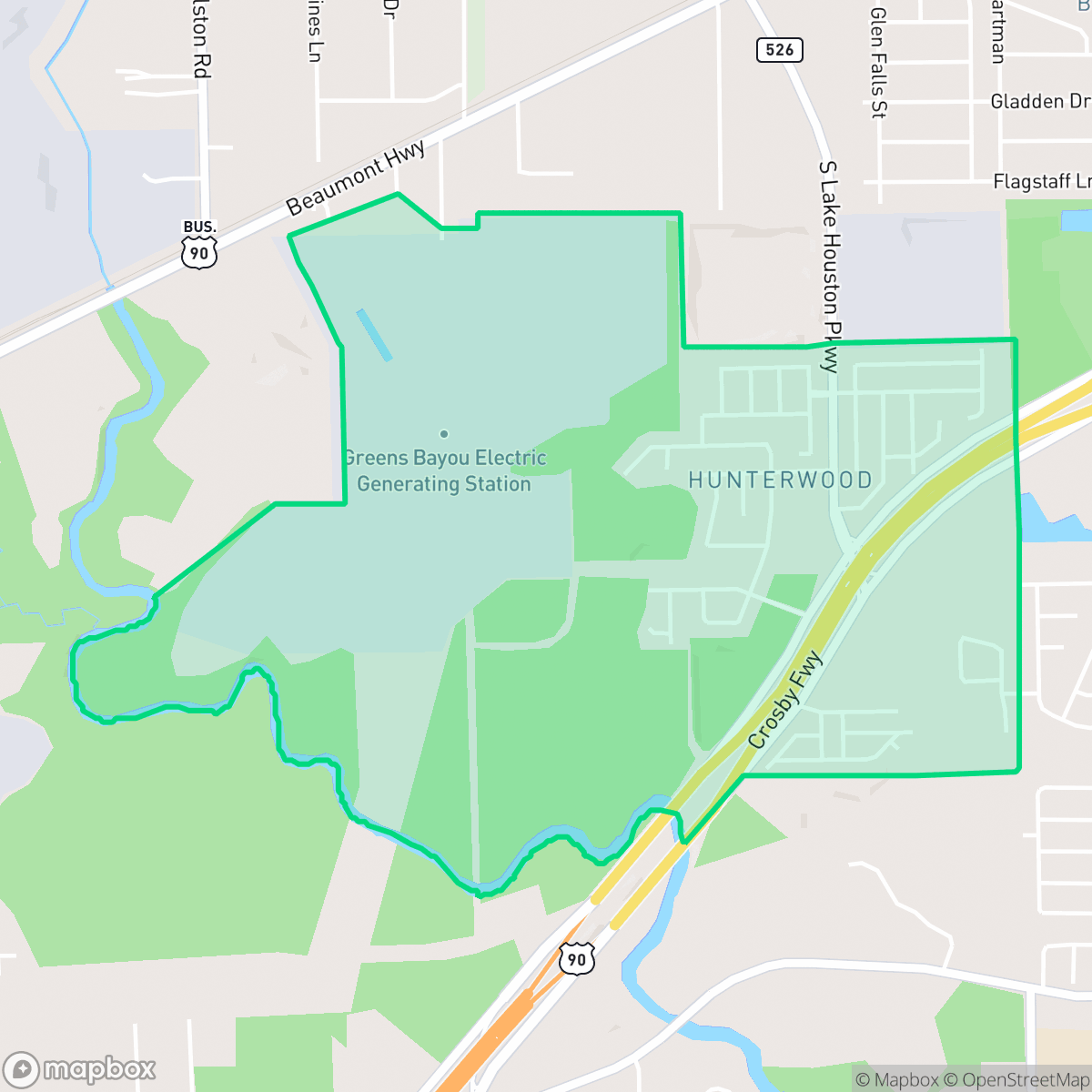
Located east of Greens Bayou, Hunterwood is a residential subdivision and recognized Super Neighborhood in Houston, Texas. Development in the community began in the mid-1970s, but property values declined sharply during the 1980s real estate market crash. Throughout the 1990s, the neighborhood’s recovery was stymied by the high tax rates of the former Hunterwood Municipal Utility District. To alleviate this financial burden and revitalize the local housing market, the district requested annexation by the City of Houston in 1996. Following the successful annexation, the neighborhood experienced a resurgence, and new home construction resumed, defining its modern residential landscape.
Located east of Greens Bayou, this area functions as a quiet, industrial-adjacent suburb that balances dense residential pockets with vast undeveloped woodland. The environment is defined by its proximity to logistical hubs, including trucking terminals and power infrastructure, which contributes to a distinct, low-density atmosphere. According to iHuus data, the landscape is primarily car-oriented, with few social or leisure spots located within the immediate vicinity, making it a remote setting for those who prefer privacy over urban convenience.
Prospective residents should consider the trade-offs of living in a location with high industrial proximity and significant road noise, which averages 66 decibels. While the neighborhood benefits from relatively high flood safety compared to other parts of the city, the air quality and acoustic environment remain notable challenges. The area is best suited for those who prioritize a quiet, suburban setting and are comfortable with a commute, as local business options are limited. Families may access educational opportunities through the stable Galena Park Independent School District or high-performing charter options like Idea Lake Houston.
Neighborhood Scores Across 15 Qualities
Residential spacing is mixed with some buffer between neighbors, representing a level of privacy that is roughly in line with the Houston average. According to iHuus data, the density provides a balance between open space and proximity to adjacent properties.
Quiet streets allow for easy walking, though the lack of sidewalks makes the area less walkable than the Houston average according to iHuus data.
Standard tract housing defines the area, characterized by uniform rooflines and modest yard spaces. According to iHuus data, the visual variety in this neighborhood is lower than the Houston average.
Access to public parks and wide green verges is relatively sparse in this area. According to iHuus data, pet owners will find fewer recreational opportunities for dogs compared to the Houston average.
A fragmented landscape of undeveloped woodlands, residential clusters, and large-scale industrial warehouses characterizes this area. According to iHuus data, the prevalence of open land and forested patches makes the environment slightly more rural than the Houston average.
Low levels of commercial activity and a heavy industrial presence make this area significantly less lively than the Houston average. Most residents will find very few local businesses or social hubs nearby, as the landscape is primarily composed of warehouses, railways, and residential blocks.
Frequent noise from nearby railroad tracks and heavy freeway traffic creates an environment much louder than the Houston average. According to iHuus data, the proximity to major transit corridors results in significantly lower acoustic comfort.
Frequent unhealthy air quality levels pose a significant risk to sensitive groups. According to iHuus data, the atmosphere in Hunterwood is notably less clear than the Houston average.
Heavy industrial activity, including large-scale logistics hubs, trucking terminals, and quarry sites, is prevalent in this area. According to iHuus data, the density of warehouses and utility infrastructure is notably lower than the Houston average.
Health insurance access is significantly lower in this area than the Houston average. Residents may face greater challenges accessing employer-sponsored or private medical coverage according to iHuus data.
Political leanings in this area are predominantly liberal, representing a more progressive tilt than the Houston average according to iHuus data.
Residents live alongside a varied mix of young adults, families, and seniors. This demographic spread is slightly lower than the Houston average, according to iHuus data.
Flood risk in this area is relatively low compared to the Houston average, though some residual risk exists within the 500 year floodplain according to iHuus data.
Address-Level Insights for Hunterwood


iHuus Neighborhood Intelligence Insights
Get address-level neighborhood insights for Hunterwood
- Street-level scores — see how individual blocks compare, not just neighborhood averages
- Micro-zone boundaries — identify quiet pockets, flood boundaries, and walkable clusters before you visit
- 15 dimensions in full — walkability, noise, air quality, school quality, insurance coverage, population age profile, urban/rural index, and more
- Boundary risk alerts — know if your address sits near a block boundary where scores drop, the kind of detail no listing will ever mention
- School insights — individual school ratings and insights, not just district-level data
- Compare before you commit — side-by-side data across neighborhoods, down to block precision
No credit card required
Compare with Any Neighborhood
| Dimension | Hunterwood | Acres Home |
|---|---|---|
| 🚶 Walkabilityavg 7.08 | ||
| 🔊 Acoustic Comfortavg 4.14 | ||
| 🤫 Privacy Indexavg 5.34 | ||
| 🎨 Visual Appealavg 6.42 | ||
| 🐕 Dog Friendlinessavg 6.33 | ||
| 🗺️ Urban-Rural Indexavg 6.64 | ||
| ✨ Neighborhood Vibeavg 4.4 | ||
| 🏥 Health Insurance Coverageavg 5.46 | ||
| 🌿 Air Qualityavg 3.58 | ||
| 🏭 Industrial Proximityavg 6.9 | ||
| 🌊 Flood Safetyavg 6.27 | ||
| 🗳️ Ideological Leanavg 6.39 | ||
| 👥 Population Age Profileavg 4.6 | ||
| 🔥 Fire Safety | ||
| 🏫 School Quality |
Hunterwood Rankings
School Districts Serving Hunterwood
School Insights for Hunterwood
Below average outcomes; significant attendance and academic challenges.
School Insights
See what's really behind every school rating near Hunterwood
- Individual school ratings — each school's own score with outcome context, not just a district average
- Enrollment & class size data — student-to-teacher ratio and how it compares to the state average
- Full demographics breakdown — ethnicity and gender composition for every school in the enrollment zone
- Every school in the district — all schools within the enrollment boundary ranked by rating, not just the closest one
- Grade levels & benchmarks — elementary through high school, with below/above state-average flags
No credit card required