Hidden Valley, Houston
Updated · 5,455 residents
Hidden Valley is a residential enclave in north Houston defined by its collection of postwar ranch-style homes and quiet, curvilinear streets. While the area offers a consistent sidewalk network for pedestrians, residents should be aware of elevated noise levels stemming from its proximity to Interstate 45 and local logistics corridors.
Key Highlights
About Hidden Valley
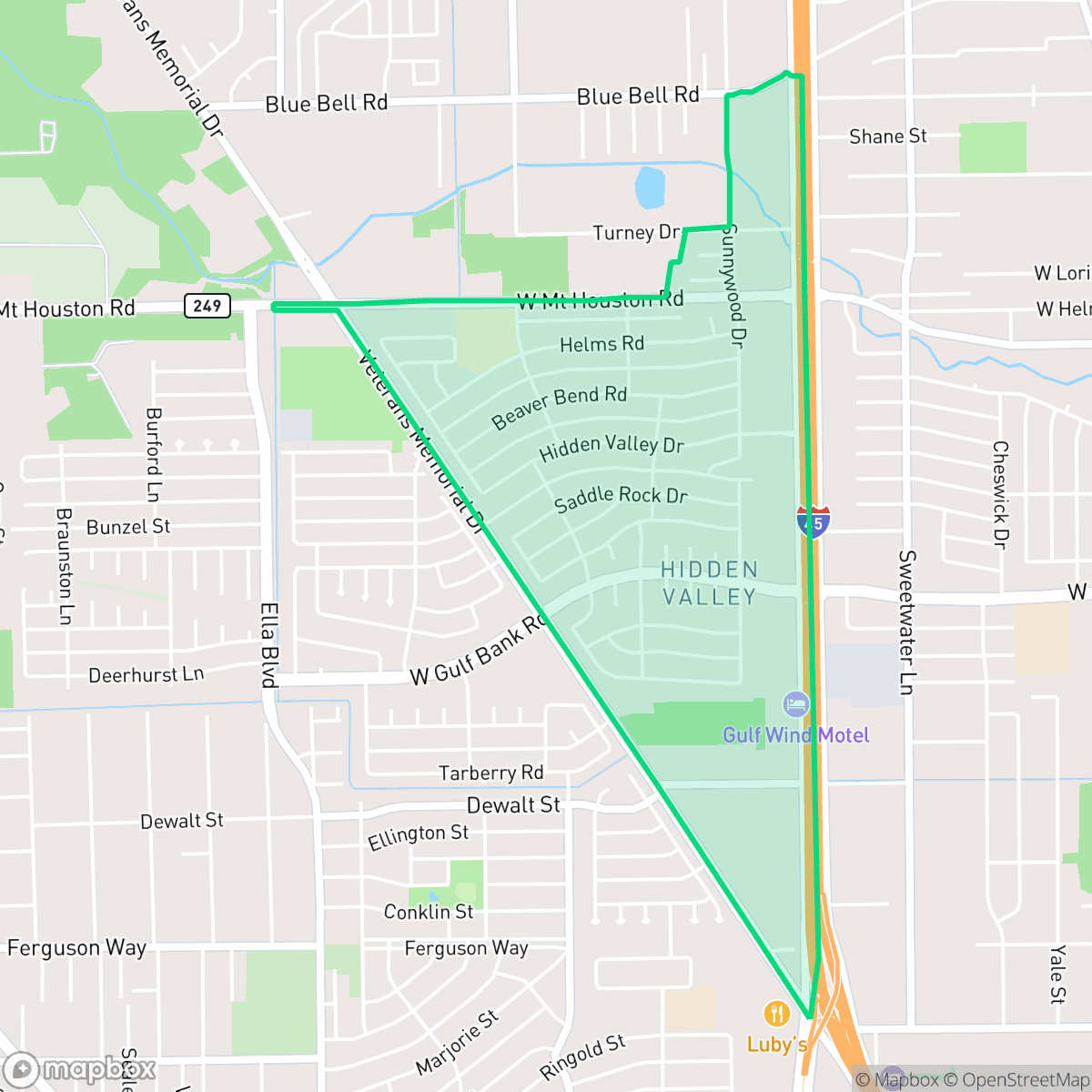
Developed in 12 sections between 1956 and 1979 by Smith & Son, the Hidden Valley neighborhood in north Houston was built along the west side of US 75 (now Interstate 45). Although situated between heavily wooded areas, the land was entirely treeless when development began. The neighborhood is characterized by Transitional Ranch-style single-family homes on medium-sized lots lining curvilinear streets. Its boundaries form a rough triangle between Interstate 45, Veterans Memorial Drive (formerly Stuebner Airline Road), and West Mount Houston Road. During its initial development, the neighborhood's developers sold a ten-acre tract along West Mount Houston Road to the Aldine Independent School District to establish Hidden Valley Elementary School. Today, the neighborhood remains a highly residential postwar enclave.
The area maintains a dense suburban atmosphere, characterized by a mix of single-family residences and nearby light industrial zones. Its layout provides a predictable grid of residential streets, though the presence of major highway interchanges and truck terminals introduces a significant industrial influence. The neighborhood benefits from a favorable flood safety profile compared to the city average, providing a sense of stability for long-term homeowners. Residents will find a community that prioritizes a quiet, established environment over a high-energy social scene or commercial density.
Prospective residents should weigh the calm, residential nature of the community against the environmental trade-offs of living near major transit arteries. The area is best suited for those prioritizing proximity to major thoroughfares and established neighborhood infrastructure. While local amenities are somewhat limited, the presence of schools like Goodman Elementary and the accessibility of the surrounding region make it a functional choice for commuters and families seeking a traditional suburban footprint.
Neighborhood Scores Across 15 Qualities
Homes feature moderate density with consistent buffers between neighbors, providing more separation than the typical Houston streetscape according to iHuus data.
Low traffic on interior streets and cul-de-sacs provides a safe environment for walking, though the lack of a comprehensive sidewalk network makes this area less walkable than most of Houston. According to iHuus data, the presence of a major highway nearby limits pedestrian connectivity to the surrounding areas.
Uniform tract housing and apartment complexes define the landscape, which offers less visual variety than the Houston average. Properties typically feature consistent rooflines and small, tidy yards.
Central wooded areas and consistent sidewalks offer adequate space for pet walking, though overall accessibility is slightly below the Houston average. A large park located in the northwest portion of the neighborhood provides additional recreational space for dogs.
Open land and woodland areas are interspersed with industrial warehouses and residential pockets, making the landscape similar to the Houston average. According to iHuus data, the area maintains a low-density character defined by a mix of suburban tracts and commercial strips.
Primarily characterized by industrial landscapes and warehouses, this area offers a quiet atmosphere with limited social activity. According to iHuus data, the level of liveliness is below the Houston average, as most amenities and dining options require a car to access.
Persistent noise from nearby major freeways and railroad tracks characterizes this area. According to iHuus data, acoustic comfort in Hidden Valley is significantly lower than the Houston average.
Frequent unhealthy air quality levels pose a significant risk to sensitive groups. According to iHuus data, the air quality in Hidden Valley is notably worse than the Houston average.
Logistics hubs, warehouses, and heavy truck traffic are present alongside residential areas, resulting in a level of industrial proximity slightly below the Houston average. According to iHuus data, certain sections of the neighborhood experience notable noise and traffic from nearby multi-lane highways and large-scale commercial yards.
Health insurance access is notably lower than the Houston average, which may present challenges for residents seeking consistent medical coverage. According to iHuus data, a small portion of the population holds active health insurance plans.
Voting patterns and census indicators in this area reflect a much more liberal political leaning than the Houston average, according to iHuus data.
Residents experience a balanced demographic mix of young adults, families, and seniors. This age distribution aligns with the broader Houston average, according to iHuus data.
Flood risk in this area is difficult to assess because official federal studies for the neighborhood are currently incomplete. According to iHuus data, this lack of detailed mapping means the local risk level is slightly higher than the Houston average.
Address-Level Insights for Hidden Valley


iHuus Neighborhood Intelligence Insights
Get address-level neighborhood insights for Hidden Valley
- Street-level scores — see how individual blocks compare, not just neighborhood averages
- Micro-zone boundaries — identify quiet pockets, flood boundaries, and walkable clusters before you visit
- 15 dimensions in full — walkability, noise, air quality, school quality, insurance coverage, population age profile, urban/rural index, and more
- Boundary risk alerts — know if your address sits near a block boundary where scores drop, the kind of detail no listing will ever mention
- School insights — individual school ratings and insights, not just district-level data
- Compare before you commit — side-by-side data across neighborhoods, down to block precision
No credit card required
Compare with Any Neighborhood
| Dimension | Hidden Valley | Acres Home |
|---|---|---|
| 🚶 Walkabilityavg 7.08 | ||
| 🔊 Acoustic Comfortavg 4.14 | ||
| 🤫 Privacy Indexavg 5.34 | ||
| 🎨 Visual Appealavg 6.42 | ||
| 🐕 Dog Friendlinessavg 6.33 | ||
| 🗺️ Urban-Rural Indexavg 6.64 | ||
| ✨ Neighborhood Vibeavg 4.4 | ||
| 🏥 Health Insurance Coverageavg 5.46 | ||
| 🌿 Air Qualityavg 3.58 | ||
| 🏭 Industrial Proximityavg 6.9 | ||
| 🌊 Flood Safetyavg 6.27 | ||
| 🗳️ Ideological Leanavg 6.39 | ||
| 👥 Population Age Profileavg 4.6 | ||
| 🔥 Fire Safety | ||
| 🏫 School Quality |
Hidden Valley Rankings
School Districts Serving Hidden Valley
School Insights for Hidden Valley
Below average outcomes; significant attendance and academic challenges.
School Insights
See what's really behind every school rating near Hidden Valley
- Individual school ratings — each school's own score with outcome context, not just a district average
- Enrollment & class size data — student-to-teacher ratio and how it compares to the state average
- Full demographics breakdown — ethnicity and gender composition for every school in the enrollment zone
- Every school in the district — all schools within the enrollment boundary ranked by rating, not just the closest one
- Grade levels & benchmarks — elementary through high school, with below/above state-average flags
No credit card required