Gulfton, Houston
Updated · 48,106 residents
Gulfton is a densely populated and culturally diverse hub in Southwest Houston known for its vibrant international dining scene and high concentration of multi-family housing. While the area offers a lively atmosphere with numerous social spots, residents experience limited privacy due to tight building density and significant noise from nearby road traffic.
Key Highlights
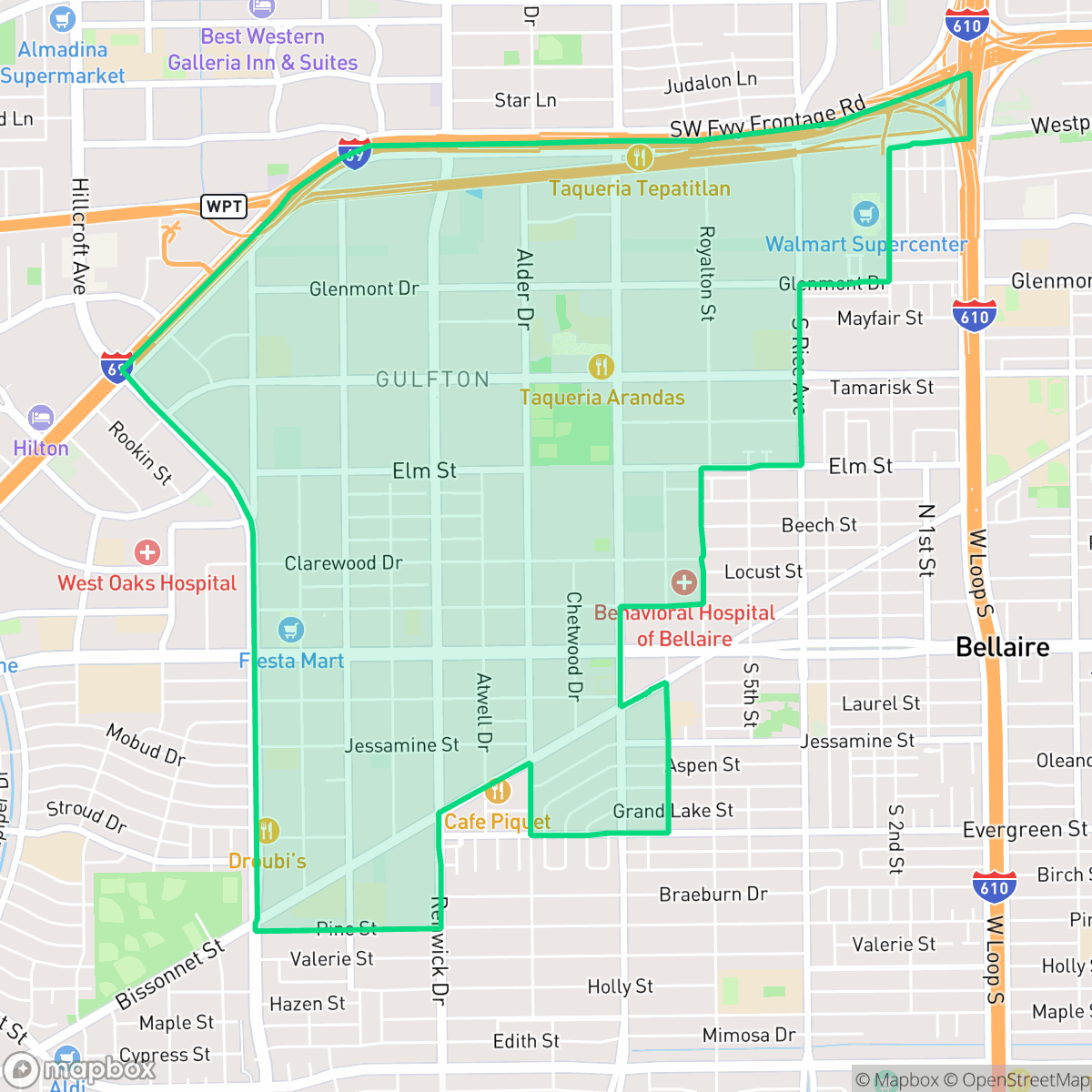
About Gulfton
Originally developed as the rural Westmoreland Farms subdivision, Southwest Houston’s Gulfton neighborhood underwent a dramatic transformation during the 1970s oil boom. Developers utilized its large acreage parcels to construct massive, amenity-heavy apartment complexes designed for young single workers, earning the area the nickname "Swingersville". However, the 1980s oil bust triggered widespread vacancies and foreclosures. To fill the empty units, property owners marketed to newly arrived immigrants, transforming the neighborhood. Today, Gulfton is recognized as Houston's most densely populated community and is often called the city's "Ellis Island". It is a vibrant, highly diverse enclave where residents speak over 50 languages, with particularly strong cultural roots from Mexico, El Salvador, and other Latin American nations.
This neighborhood functions as a dense urban-suburban mix, characterized by a high concentration of apartment complexes, light industrial warehouses, and diverse commercial strips. It is a center for international cuisine, featuring a variety of local bakeries, cafes, and restaurants that reflect the deep cultural roots of its residents. The area provides a steady, active environment with social hubs and green spaces like Burnett Bayland Park, though the landscape is dominated by multi-family developments and large-scale logistics facilities that contribute to a distinct industrial presence. Residents benefit from a clear grid of sidewalks, though the overall environment is heavily influenced by proximity to major highway infrastructure and high-traffic arterials. Living here requires navigating specific trade-offs, particularly regarding acoustic comfort and air quality, which are impacted by ongoing logistics activity and road noise. The area presents a complex landscape for families, as the local school district currently faces significant operational volatility. However, several high-performing charter schools are available within the community. Given the high-density housing and lower privacy scores, this neighborhood is best suited for individuals who prioritize cultural variety and central access over quiet, low-density suburban living.
Neighborhood Scores Across 15 Qualities
Closely packed apartment blocks and shared walls create a denser living environment than the Houston average. Residents in multi-family zones may experience minimal separation between structures, although some detached homes maintain moderate setbacks.
Quiet residential streets allow for easy walking, but massive highway barriers and large parking lots make navigating the area on foot more difficult than in most parts of Houston. According to iHuus data, the sidewalk network remains fragmented and is frequently interrupted by high-traffic arterials.
The visual landscape consists of a mix of high-density apartment complexes, industrial warehouses, and modest single-family homes. This variety in building types and residential density is largely in line with the city average.
Public walking areas for pets are inconsistent due to a prevalence of large freeway interchanges and gated apartment complexes. While some residential pockets and sports complexes offer accessible greenery, the overall availability of open parkland is below the Houston average according to iHuus data.
Frequent apartment complexes, commercial strips, and major highway infrastructure create an intensely developed landscape. This level of density and built-up environment is largely consistent with the broader Houston area.
Active pockets of dining and social hubs provide a more vibrant atmosphere than the Houston average; however, most amenities require a vehicle to reach. Residents will find a diverse mix of eateries and green spaces, though the area's character ranges from quiet suburban blocks to busier, industrial-adjacent corridors.
Frequent disturbances from nearby freeway and railroad traffic characterize this area. According to iHuus data, acoustic comfort in Gulfton is lower than the Houston city average.
Frequent unhealthy air quality levels pose significant risks to sensitive groups. This condition is notably worse than the Houston average, according to iHuus data.
Residential streets are interspersed with various warehouses and logistics hubs that may generate localized noise and truck traffic. This level of industrial activity is roughly in line with the Houston average.
Health insurance coverage is notably lower than the Houston average, which may impact access to routine medical care for many residents. According to iHuus data, the majority of the population lacks employer-sponsored or private coverage.
Political leanings in this area are more liberal than the Houston average, according to iHuus data.
Residents experience a varied demographic mix of young adults, families, and seniors. This population spread is slightly lower than the Houston average, according to iHuus data.
Flood risk levels in this area are difficult to precisely determine because detailed federal studies have not been completed. According to iHuus data, this lack of clarity places the neighborhood at a higher risk level than the Houston average.
Address-Level Insights for Gulfton


iHuus Neighborhood Intelligence Insights
Get address-level neighborhood insights for Gulfton
- Street-level scores — see how individual blocks compare, not just neighborhood averages
- Micro-zone boundaries — identify quiet pockets, flood boundaries, and walkable clusters before you visit
- 15 dimensions in full — walkability, noise, air quality, school quality, insurance coverage, population age profile, urban/rural index, and more
- Boundary risk alerts — know if your address sits near a block boundary where scores drop, the kind of detail no listing will ever mention
- School insights — individual school ratings and insights, not just district-level data
- Compare before you commit — side-by-side data across neighborhoods, down to block precision
No credit card required
Compare with Any Neighborhood
| Dimension | Gulfton | Acres Home |
|---|---|---|
| 🚶 Walkabilityavg 7.08 | ||
| 🔊 Acoustic Comfortavg 4.14 | ||
| 🤫 Privacy Indexavg 5.34 | ||
| 🎨 Visual Appealavg 6.42 | ||
| 🐕 Dog Friendlinessavg 6.33 | ||
| 🗺️ Urban-Rural Indexavg 6.64 | ||
| ✨ Neighborhood Vibeavg 4.4 | ||
| 🏥 Health Insurance Coverageavg 5.46 | ||
| 🌿 Air Qualityavg 3.58 | ||
| 🏭 Industrial Proximityavg 6.9 | ||
| 🌊 Flood Safetyavg 6.27 | ||
| 🗳️ Ideological Leanavg 6.39 | ||
| 👥 Population Age Profileavg 4.6 | ||
| 🔥 Fire Safety | ||
| 🏫 School Quality |
Gulfton Rankings
School Districts Serving Gulfton
School Insights for Gulfton
Below average outcomes; significant attendance and academic challenges.
School Insights
See what's really behind every school rating near Gulfton
- Individual school ratings — each school's own score with outcome context, not just a district average
- Enrollment & class size data — student-to-teacher ratio and how it compares to the state average
- Full demographics breakdown — ethnicity and gender composition for every school in the enrollment zone
- Every school in the district — all schools within the enrollment boundary ranked by rating, not just the closest one
- Grade levels & benchmarks — elementary through high school, with below/above state-average flags
No credit card required