Greenway - Upper Kirby Area, Houston
Updated · 23,125 residents
Greenway - Upper Kirby is a high-energy urban area known for its diverse dining scene and mix of mid-rise apartments and single-family homes. While the neighborhood offers excellent access to local social hubs and green spaces like Levy Park, residents should expect significant road traffic noise and a dense, car-dependent layout.
Key Highlights
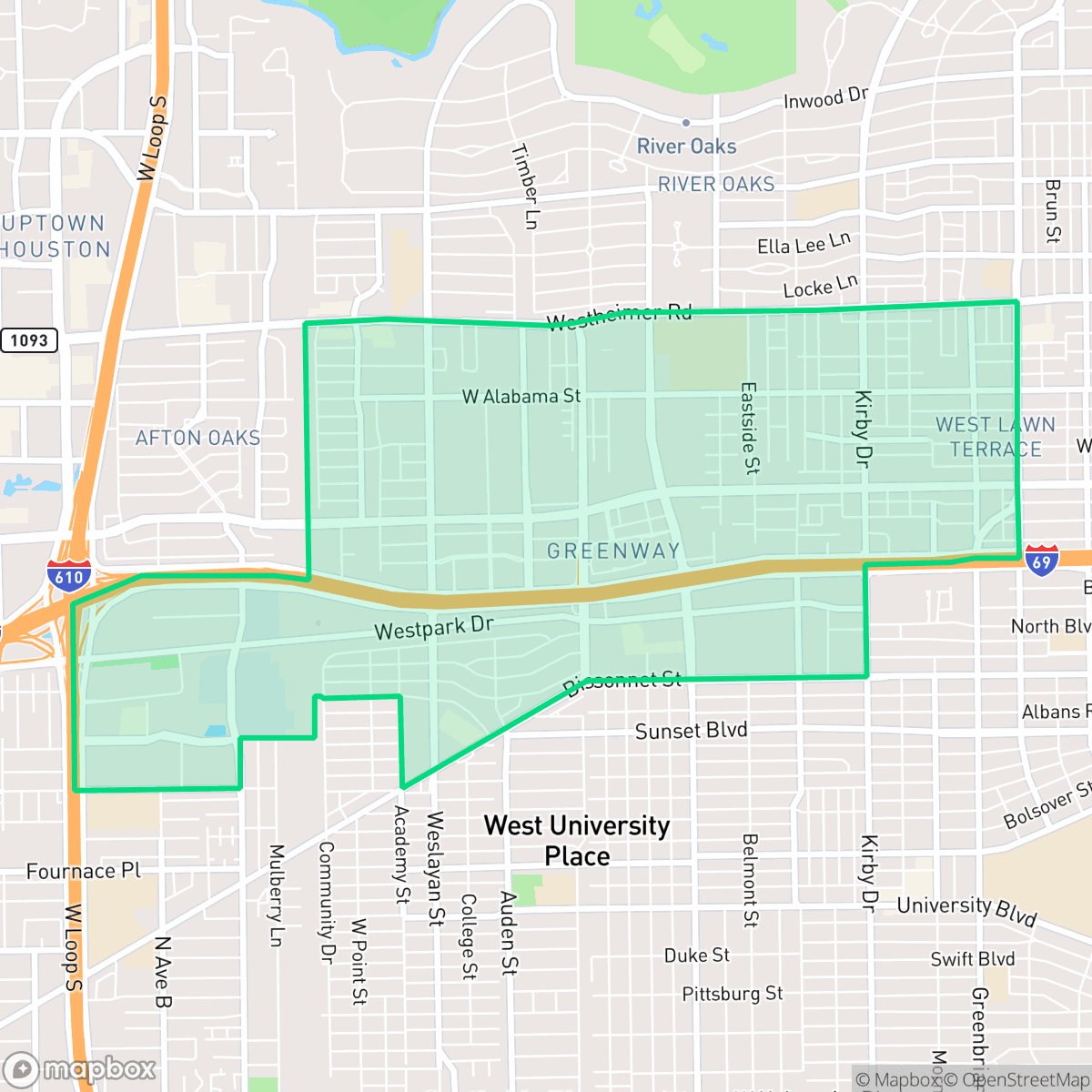
About Greenway - Upper Kirby Area
Developed primarily in the 1940s and 1950s with spacious ranch-style homes, the Greenway - Upper Kirby Area initially lacked a cohesive neighborhood identity. To counter urban decline, local business owners formed a merchant association in 1987, establishing the Upper Kirby District. In a creative branding move, the district embraced its "U.K." initials by installing iconic red British telephone booths along its streets. The neighborhood is anchored by Greenway Plaza, a master-planned, multi-building commercial complex developed in the late 1960s and 1970s. Local landmarks include the historic 1939 Alabama Theatre—now operating as a Trader Joe's—and Levy Park, which was donated by Leon Levy in 1941 and later transformed into a premier, award-winning urban green space.
This neighborhood functions as a dense urban and suburban hybrid, characterized by a mix of mid-rise institutional buildings, multi-family housing, and established residential blocks. The area features a vibrant culinary landscape with numerous restaurants and social venues, making it a popular destination for those seeking an active lifestyle within Houston. Visually, the streets are defined by a mix of upscale apartment complexes with private courtyards and single-family homes that often include backyard pools and mature tree canopies. While the area benefits from a well-defined grid system and consistent sidewalk coverage, the presence of major highway corridors creates significant pedestrian barriers and contributes to higher levels of ambient traffic noise.
Neighborhood Scores Across 15 Qualities
Housing layouts range from dense, shared-wall townhomes to detached homes with small yards, offering slightly less physical separation between neighbors than the Houston average. According to iHuus data, many structures are closely spaced with narrow setbacks, though some areas maintain buffers through mature landscaping and fencing.
Pedestrian connectivity is slightly above the city average due to a well-defined street grid with frequent crosswalks and sidewalks. While many residential streets offer shaded, walkable paths, large highway corridors and expansive parking lots can create significant barriers to movement in certain areas.
Large custom homes with private pools and mature tree canopies characterize this area, providing a more polished landscape than the Houston average. According to iHuus data, the presence of high-end apartment courtyards and well-maintained landscaping contributes to a premium visual environment.
Wide green verges and nearby athletic fields provide decent walking opportunities for pets, though access to large dedicated public parks is below the city average. Some street segments feature continuous tree-lined sidewalks, while other areas are dominated by freeway interchanges and limited green space.
Residential streets and green spaces are found in roughly equal measure to commercial blocks. This area presents a slightly less dense layout compared to the Houston average, offering a blend of single-family homes and multi-story apartment complexes.
Dynamic social hubs and diverse dining options create a more active atmosphere than the Houston average. While some mid-rise blocks offer high energy, other pockets remain quiet and suburban with limited walking access to amenities.
A steady hum of local traffic from nearby busy streets characterizes the area. According to iHuus data, acoustic levels are slightly higher than the Houston average.
Air quality levels in this area fluctuate between acceptable and unhealthy, presenting occasional concerns for sensitive groups. According to iHuus data, conditions here are slightly worse than the Houston average.
Industrial activity is notably absent from most of the area, which consists primarily of residential, commercial, and educational zones. According to iHuus data, the neighborhood lacks the heavy warehouses and hazardous industrial sites found more frequently elsewhere in Houston.
Health insurance accessibility is significantly higher than the Houston average, according to iHuus data. Residents in this area benefit from much greater rates of coverage than most of the city.
Political leanings in this area align closely with the city average, characterized by a liberal majority and a modest conservative presence according to iHuus data.
A diverse mix of young professionals, families, and seniors resides here, representing a slightly more even age distribution than the Houston average according to iHuus data.
Flood risk in this area is notably higher than the Houston average because some properties are located within the 500-year floodplain. According to iHuus data, while most areas are considered relatively safe, some residual flood risk remains for certain locations.
Address-Level Insights for Greenway - Upper Kirby Area


iHuus Neighborhood Intelligence Insights
Get address-level neighborhood insights for Greenway - Upper Kirby Area
- Street-level scores — see how individual blocks compare, not just neighborhood averages
- Micro-zone boundaries — identify quiet pockets, flood boundaries, and walkable clusters before you visit
- 15 dimensions in full — walkability, noise, air quality, school quality, insurance coverage, population age profile, urban/rural index, and more
- Boundary risk alerts — know if your address sits near a block boundary where scores drop, the kind of detail no listing will ever mention
- School insights — individual school ratings and insights, not just district-level data
- Compare before you commit — side-by-side data across neighborhoods, down to block precision
No credit card required
Compare with Any Neighborhood
| Dimension | Greenway - Upper Kirby Area | Acres Home |
|---|---|---|
| 🚶 Walkabilityavg 7.08 | ||
| 🔊 Acoustic Comfortavg 4.14 | ||
| 🤫 Privacy Indexavg 5.34 | ||
| 🎨 Visual Appealavg 6.42 | ||
| 🐕 Dog Friendlinessavg 6.33 | ||
| 🗺️ Urban-Rural Indexavg 6.64 | ||
| ✨ Neighborhood Vibeavg 4.4 | ||
| 🏥 Health Insurance Coverageavg 5.46 | ||
| 🌿 Air Qualityavg 3.58 | ||
| 🏭 Industrial Proximityavg 6.9 | ||
| 🌊 Flood Safetyavg 6.27 | ||
| 🗳️ Ideological Leanavg 6.39 | ||
| 👥 Population Age Profileavg 4.6 | ||
| 🔥 Fire Safety | ||
| 🏫 School Quality |
Greenway - Upper Kirby Area Rankings
School Districts Serving Greenway - Upper Kirby Area
School Insights for Greenway - Upper Kirby Area
Below average outcomes; significant attendance and academic challenges.
School Insights
See what's really behind every school rating near Greenway - Upper Kirby Area
- Individual school ratings — each school's own score with outcome context, not just a district average
- Enrollment & class size data — student-to-teacher ratio and how it compares to the state average
- Full demographics breakdown — ethnicity and gender composition for every school in the enrollment zone
- Every school in the district — all schools within the enrollment boundary ranked by rating, not just the closest one
- Grade levels & benchmarks — elementary through high school, with below/above state-average flags
No credit card required