Greater Uptown, Houston
Updated · 54,298 residents
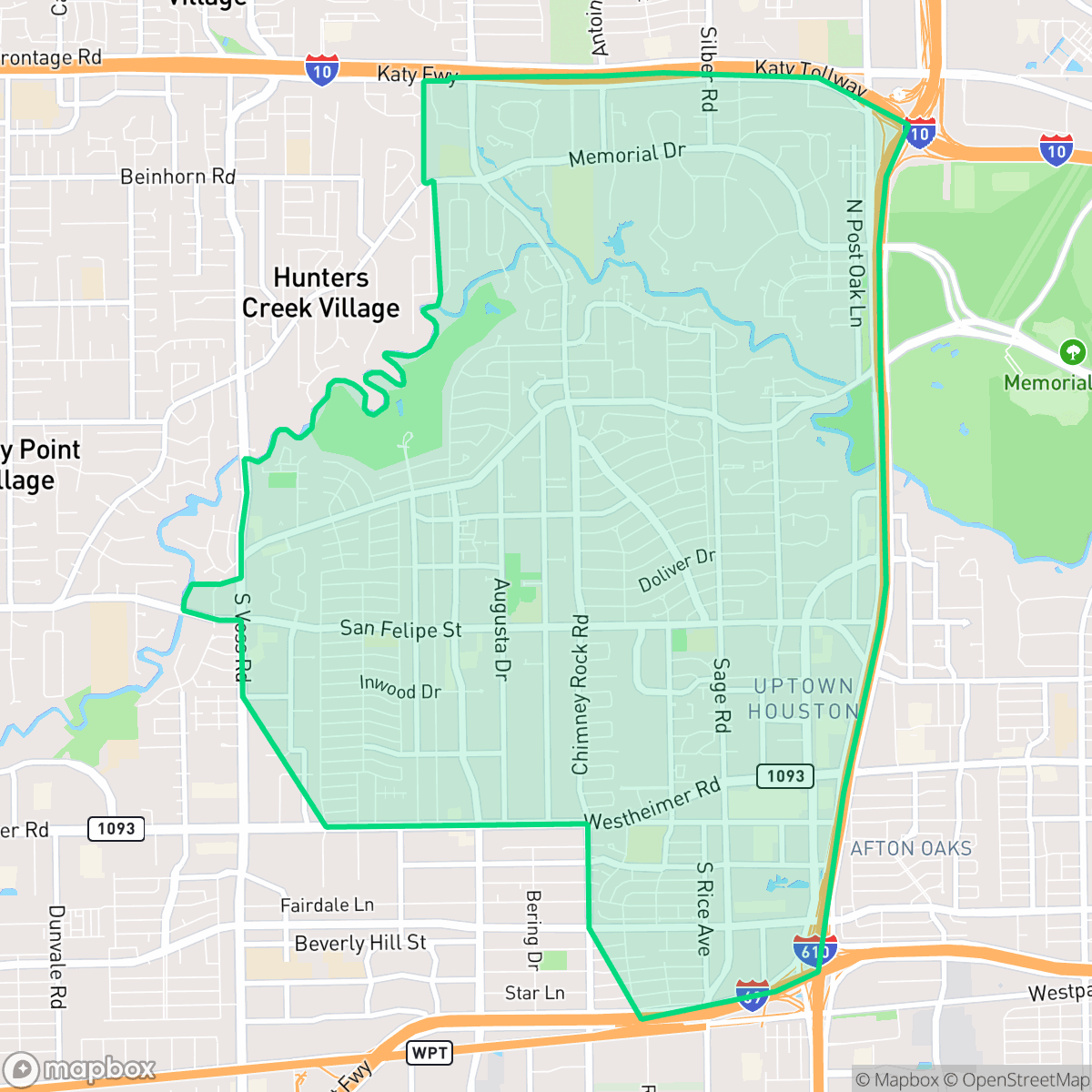
Greater Uptown is a prominent Houston district defined by its iconic skyline, including the Williams Tower and the massive Galleria shopping complex. While the area offers high walkability and a polished urban aesthetic, residents experience a dense environment with limited privacy and significant noise from surrounding traffic.
Key Highlights
About Greater Uptown
Traversed by Stephen F. Austin’s colonists along the San Felipe Trail in the 1800s, Greater Uptown began as a rural flatland of Italian immigrant vegetable farms. In 1948, the area lay outside Houston's city limits, described as a "lonely, unlit, pockmarked booby trap." Its modern transformation began post-WWII under visionaries like William Farrington and Gerald D. Hines. Hines opened the landmark Galleria mall in 1970, anchoring its growth into a premier "edge city." The neighborhood features architectural marvels like the 901-foot Williams Tower, designed by Philip Johnson as the world’s tallest skyscraper outside a central business district, and César Pelli's Four Leaf Towers. Its distinct streetscape is defined by iconic polished stainless steel arches and rings designed in the 1990s, inspired by Texas's oil and gas infrastructure.
The area functions as a premier commercial and residential hub, characterized by its blend of high-rise office towers and dense multi-family housing. Its streetscape is highly maintained, featuring professional landscaping and modern architecture that contributes to a strong visual appeal. According to iHuus data, residents benefit from a high degree of health insurance coverage and proximity to essential services, though the neighborhood remains a dense, car-oriented environment despite its pedestrian infrastructure. Living here requires balancing the convenience of a central location with the realities of urban density. While the area provides excellent access to retail and dining, the proximity of high-traffic roads results in constant noise levels and moderate air quality concerns. It is best suited for professionals and those seeking an active, upscale lifestyle who prioritize proximity to major employment centers over the quiet or privacy of a suburban setting.
Neighborhood Scores Across 15 Qualities
Residential spacing varies from shared walls in dense apartment blocks to detached homes with moderate yard buffers. Privacy levels are slightly lower than the Houston average due to the presence of tightly packed townhomes and high-rise structures overlooking communal areas.
Pedestrian connectivity varies across the area; while many residential streets feature continuous sidewalks, massive multi-lane highways and large surface parking lots create significant barriers to movement. This level of walkability is slightly below the Houston average due to the disconnected nature of the street network near major arterial roads.
Upscale architecture and manicured greenery define the area, with many properties featuring private pools and well-maintained courtyards. This level of visual amenity is notably higher than the Houston average according to iHuus data.
Public park access and wide walking verges are below the city average, as much of the greenery is confined to private backyards or gated apartment courtyards. Some pockets near the river and golf course offer excellent amenities for pets, but many areas are dominated by highway interchanges and narrow sidewalks.
A balanced blend of high-rise commercial towers and residential apartment complexes defines the landscape, offering a slightly more suburban feel than the city average. Streetscapes vary from dense concrete-heavy corridors to suburban clusters with moderate tree canopy.
Lively mid-rise hubs and diverse dining options provide a more active atmosphere than the city average. While some blocks offer high-energy social centers, other areas remain quiet and suburban with limited walking access to amenities.
Frequent noise from nearby-freeways and rail lines characterizes the area. According to iHuus data, acoustic comfort is lower than the Houston average due to this proximity to major transit corridors.
Air quality levels fluctuate between acceptable and unhealthy periods, though conditions are slightly better than the Houston average according to iHuus data. Sensitive groups should remain mindful of occasional periods of poor air quality.
Minimal exposure to heavy industry or large warehouses makes this area significantly cleaner of industrial hazards than the Houston average. According to iHuus data, the landscape is primarily composed of residential, commercial, and recreational spaces without the presence of major logistics hubs or manufacturing plants.
Health insurance enrollment is notably higher here than the Houston average, according to iHuus data. This indicates a greater proportion of the resident population has access to medical coverage.
Political leanings in this area are split relatively evenly between conservative and liberal perspectives, making the local landscape less ideologically skewed than the Houston average according to iHuus data.
A balanced demographic of young professionals, families, and seniors defines the area. According to iHuus data, the age distribution is slightly more varied than the Houston average.
Residual flood risks exist within this area due to its location in a 500-year floodplain. According to iHuus data, the safety level is slightly above the Houston city average.
Address-Level Insights for Greater Uptown


iHuus Neighborhood Intelligence Insights
Get address-level neighborhood insights for Greater Uptown
- Street-level scores — see how individual blocks compare, not just neighborhood averages
- Micro-zone boundaries — identify quiet pockets, flood boundaries, and walkable clusters before you visit
- 15 dimensions in full — walkability, noise, air quality, school quality, insurance coverage, population age profile, urban/rural index, and more
- Boundary risk alerts — know if your address sits near a block boundary where scores drop, the kind of detail no listing will ever mention
- School insights — individual school ratings and insights, not just district-level data
- Compare before you commit — side-by-side data across neighborhoods, down to block precision
No credit card required
Compare with Any Neighborhood
| Dimension | Greater Uptown | Acres Home |
|---|---|---|
| 🚶 Walkabilityavg 7.08 | ||
| 🔊 Acoustic Comfortavg 4.14 | ||
| 🤫 Privacy Indexavg 5.34 | ||
| 🎨 Visual Appealavg 6.42 | ||
| 🐕 Dog Friendlinessavg 6.33 | ||
| 🗺️ Urban-Rural Indexavg 6.64 | ||
| ✨ Neighborhood Vibeavg 4.4 | ||
| 🏥 Health Insurance Coverageavg 5.46 | ||
| 🌿 Air Qualityavg 3.58 | ||
| 🏭 Industrial Proximityavg 6.9 | ||
| 🌊 Flood Safetyavg 6.27 | ||
| 🗳️ Ideological Leanavg 6.39 | ||
| 👥 Population Age Profileavg 4.6 | ||
| 🔥 Fire Safety | ||
| 🏫 School Quality |
Greater Uptown Rankings
School Districts Serving Greater Uptown
School Insights for Greater Uptown
Below average outcomes; significant attendance and academic challenges.
School Insights
See what's really behind every school rating near Greater Uptown
- Individual school ratings — each school's own score with outcome context, not just a district average
- Enrollment & class size data — student-to-teacher ratio and how it compares to the state average
- Full demographics breakdown — ethnicity and gender composition for every school in the enrollment zone
- Every school in the district — all schools within the enrollment boundary ranked by rating, not just the closest one
- Grade levels & benchmarks — elementary through high school, with below/above state-average flags
No credit card required