Greater Third Ward, Houston
Updated · 16,785 residents
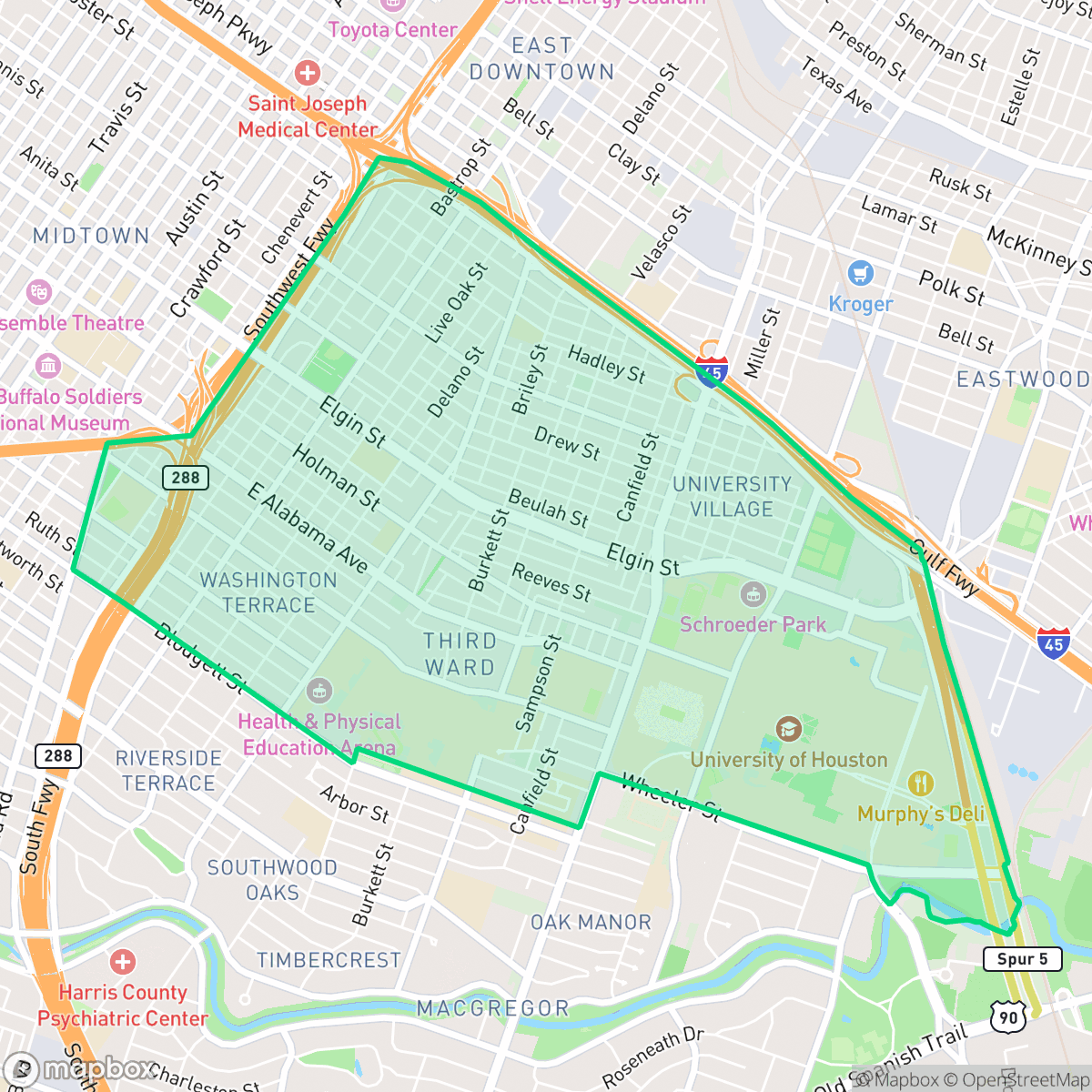
Greater Third Ward is a culturally significant Houston neighborhood defined by its dense urban grid, historic architecture, and proximity to major universities. While residents benefit from high walkability and strong health insurance coverage, the area features tightly packed housing with limited private yard space and moderate noise levels.
Key Highlights
About Greater Third Ward
Established shortly after Houston's 1836 founding, the Greater Third Ward—locally known as "The Tre"—evolved post-Civil War into a vital hub of Black culture, commerce, and civil rights activism. In 1872, formerly enslaved residents pooled funds to purchase land for Emancipation Park, the oldest public park in Texas, to celebrate Juneteenth. By the mid-20th century, the Dowling Street (now Emancipation Avenue) corridor flourished with Black-owned businesses and a legendary blues scene centered at the Eldorado Ballroom. Architecturally, the neighborhood is famous for its historic shotgun houses, many of which are preserved by the renowned Project Row Houses art initiative. Anchored by Texas Southern University and the University of Houston, the neighborhood served as the cradle of Houston's civil rights movement and remains a cornerstone of the city's African American heritage.
This neighborhood functions as a dense, institutional-heavy environment anchored by Texas Southern University and the University of Houston. The streetscape is characterized by a mix of modest residential homes and mid-rise buildings, resulting in a high-density urban feel. According to iHuus data, the area maintains a high walkability score, supported by a network of campus paths and consistent sidewalks that connect residents to local dining spots and various community churches. The area is a hub of activity during the day, blending residential life with the constant flow of students and faculty from the nearby academic institutions.
The neighborhood presents a distinct urban experience where privacy is limited due to close-set structures and high-density residential plots. While it offers excellent access to academic institutions and cultural landmarks, prospective residents should note the moderate air quality and the ongoing operational challenges within the local school district. It is best suited for those who prioritize proximity to university life and a central urban location over suburban-style privacy or expansive private green space.
Neighborhood Scores Across 15 Qualities
Residential structures are tightly packed with minimal yard space or buffers between neighbors. According to iHuus data, this level of density offers less personal privacy than the Houston average.
Pedestrian access is consistent with the city average, featuring a dense network of campus paths, residential sidewalks, and visible crosswalks. While the highway creates a notable barrier for movement, many residential blocks and university areas provide safe, low-traffic routes for walkers.
Standard tract housing and dense apartment complexes define the local landscape, which presents a less varied visual profile than the Houston average. Streetscapes primarily consist of uniform rooflines and compact lots with limited private greenery.
Access to dog walking areas varies by block, though proximity to University of Houston lawns and bayou trails provides notable exercise options. Overall, the availability of public green space for pets is slightly below the Houston average.
Streetscapes feature a balance of residential pockets and large institutional or industrial structures. This landscape is less suburban than the Houston average, characterized by a dense mix of urban grids, parking lots, and university-related infrastructure.
A mix of high-energy social hubs and quiet industrial pockets creates a landscape that is more active than the Houston average. While some blocks feature dense amenities and diverse dining, many areas remain suburban in character and largely require a vehicle to reach local services.
Steady traffic noise from nearby busy streets is common here, though levels are slightly more tranquil than the Houston average according to iHuus data.
Air quality fluctuates between acceptable and unhealthy levels, though levels remain slightly better than the Houston average according to iHuus data. Sensitive groups should monitor local conditions during periods of occasional concern.
Industrial presence is minimal across most of the area, which remains predominantly residential and institutional. While some pockets near rail corridors and utility substations exist, the lack of heavy industrial activity is noticeably higher than the Houston average, according to iHuus data.
Health insurance access among residents is notably higher than the Houston average, according to iHuus data.
Voting patterns and census indicators reflect a distinctly progressive political landscape, significantly more liberal than the Houston average.
A balanced mix of young professionals, families, and older residents characterizes this area. According to iHuus data, the demographic distribution is slightly more concentrated in certain age groups than the Houston average.
Flood risk levels in this area are difficult to determine because official federal studies are currently incomplete. According to iHuus data, the lack of detailed mapping makes the flood safety profile lower than the Houston average.
Address-Level Insights for Greater Third Ward


iHuus Neighborhood Intelligence Insights
Get address-level neighborhood insights for Greater Third Ward
- Street-level scores — see how individual blocks compare, not just neighborhood averages
- Micro-zone boundaries — identify quiet pockets, flood boundaries, and walkable clusters before you visit
- 15 dimensions in full — walkability, noise, air quality, school quality, insurance coverage, population age profile, urban/rural index, and more
- Boundary risk alerts — know if your address sits near a block boundary where scores drop, the kind of detail no listing will ever mention
- School insights — individual school ratings and insights, not just district-level data
- Compare before you commit — side-by-side data across neighborhoods, down to block precision
No credit card required
Compare with Any Neighborhood
| Dimension | Greater Third Ward | Acres Home |
|---|---|---|
| 🚶 Walkabilityavg 7.08 | ||
| 🔊 Acoustic Comfortavg 4.14 | ||
| 🤫 Privacy Indexavg 5.34 | ||
| 🎨 Visual Appealavg 6.42 | ||
| 🐕 Dog Friendlinessavg 6.33 | ||
| 🗺️ Urban-Rural Indexavg 6.64 | ||
| ✨ Neighborhood Vibeavg 4.4 | ||
| 🏥 Health Insurance Coverageavg 5.46 | ||
| 🌿 Air Qualityavg 3.58 | ||
| 🏭 Industrial Proximityavg 6.9 | ||
| 🌊 Flood Safetyavg 6.27 | ||
| 🗳️ Ideological Leanavg 6.39 | ||
| 👥 Population Age Profileavg 4.6 | ||
| 🔥 Fire Safety | ||
| 🏫 School Quality |
Greater Third Ward Rankings
School Districts Serving Greater Third Ward
School Insights for Greater Third Ward
Below average outcomes; significant attendance and academic challenges.
School Insights
See what's really behind every school rating near Greater Third Ward
- Individual school ratings — each school's own score with outcome context, not just a district average
- Enrollment & class size data — student-to-teacher ratio and how it compares to the state average
- Full demographics breakdown — ethnicity and gender composition for every school in the enrollment zone
- Every school in the district — all schools within the enrollment boundary ranked by rating, not just the closest one
- Grade levels & benchmarks — elementary through high school, with below/above state-average flags
No credit card required